Main presentation file:
×

T4INF1202: Kryptologie
Part 2: Hash functions
2026-04-07
Table of Contents
2 / 65
Table of Contents
2 / 65
Recap
- Last week we spoke about simple/historic ciphers and how they can be attacked
- We mentioned Shannon's One-Time-Pad
- Today we will discuss one of the most fundamental primitives in cryptography, hash functions
Introduction
3 / 65
Hash function
- A hash function takes an input and, from that creates some deterministic output
- It has many applications in computer science generally, but hash functions are particularly interesting for cryptographic purposes
- Note that, generally speaking, hash functions do not need to have the properties you might typically associate with them
Introduction
4 / 65
Hash function flavors
- A hash function can produce constant or variable length input or output (e.g., compare forensic hash functions)
- It can compress to varying degree or not at all (non-compressing hash function)
- It can be possible or impossible to reverse (i.e., going from the output back to the input)
- It needs not to operate on byte level (can also be on bit level – actually, all “popular” hash functions are defined at bit level)
Introduction
5 / 65
Hash function schematic

Introduction
6 / 65
Hash function flavors
- For many purposes in computer science, hash functions are used
- An example are ADTAbstract data types like a dictionary (aka hash map)
- In those applications, we usually want the input to be chopped up in a way that the output values are uniformly distributed
Introduction
7 / 65
Introduction
Cryptographic use

8
Hash function rigidity
- For cryptographic purposes, uniform distribution is not the only property we are looking for
- We also want the “chopping up” to occur in a manner that is not easily predictable unless the hash function is actually executed
- I.e., there should be no simple correlation between changes in input to changes in output
Introduction
Cryptographic use
9 / 65
Cryptographic hash function
- Such primitives have different synonyms: cryptographic hash function, compression functions, message digests, one-way functions or trapdoor functions
- They take variable-length input and produce fixed-length output
- We will now examine their properties more formally
Introduction
Cryptographic use
10 / 65
Avalanche property and uniformity
- Avalanche property: Error propagation (minimal disturbance in input leads to maximal change in output)
- Statistically, 50% of bits flip as a result to any change of the input
- Uniform output: For random inputs, every output occurs with the same probability
- Uncorrelated output: The dependence of the output form the input is quasi-random
Introduction
Cryptographic use
11 / 65
Hash function definition
- Let Q4mta4Ck5NLHHZf1qH71g5gJY be a cryptographic hash function
- For this function Q4mta4Ck5NLHHZf1qH71g5gJY and a message Q4mta4Ck5NLHmZf1qH71g5gJY, let the output hash value be Q4mta4Ck5NLHh = H(m)Zf1qH71g5gJY
- Computation of Q4mta4Ck5NLHhZf1qH71g5gJY given Q4mta4Ck5NLHmZf1qH71g5gJY is efficiently possible
- There are typically three security guarantees associated with a cryptographically strong hash function, which we will cover next
Introduction
Cryptographic use
12 / 65
Pre-image resistance
- Pre-image resistance: Given Q4mta4Ck5NLHhZf1qH71g5gJY, an attacker cannot efficiently compute any Q4mta4Ck5NLHmZf1qH71g5gJY so that Q4mta4Ck5NLHH(m) = hZf1qH71g5gJY
- In other words: no message can be crafted that matches a specific hash and the function is not “reversible”
- Only attack is to exhaustively walk through all messages Q4mta4Ck5NLHmZf1qH71g5gJY and try hashing each one
Introduction
Cryptographic use
13 / 65
Second pre-image resistance
- Second pre-image resistance: Given Q4mta4Ck5NLHmZf1qH71g5gJY, an attacker cannot efficiently compute any Q4mta4Ck5NLHm' \neq mZf1qH71g5gJY so that Q4mta4Ck5NLHH(m') = H(m)Zf1qH71g5gJY
- In other words: An attacker cannot modify a given message Q4mta4Ck5NLHmZf1qH71g5gJY so that it becomes a different message that still produces the same hash value
Introduction
Cryptographic use
14 / 65
Collision resistance
- Collision resistance: an attacker cannot efficiently create two arbitrary messages Q4mta4Ck5NLHm_1Zf1qH71g5gJY and Q4mta4Ck5NLHm_2Zf1qH71g5gJY so that Q4mta4Ck5NLHH(m_1) = H(m_2)Zf1qH71g5gJY with Q4mta4Ck5NLHm_1 \neq m_2Zf1qH71g5gJY
- This is by far the easiest attacker model – nothing is fixed, the attacker needs to find just two different messages that need to produce the same hash value
Introduction
Cryptographic use
15 / 65
Collision difficulty
- Imagine you are filling an empty room with people, one at a time
- How many people do you need to send in there to have more than a 50% probability that at least two of those people have birthday on the same day?
- What do you think?
Introduction
Cryptographic use
16 / 65
Birthday paradox
- The number of people you need is unintuitively low.
- For 365 days in a year, you only need 23 people to have a 50.7% chance of this event happening.
- This is because we are not looking for someone having birth on a specific day (there, the answer would be 183 days), but we just are interested in collisions of any day
- This phenomenon is called the birthday paradox
Introduction
Cryptographic use
17 / 65
Birthday paradox
- The chance increases rapidly depending on the number of people
- At 41 people, this probability is already 90.3%
- For 58, it is 99.2%
Introduction
Cryptographic use
18 / 65
Birthday paradox
- More generally, we have Q4mta4Ck5NLHnZf1qH71g5gJY categories and Q4mta4Ck5NLHkZf1qH71g5gJY candidates that occupy one category each
- What is the probability Q4mta4Ck5NLHpZf1qH71g5gJY that two candidates fall into the same category?
- For the example before, Q4mta4Ck5NLHn = 365Zf1qH71g5gJY and for Q4mta4Ck5NLHk = 23Zf1qH71g5gJY it follows Q4mta4Ck5NLHp \approx 50.7\%Zf1qH71g5gJY
Introduction
Cryptographic use
19 / 65
Birthday paradox
QBEntEozXWiop = 1 - \frac{n!}{n^k \cdot (n - k)!}kIt7msRdzcHK
QBEntEozXWiop \approx 1 - e^{-\frac{k(k-1)}{2n}}kIt7msRdzcHK
Introduction
Cryptographic use
20 / 65
Birthday paradox probability
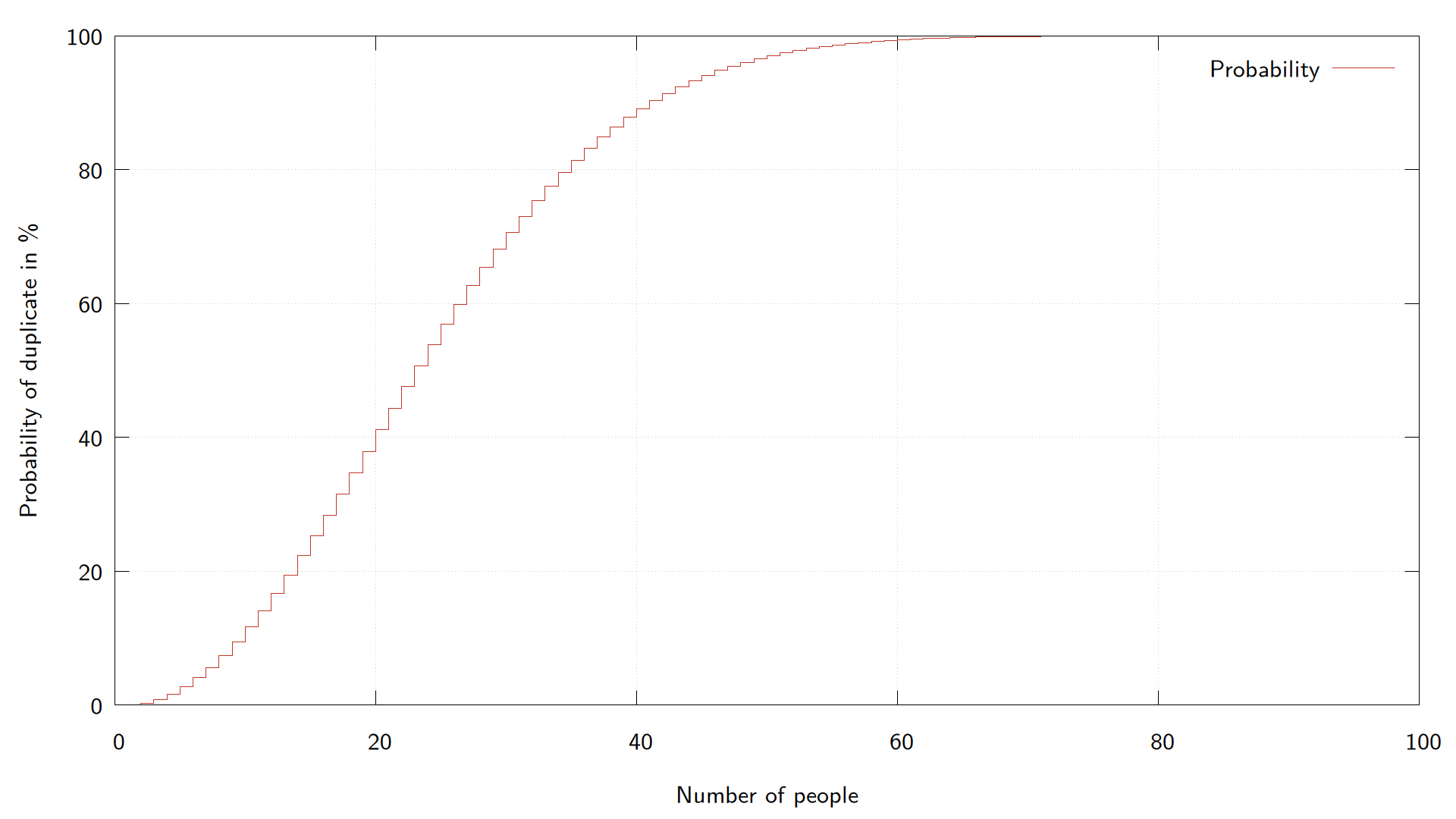
Introduction
Cryptographic use
21 / 65
Sock drawer
- You can visually this easily by imagining a drawer full of 20 (unpaired) socks
- Imagine there are five different colors of sock: red, green, yellow, blue, and purple, 4 of each
- You are getting dressed. You need a pair of socks. A sock collision.
Introduction
Cryptographic use
22 / 65
Sock finding strategy 1
- First strategy: You decide that you want a red sock beforehand.
- We then pull out socks one by one. If it is not the one we are looking for, we put it back.
- Note that for large enough sock drawers (Q4mta4Ck5NLH2^{256}Zf1qH71g5gJY “socks”), it practically does not make a difference if we put it back or keep it
Introduction
Cryptographic use
23 / 65
Sock finding strategy 1
- The probability of finding one by randomly grabbing inside the drawer is Q4mta4Ck5NLH\frac{4}{20}Zf1qH71g5gJY
- This means an 80% chance of grabbing a non-red sock. In other words, you need to try 20 times (!) to have a 99% chance of finding a red sock: Q4mta4Ck5NLHp = 1 - \left(\frac{20 - 4}{20} \right)^{20} \approx 99\%Zf1qH71g5gJY
Introduction
Cryptographic use
24 / 65
Sock finding strategy 1
- Note that using this method you have only now found the first red sock. You even need a second one.
- The average case performs a little bit better, using the expected value of the negative binominal distribution, we find that Q4mta4Ck5NLHE = \frac{k}{p} = \frac{2}{0.2} = 10Zf1qH71g5gJY
- However, you still need 10 attempts to find the desired pair on average
Introduction
Cryptographic use
25 / 65
Sock finding strategy 2
- Now imagine that you do not care what sock color you wear on that day
- Instead, you randomly pull out socks one by one until you have a matching pair
- With one sock pulled out, you have a collision with Q4mta4Ck5NLHp = 0Zf1qH71g5gJY
- For the second one you either have a collision with Q4mta4Ck5NLHp = 0.2Zf1qH71g5gJY or you now have two different colors to match
Introduction
Cryptographic use
26 / 65
Sock finding strategy 2
- 3rd: Q4mta4Ck5NLHp = 0.4Zf1qH71g5gJY (or 3 possibilities on non-match)
- 4th: Q4mta4Ck5NLHp = 0.6Zf1qH71g5gJY (or 4 possibilities on non-match)
- 5th: Q4mta4Ck5NLHp = 0.8Zf1qH71g5gJY (or 5 possibilities on non-match)
- 6th: Q4mta4Ck5NLHp = 1Zf1qH71g5gJY → guaranteed match!
- I.e., you need almost half of the tries for this approach just because you do not care about the color (= hash value)
Introduction
Cryptographic use
27 / 65
Consequence
- Therefore, an efficient attack on cryptographic hash functions will always be looking for a collision rather than a preimage
- Collision attacks are typically also the first to be published before a hash function is fully broken
- There is an implication on the effective security level of a hash function further below
Introduction
Cryptographic use
28 / 65
Anatomy of Hash Functions
29
Iterated construction
- Internally, hash functions have a state which has a static size
- With each iteration (and supplying of new data), this state is updated
- Sometimes this update only happens once a buffered internal block is full
- This allows processing of infinite input (length does not have to be known in advance either)
Anatomy of Hash Functions
Design
30 / 65
Data streaming
- Data is streamed through the cryptographic hash function
- Imagine a car wash through which you drive a long car (like a stretch limousine) – this does not require a larger car wash, just takes more time
- Similarly, a hash function does not require more storage, just more time to process the data piecewise
Anatomy of Hash Functions
Design
31 / 65
Iterated construction
- Generally, a hash function therefore has three different internal sizes
- Size of the hash state
- Block size (internal data buffer)
- Output size
- For example, MD5 has 128 bit state, 512 bit block buffer and 128 bit output
Anatomy of Hash Functions
Design
32 / 65
Merkle-Damgård
- A typical design that is frequently used by hash functions is the Merkle–Damgård construction
- Basic build block: collision-resistant one way compression function with static input length
- Derived result: collision-resistant cryptographic hash function with dynamic input length
- MD5, SHA-1, SHA-2 all use this
Anatomy of Hash Functions
Design
33 / 65
Sponge construction
- A relatively new alternative to the Merkle–Damgård construction is the sponge construction
- Using this, there are two phases, one where the sponge is fed data that runs through it (absorption phase)
- Once enough absorption has happened, there is a phase in which data is then extracted from that internal state (squeezing phase)
- SHA-3 uses this construction
Anatomy of Hash Functions
Design
34 / 65
Examples
- MD5 (1992): 128 bit output, 128 bit state, Merkle-Damgård, broken 1996/2005
- SHA-1 (1993): 160 bit output, 192 bit state, Merkle-Damgård, broken 2005
- SHA-256 (2001): 256 bit output, 512 bit state, Merkle-Damgård
- SHA-3-256 (2016): 256 bit output, 1600 bit state, Sponge
Anatomy of Hash Functions
Examples
35 / 65
Considerations
- Typically, the internal state size should be at least double that of the output size
- This is the case up to SHA-256 in the SHA-2 family, but not for SHA-384 or SHA-512 anymore (512 bits throughout)
- Still, there are no practical attacks known against SHA-256 or better in that family
Anatomy of Hash Functions
Examples
36 / 65
Hash function security
- When evaluating the security of a hash function theoretically, we can idealize the function
- I.e., assume there are no algorithmic/cryptographic weaknesses to the function that can be used as a “shortcut” for the adversary
- In this case, one might naïvely expect that a hash function with Q4mta4Ck5NLHbZf1qH71g5gJY bit output size needs on average Q4mta4Ck5NLH2^{b-1}Zf1qH71g5gJY attempts to find a preimage
Anatomy of Hash Functions
Examples
37 / 65
Hash function security
- However, because of the birthday paradox it is much easier to find collisions than it is to find preimages
- This is the (more difficult) bar that we apply when judging the security level of a hash function
- Therefore, a hash function with output of Q4mta4Ck5NLHbZf1qH71g5gJY bits provides only Q4mta4Ck5NLH\frac{b}{2}Zf1qH71g5gJY bits of security; the average number of attempts is assumed to be Q4mta4Ck5NLH2^{\frac{b}{2}}Zf1qH71g5gJY
Anatomy of Hash Functions
Examples
38 / 65
Hash function security
- Concretely, what this means is that if you want to achieve a security level of 128 bits, you need at least a hash function output of 256 bits
- In a compound, the weakest point in cryptographic constructions is that which is going to be attacked first
- Therefore, any compound construction is judged by its weakest link
Anatomy of Hash Functions
Examples
39 / 65
Usage
40
Ubiquity
- Cryptographic hash functions are ubiquitous throughout applied cryptography
- They are immensely useful and there are few primitives that can do without
- We will only highly two uses here (password storage and digital signatures, but there are dozens more): proof-of-work, cipher construction, ADTAbstract data types, etc.
Usage
41 / 65
Password storage
- One area where hash functions are routinely used is for password storage
- E.g., imagine a backend that needs to store the password to a given username
- If you store these passwords in clear text, any leak/hack of said database immediately reveals all passwords of every user
Usage
Password storage
42 / 65
Password storage
- Therefore, one of the solutions to this is to hash the password when it is set initially and every time a user authenticates
- Then, only the hash values are compared
- We can assume with reasonable probability that the original passwords are identical if their hash values are identical
- During authentication, the password needs to be present in clear text, however
Usage
Password storage
43 / 65
Password storage drawbacks
- Hash functions are one-way functions, i.e., from a hash value the password cannot be efficiently inferred
- Why is such a naïve implementation still problematic?
- What could be possible attacks?
Usage
Password storage
44 / 65
Password storage drawbacks
- If we cannot attack the hash function efficiently, we can attack it inefficiently
- Precomputation of large dictionaries leads to generation of hash tables
- Once this precomputation has been completed, lookup is exceptionally efficient
- May not compromise all passwords, but certainly all bad ones in a hashed database
- How can we improve this?
Usage
Password storage
45 / 65
Password storage solutions
- We can force same passwords to hash to different values by introduction of a salt value
- It is also stored within the database and in a naïve construction simply concatenated to the password
- Salt values are randomly generated when setting the password
- Same passwords then have different hash values and precomputation isn't possible anymore (it needs to be salt-specific)
Usage
Password storage
46 / 65
Password storage solutions
- Different issue: Hashes are still reasonably efficient in their computation
- This allows an attacker with a good setup (e.g., many GPUGraphics processing units in one system, working in parallel) to quickly brute-force a salt/hash combination
- Therefore, we would like to deliberately slow down hashing
Usage
Password storage
47 / 65
Password storage solutions
- Idea: simply hash 1000, 10000, 100000 times in a row: Q4mta4Ck5NLHH(H( \ldots H(p)))Zf1qH71g5gJY
- Iterated hashing should also not be done naïvely, more sophisticated solutions such as PBKDF2Password-Based Key Derivation Function 2, scrypt or Argon2 should be used – topic for a different lecture
Usage
Password storage
48 / 65
Usage
Digital signatures
49
Signing data
- Imagine we want to create a digital signature over some data, for example an email
- The length of the data is variable
- We want to somehow use this data as input to a mathematical function (“magic”) that performs the signing
Usage
Digital signatures
50 / 65
Signing data
- The mathematical operation has certain bounds in which it operates
- For example, it depends on the size of the underlying field in finite field cryptography
- Any modular arithmetic has this limitation, a finite (albeit large) number of elements
- Our message needs to stay within these bounds – but arbitrary message sizes can become arbitrarily large
Usage
Digital signatures
51 / 65
Signing data
- Almost universally, when data is signed digitally, that data is therefore run through a cryptographic hash function as the first step
- This ensures the values that are output generally stay within the confines of the mathematical operation that comes as step 2
Usage
Digital signatures
52 / 65
Signing data

Usage
Digital signatures
53 / 65
Attacking hash functions
- One reason why the cryptographic strength of hash functions is important is that they directly relate to the strength of derived data
- For example, in signature schemes, they directly relate to the strength of the generated signature
- Look at the next slide and determine what kind of hash function attack is shown.
Usage
Digital signatures
54 / 65
Attacking hash functions
- Shown is a second pre-image attack
- If the hash function is not resistant to this type of attack, an attacker can easily modify the original message into a forgery
- This forgery Q4mta4Ck5NLHm'Zf1qH71g5gJY, because it has the same hash value (recall Q4mta4Ck5NLHH(m) = H(m')Zf1qH71g5gJY) therefore also has the same signature
- The attacker takes the original signature and re-uses it, since it is also valid for the forgery
Usage
Digital signatures
55 / 65
Attacking hash functions
- Note that for legitimate signing of data, the correct private key is required
- But if we are directly attacking the hash function, we do not know the key nor do we care
- We might be able to create a forgery without knowing the key
Usage
Digital signatures
56 / 65
Attacking hash functions
- Remember how we talked about collision resistance which needs to be given as well
- Imagine you can trick a party to sign one message Q4mta4Ck5NLHmZf1qH71g5gJY, but they will not sign any message
- I.e., you can make them sign
“Alice has worked 7 hours today” or
“Alice has worked 3 hours today” - But you cannot make them sign “Alice has worked 99999 hours today”
Usage
Digital signatures
57 / 65
Attacking hash functions
- Imagine there is more diversity in the message (e.g., a comment field), so there are millions of possibly valid messages
- I.e., the attacker has some control over the message that gets a legitimate signature
- But not full control (which they would want to sign arbitrary messages)
- Why would this collision attack be easier to pull off compared to the second pre-image attack?
Usage
Digital signatures
58 / 65
Forging data by collision

Usage
Digital signatures
59 / 65
Forging data by collision

Usage
Digital signatures
59 / 65
Attacking hash functions
- Note that the attacker can pre-compute a collision
- Then have a seemingly legitimate message signed (that is within the confines of what the signer is willing to sign)
- And instantly receive a signature that is valid for the malicious message as well
- This is why collision attacks are the relevant measure of security for signature functions
Usage
Digital signatures
60 / 65
Conclusion
61
Conclusions
- Hash functions are one of the most important building blocks of modern cryptography
- Their cryptographic strength and statistical distribution characteristic is paramount, as it translates directly to the security of derived algorithms
- Play around with them and get a feeling for how they behave, they will appear pretty much anywhere
Conclusion
62 / 65
Thank you!
Any questions?
Acronyms
Acronyms
64 / 65