Main presentation file:
×

T4INF1202: Kryptologie
Part 3: Authentication functions
2026-04-14
Table of Contents
2 / 48
Recap
- Last week we discussed hash functions and their different flavors in detail
- Today, we will build upon that foundation and build authentication functions
- The goal is to meet one of our security goals, data integrity
Introduction
3 / 48
Hashing vs. authentication
- Imagine you are transmitting data over an insecure line
- Confidentiality is not important to you, data integrity is
- Implementation: You use a cryptographically secure hash function like SHA-256 and append the hash over the data to your datagram
- What is the issue with this?
Introduction
4 / 48
Hashing vs. authentication
- Such a scheme is resilient against faults, i.e., non-targeted attacks
- Protects against bit/burst errors nicely
- It does not protect against a malicious, deliberate attacker
- The attacker can simply alter the data, recompute the MICMessage Integrity Code and alter the MICMessage Integrity Code field of the message
Introduction
5 / 48
Hashing vs. authentication
- In other words, it may not be the case that the attacker is able to recompute the MICMessage Integrity Code
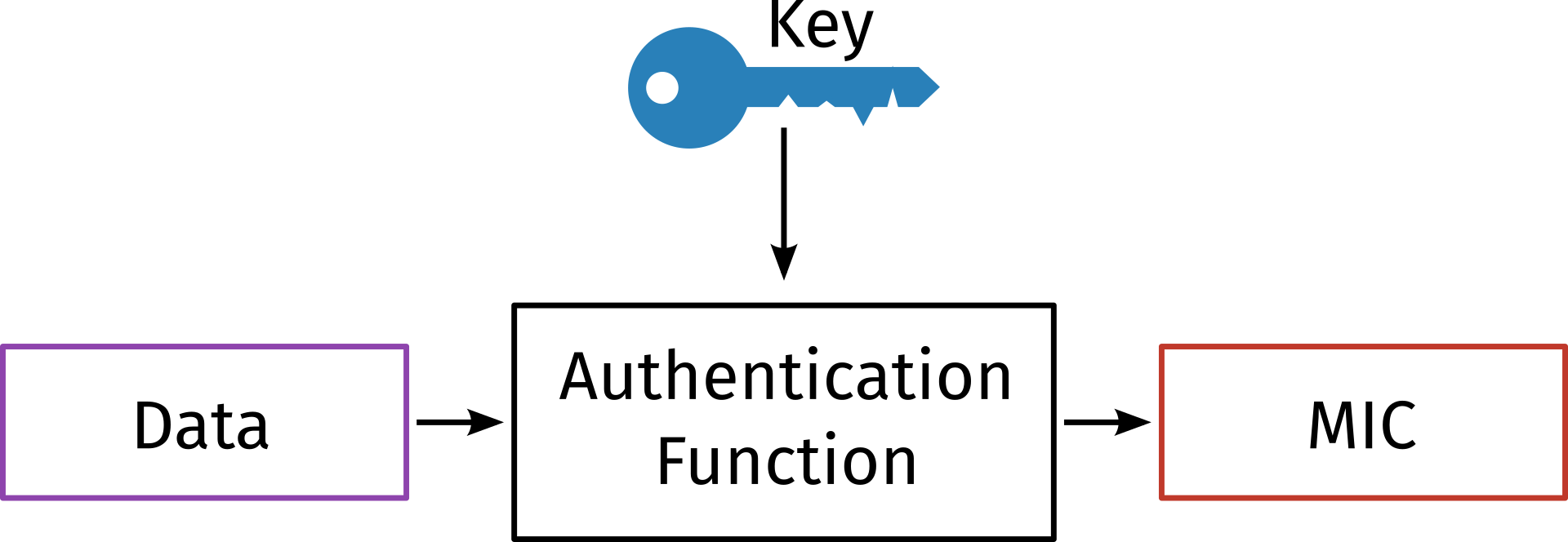
- The MICMessage Integrity Code needs to depend on something secret, something known only to the communicating parties
- We need to introduce a key into the system that is used to authenticate (and validate) the data
Introduction
6 / 48
Hash function

Introduction
7 / 48
Authentication function
Introduction
8 / 48
Hashing vs. authentication
- Authentication functions are sometimes therefore also called keyed hashes
- Another commonly used name is MACMessage Authentication Code
- Similarly, the resulting value is sometimes called MACMessage Authentication Code, MICMessage Integrity Code or authentication tag – they can be used synonymously
- During this course, MACMessage Authentication Code will reference the function itself while MICMessage Integrity Code will reference the values it produces
Introduction
9 / 48
Relation between hashing and authentication
- Authentication and hash functions are structurally quite similar
- Many constructions of MACMessage Authentication Code use hash functions internally
- Some may, however, also utilize ciphers for efficiency reasons (e.g., AESAdvanced Encryption Standard-CCMCounter with CBC-MAC)
- Generally, AEADAuthenticated Encryption with Associated Data constructions of ciphers do not rely on external hash functions
Introduction
10 / 48
Signature function
- MICMessage Integrity Codes are, in some instances, also referred to as symmetric signatures
- Both symmetric and asymmetric signatures are typically denoted by the letter Q4mta4Ck5NLH\sigmaZf1qH71g5gJY
- Symmetric refers to the property that it is the identical key Q4mta4Ck5NLHKZf1qH71g5gJY on both sides which is used to generate and validate the signature
Introduction
11 / 48
Symmetric signing
- Assume sender and receiver have negotiated a secret key Q4mta4Ck5NLHKZf1qH71g5gJY only known to the two of them
- Then a message Q4mta4Ck5NLHmZf1qH71g5gJY can be authenticated and transmitted: Q4mta4Ck5NLHm\ ||\ \sigma(m, K)Zf1qH71g5gJY
- The receiving party also computes Q4mta4Ck5NLH\sigma(m, K)Zf1qH71g5gJY and compares if that value is the same as that was appended to the message
Introduction
12 / 48
Symmetric signing issue
- One fundamental problem with this scheme is the following: Any of the two parties can claim the other sent them a “signed” message
- Both parties need to have Q4mta4Ck5NLHKZf1qH71g5gJY, therefore a “signed” message can have originated from either one
- It's impossible to tell who the original author is
- Symmetric authentication can therefore never achieve non-repudiation
Introduction
13 / 48
Constructing an authentication function
- How can we easily introduce a key into a hash function construct so that the MICMessage Integrity Code can only be created by those who know the key?
- What would be your idea?
Authentication Functions
From scratch
14 / 48
Naive implementation
- The simplest way of doing this is by simply concatenating the key Q4mta4Ck5NLHKZf1qH71g5gJY to the data
- I.e., instead of computing just a hash function Q4mta4Ck5NLHHZf1qH71g5gJY over a message Q4mta4Ck5NLHmZf1qH71g5gJY, we add the secret key Q4mta4Ck5NLHKZf1qH71g5gJY
- Q4mta4Ck5NLHH(m) \rightarrow H(K\ ||\ m)Zf1qH71g5gJY
- Or should we rather do Q4mta4Ck5NLHH(m\ ||\ K)Zf1qH71g5gJY? Any difference?
Authentication Functions
From scratch
15 / 48
Append vs. prepend construction
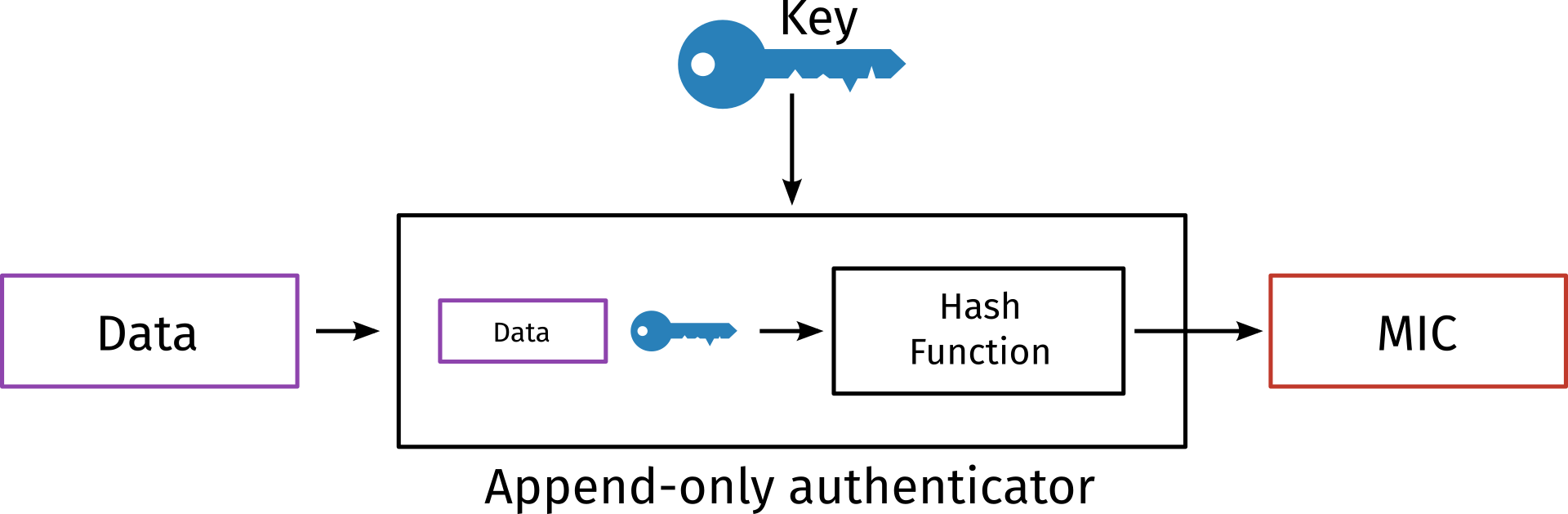
- Q4mta4Ck5NLHH(m\ ||\ K)Zf1qH71g5gJY is called the append-only construction
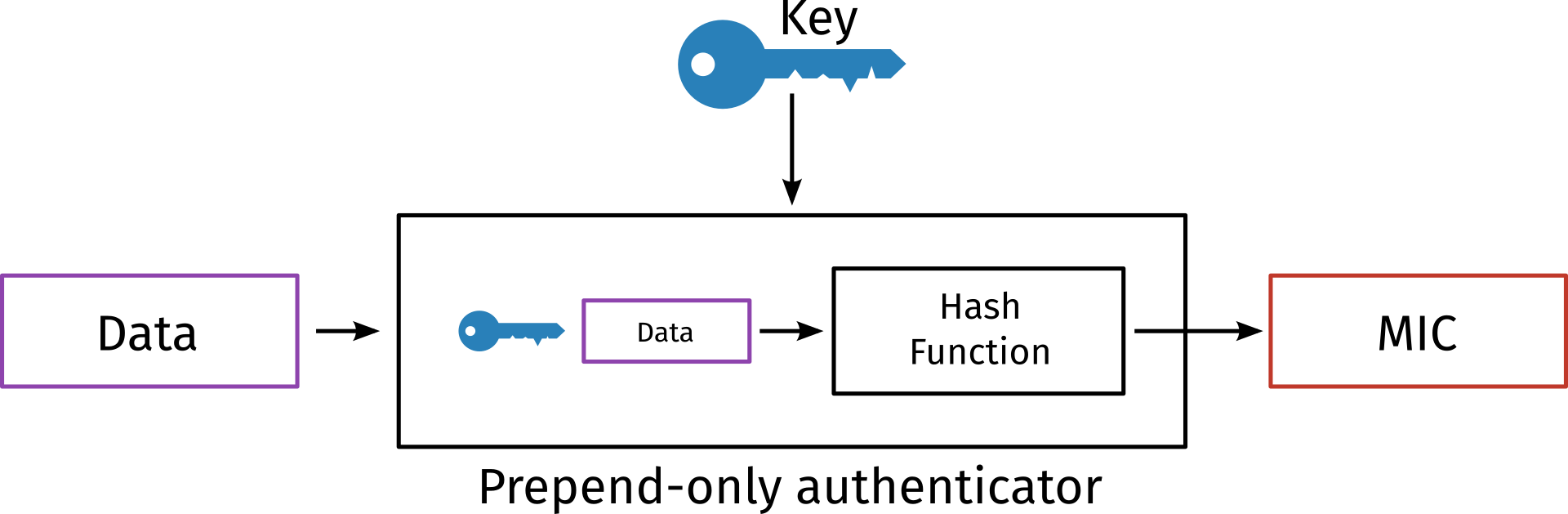
- Q4mta4Ck5NLHH(K\ ||\ m)Zf1qH71g5gJY is called the prepend-only construction
- Both are used in various contexts as naive implementations of an authentication function
- Interestingly, neither are secure
Authentication Functions
From scratch
16 / 48
Append-only authenticator
Authentication Functions
From scratch
17 / 48
Prepend-only authenticator
Authentication Functions
From scratch
18 / 48
Authentication security
- Things we want in an authentication function:
- Even if a collision can be found in the hash function, we do not want that to translate to a collision in the authentication function
- From messages and their respective MICMessage Integrity Codes, no new MICMessage Integrity Codes for different messages can be efficiently computed
Authentication Functions
From scratch
19 / 48
Append-only security
- Recall the append-only construction: Q4mta4Ck5NLHH(m\ ||\ K)Zf1qH71g5gJY
- Think about the internal state of the hash function during the computation of the message
- If there are two messages Q4mta4Ck5NLHmZf1qH71g5gJY and Q4mta4Ck5NLHm'Zf1qH71g5gJY that lead to a collision, what is the internal state of Q4mta4Ck5NLHHZf1qH71g5gJY going to be after input of Q4mta4Ck5NLHmZf1qH71g5gJY or Q4mta4Ck5NLHm'Zf1qH71g5gJY?
Authentication Functions
From scratch
20 / 48
Append-only security
- The internal state of two hash functions that produce a collision is synchronized, they're in lockstep
- This means any data that is fed into Q4mta4Ck5NLHHZf1qH71g5gJY after that leads to the deterministically identical result
- In consequence, this means that a collision of the hash function in an append-only authenticator just appends an (unknown) key Q4mta4Ck5NLHKZf1qH71g5gJY
- Since the states are synchronized, the MICMessage Integrity Codes are going to be identical
Authentication Functions
From scratch
21 / 48
Append-only security
- Append-only authenticators therefore have the undesirable property that collisions in Q4mta4Ck5NLHHZf1qH71g5gJY automatically give a valid collision in the authenticator
- No extra work is required, it's an inherent property of the construction
- Therefore, not a good choice for an authenticator
Authentication Functions
From scratch
22 / 48
Prepend-only security
- Note that this does not apply to the prepend-only construction
- Since Q4mta4Ck5NLHH(K\ ||\ m)Zf1qH71g5gJY is the authenticator, at the point where Q4mta4Ck5NLHKZf1qH71g5gJY has been fed to the authenticator, the internal states will be completely different
- Therefore, anything appended afterwards (such as Q4mta4Ck5NLHmZf1qH71g5gJY) modifies the state in different ways
Authentication Functions
From scratch
23 / 48
Prepend-only security
- Prepend-only suffers from a different flaw, however – an even more problematic one
- Think about the internal state of Q4mta4Ck5NLHHZf1qH71g5gJY after the computation of the full MICMessage Integrity Code, i.e., after Q4mta4Ck5NLHH(K\ ||\ m)Zf1qH71g5gJY
- Consider a case where the length of Q4mta4Ck5NLHK\ ||\ mZf1qH71g5gJY together with internal length fields is a multiple of the internal block size
- The output value now corresponds tightly with the internal state of Q4mta4Ck5NLHHZf1qH71g5gJY after the digesting the message
Authentication Functions
From scratch
24 / 48
Prepend-only security
- This gives rise to a so-called extension attack
- An attacker observes a message that is the correct length and the attacker also knows the legitimate (public) MICMessage Integrity Code of that message
- They then infer the internal state just before emission of the MICMessage Integrity Code
Authentication Functions
From scratch
25 / 48
Prepend-only security
- When the internal state is known at this point in time, the attacker can simply reset their Q4mta4Ck5NLHHZf1qH71g5gJY to that internal state
- Then append arbitrary malicious data and compute a valid MICMessage Integrity Code
- Knowledge of the key is not necessary at all, yet valid forgeries can be produced efficiently by the adversary
Authentication Functions
From scratch
26 / 48
Target security level
- One thing to keep in mind: No weaseling out of security guarantees.
- If an authentication function allows any forgeries or is not robust against collisions, we consider it broken
- Common fallacy: “but the forged messages do not make sense, it's not that bad”
- Yes, it is. It's exactly that bad.
Authentication Functions
From scratch
27 / 48
Abstraction layer
- When designing cryptographic primitives, we provide a layer of abstraction to the system
- Above layers need to be able to rely on that abstraction, regardless of the circumstances or use case
- This is why collision attacks are relevant for hash function security and why forgeries are breaking the system, regardless of their perceived meaningfulness
Authentication Functions
From scratch
28 / 48
Naive MAC constructions
- Build robust authentication functions is surprisingly complex
- It should never be done manually, this is a huge warning sign
- There are internal nuances to this that make accurate security estimation exceptionally difficult
- How many of the aforementioned issues would you have detected in code review?
Authentication Functions
From scratch
29 / 48
Robust MAC constructions
- So what are robust alternatives we can use to authenticate data?
- Do you know any?
Authentication Functions
From scratch
30 / 48
Authentication functions
- There exist various robust MACMessage Authentication Code constructions that exhibit good security properties
- Most commonly, HMACKeyed-Hash Message Authentication Code is used
- Less common but still prevalent are UMACUniversal Message Authentication Code (e.g., in SSHSecure Shell) and CMACCipher-based Message Authentication Code
- Which one is used depends on the present prerequisites
Authentication Functions
Robust authenticators
31 / 48
HMAC
- HMACKeyed-Hash Message Authentication Code is probably the most common and only relies on an unmodified hash function internally
- Essentially, HMACKeyed-Hash Message Authentication Code is the construction Q4mta4Ck5NLH\sigma(m, K) = H((K \oplus p_1)\ ||\ H((K \oplus p_2)\ ||\ m))Zf1qH71g5gJY
- Q4mta4Ck5NLHp_1Zf1qH71g5gJY and Q4mta4Ck5NLHp_2Zf1qH71g5gJY are fixed padding blocks
- The symbol Q4mta4Ck5NLH\sigmaZf1qH71g5gJY is used to denote a signature (in this case, a symmetric signature)
Authentication Functions
Robust authenticators
32 / 48
UMAC and CMAC
- UMACUniversal Message Authentication Code is used in constructions where (provable) security is the most important goal and resource constraints are secondary
- CMACCipher-based Message Authentication Code is used when a cipher is already present (e.g., hardware implementations such as MIFARE DESFire)
Authentication Functions
Robust authenticators
33 / 48
Encryption and authentication
- During typical communication, we want to achieve both confidentiality and data integrity
- This means a cipher is already present (achieving confidentiality) and additionally an authenticator is applied (for data integrity)
- A typical construction is EtAEncrypt-then-Authenticate (sometimes also called EtM, encrypt-then-MACMessage Authentication Code)
Authentication Functions
AEAD
34 / 48
Encryption and authentication
- Having encryption and authentication separate creates the possibility of doing things wrong
- Recall that the order of operations is critical to achieve security
- When designing cryptographic constructions, we want those to be as rigid as possible, so they cannot be accidentally misused
Authentication Functions
AEAD
35 / 48
Encrypted authentication
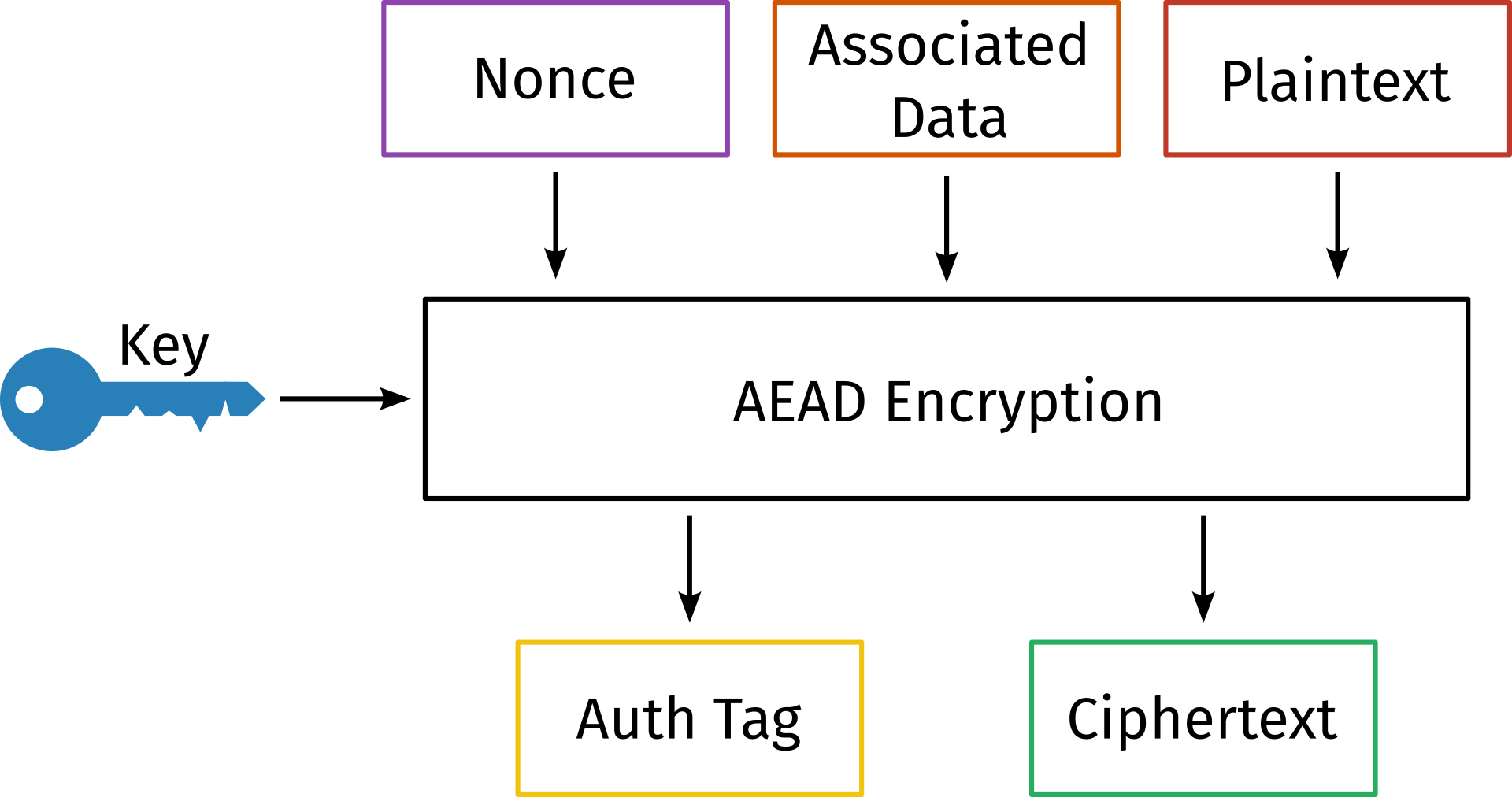
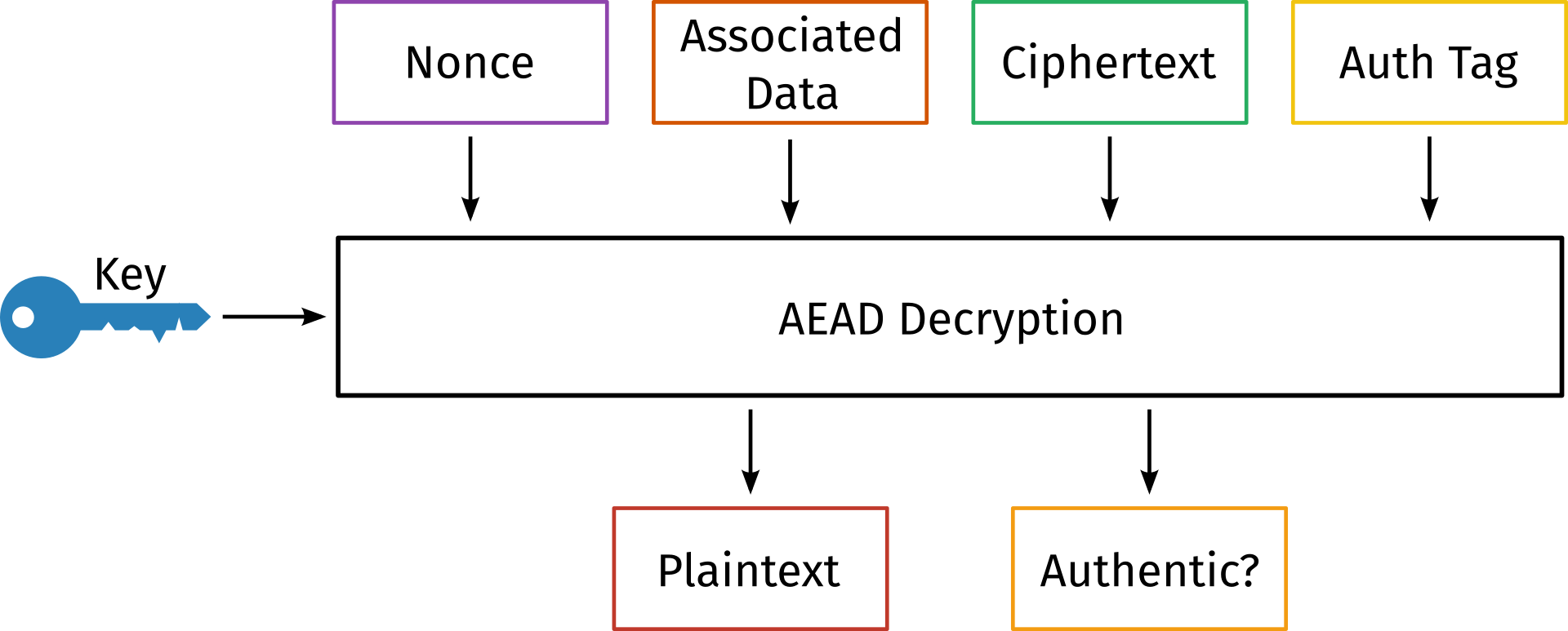
- A common way of solving this issue is to offer one cryptographic construction which handles both encryption and authentication
- Such a construction is known as AEADAuthenticated Encryption with Associated Data
- It additionally provides the possibility to authenticate non-encrypted data (e.g., OOBOut-of-Band data)
Authentication Functions
AEAD
36 / 48
Encrypted authentication
Authentication Functions
AEAD
37 / 48
Encrypted authentication
Authentication Functions
AEAD
38 / 48
Encrypted authentication
- Key drawback of AEADAuthenticated Encryption with Associated Data schemes is the nonce (number used once)
- Encryption depends on this randomized value (and hence is nondeterministic)
- Depending on the scheme, there is loss of various security guarantees if a nonce is actually reused
- Can be catastrophic, i.e., loss of full confidentiality and data integrity. Caveat emptor.
Authentication Functions
AEAD
39 / 48
Encrypted authentication
- The internal construction of these functions can be comparatively complex, but the APIApplication Programming Interface they provide to the user is much simpler
- A popular choice is AESAdvanced Encryption Standard-GCMGalois/Counter Mode: here, an authentication function uses both AESAdvanced Encryption Standard and Galois Field operations in Q4mta4Ck5NLH\mathbb{F}_{2^{128}}Zf1qH71g5gJY
- Sometimes, AESAdvanced Encryption Standard-CCMCounter with CBC-MAC is used as well, but its performance isn't as good as that of GCMGalois/Counter Mode
- We are going to look at this in more detail in the future
Authentication Functions
AEAD
40 / 48
Encrypted authentication
- Another common AEADAuthenticated Encryption with Associated Data cipher is ChaCha20-Poly1305
- Exhibits excellent performance characteristics and typically outperforms non-hardware implementations of AESAdvanced Encryption Standard-GCMGalois/Counter Mode
- All three of these AEADAuthenticated Encryption with Associated Data modes are typically preferable to manual combinations of encryption and authentication functions
Authentication Functions
AEAD
41 / 48
What achieves AEAD?
- The AEADAuthenticated Encryption with Associated Data property is not something not inherently linked to the underlying cipher
- In fact, when you look at the acronym, you will see a reference to a cipher (e.g., AESAdvanced Encryption Standard) and, separated by a dash, the so-called operation mode
- I.e., the AEADAuthenticated Encryption with Associated Data construction AESAdvanced Encryption Standard-GCMGalois/Counter Mode uses AESAdvanced Encryption Standard using the GCMGalois/Counter Mode mode of operation
Authentication Functions
AEAD
42 / 48
Conclusion

43
Summary
- Authentication is achieved either by separate cryptographic primitives (e.g., HMACKeyed-Hash Message Authentication Code) or is provided as part of the cipher (AEADAuthenticated Encryption with Associated Data)
- By default, encryption ensures confidentiality, but not data integrity
- Having a symmetric signing key that is kept secret is paramount
Conclusion
44 / 48
Complexity of operation
- The constructions that are typically used are proven and have been peer-reviewed thoroughly
- It is highly unlikely to be able to naively put together an authenticator which does not exhibit a security issue
- Much more complex than it superficially looks – do not invent your own crypto
- Easy to build something that you cannot break, difficult to build something that nobody can break
Conclusion
45 / 48
Thank you!
Any questions?
Acronyms
Acronyms
47 / 48
Acronyms
- GCM: Galois/Counter Mode
- HMAC: Keyed-Hash Message Authentication Code
- MAC: Message Authentication Code
- MIC: Message Integrity Code
- OOB: Out-of-Band
- SSH: Secure Shell
- UMAC: Universal Message Authentication Code
Acronyms
47 / 48