Main presentation file:
×

T4INF1202: Kryptologie
Part 5: Feistel ciphers
2026-04-28
Table of Contents
2 / 52
Table of Contents
2 / 52
Recap
- Last week, we discussed stream ciphers, block ciphers and operation modes
- Today, we will take a peek inside the construction of a block cipher and their common components
- More generally, we'll talk about a whole family of constructions, the Feistel network construction
Introduction
3 / 52
Design of a cipher
- When inspecting the design of a cipher, there are certain components that are reoccurring:
- Product cipher construction: key schedule and round function
- Substitution (S-boxes)
- Permutation (P-boxes)
- They are the essential building blocks of ciphers
Introduction
4 / 52
Block cipher permutation
- A block cipher is generally only an invertible permutation that is determined by a key Q4mta4Ck5NLHKZf1qH71g5gJY
- Q4mta4Ck5NLHKZf1qH71g5gJY is the efficient and easy way of expressing this permutation
- For a block size Q4mta4Ck5NLHbZf1qH71g5gJY, it generates a plaintext-ciphertext mapping of length Q4mta4Ck5NLH2^bZf1qH71g5gJY
Introduction
5 / 52
Product cipher
- A product cipher produces this permutation by applying the same function on the input data repeatedly
- Each application is called a round of the cipher
- Consequently, the applied function is called the round function
- With increased number of rounds, security of the cipher increases while performance decreases
Introduction
Product cipher
6 / 52
Product cipher
- During design, this gives great flexibility to the designer
- Iteration count can be easily tweaked to achieve the desired properties (compromise between security and performance)
- Ciphers can be transformed into much stronger equivalents by applying slightly more rounds (e.g., AES-128 has 10 rounds, AES-256 has 14 rounds)
Introduction
Product cipher
7 / 52
Product cipher
- This also gives an advantage for cryptanalysts, since it is possible to more precisely estimate the security margin of a cipher
- E.g., if Q4mta4Ck5NLHnZf1qH71g5gJY rounds are just within the realm of feasibility to break, one can simply choose, for example, Q4mta4Ck5NLH2nZf1qH71g5gJY in the final version
- Cryptanalysis of round-reduced variants gives insight to the state of the security margin
- Gives reasonable rationale for security argumentation
Introduction
Product cipher
8 / 52
Product cipher
- In summary, the core concept is iteratively applying a function which by itself would be comparatively weak
- By applying it multiple times, the amount of mixing and the possible permutations increase exponentially
- Linear complexity for benign user, exponential complexity for adversary
Introduction
Product cipher
9 / 52
Cipher properties
- Two core concepts of ciphers were already described by Claude Shannon 1945 in “A Mathematical Theory of Cryptography”
- Confusion: the dependence of the outcome on different parts of the key
- Diffusion: the dependence of the outcome on different parts of the input (avalanche property)
Introduction
Product cipher
10 / 52
Key schedule
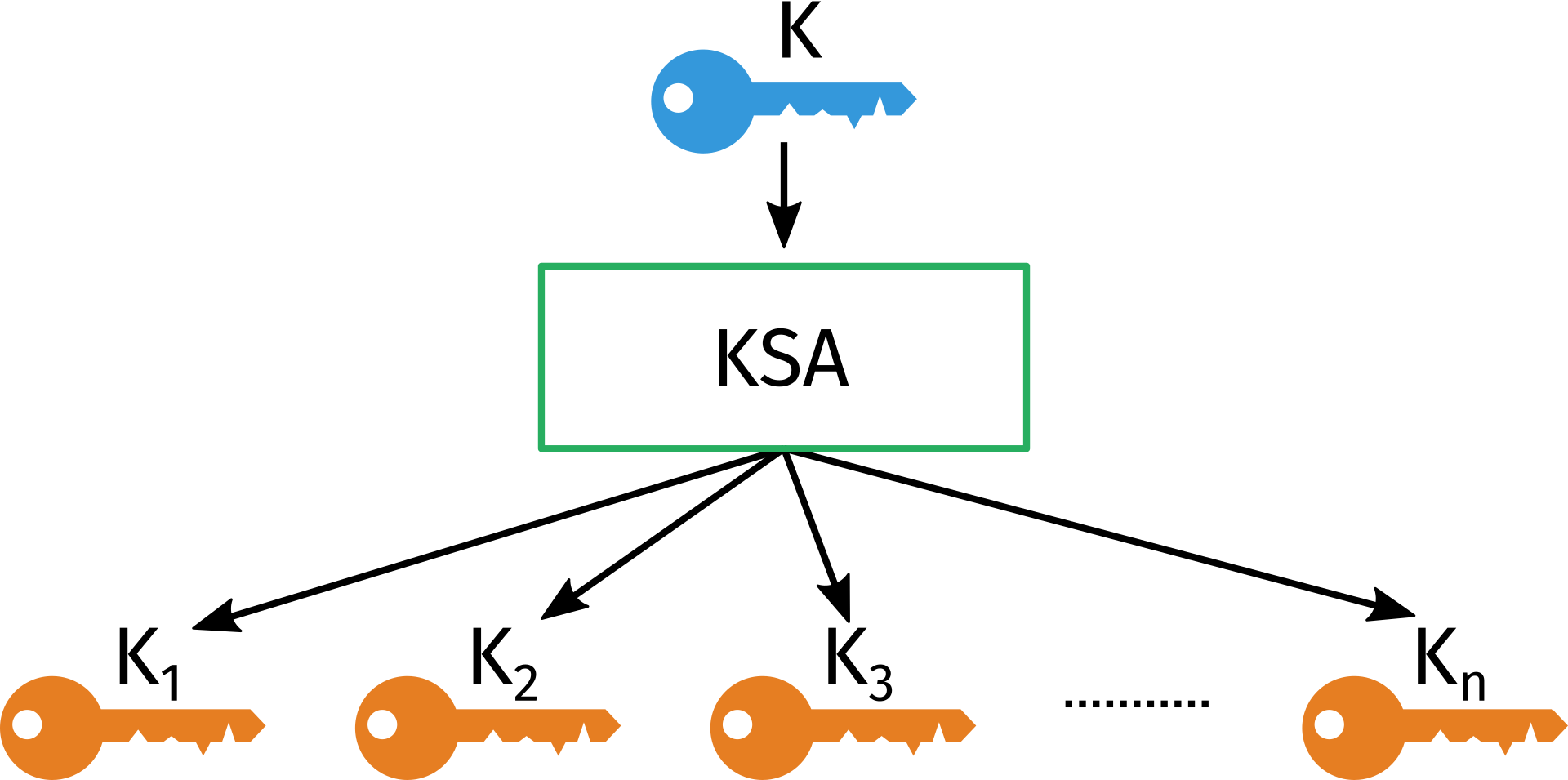
- In a product cipher, Q4mta4Ck5NLHKZf1qH71g5gJY is usually not used to influence the round function directly
- Instead, some internal derivation of Q4mta4Ck5NLHKZf1qH71g5gJY is performed, which generates the round keys (sometimes also called subkeys)
- This derivation is called the key schedule or KSAKey Scheduling Algorithm and usually performed before any encryption/decryption operation runs
Introduction
Key schedule
11 / 52
Key schedule
Introduction
Key schedule
12 / 52
Product cipher construction

Introduction
Key schedule
13 / 52
Product cipher construction

Introduction
Key schedule
13 / 52
Product cipher construction

Introduction
Key schedule
13 / 52
Product cipher construction

Introduction
Key schedule
13 / 52
Product cipher construction

Introduction
Key schedule
13 / 52
Constitution of round function
- The round function itself is built from primitives like S-boxes and P-boxes
- Needs to be composed so that it is highly non-linear
- Typically, S-boxes achieve confusion while P-boxes achieve diffusion (although the two goals are typically mixed, so they cannot be separated easily)
Introduction
Key schedule
14 / 52
S-box
- A Q4mta4Ck5NLHn \times mZf1qH71g5gJY S-box (substitution box) superficially is simply a lookup table which maps input bit vectors in Q4mta4Ck5NLH\mathbb{F}_2^nZf1qH71g5gJY onto output bit vectors in Q4mta4Ck5NLH\mathbb{F}_2^mZf1qH71g5gJY
- Q4mta4Ck5NLHnZf1qH71g5gJY and Q4mta4Ck5NLHmZf1qH71g5gJY need not necessarily be equal
- I.e., this can be seen as a boolean vector function
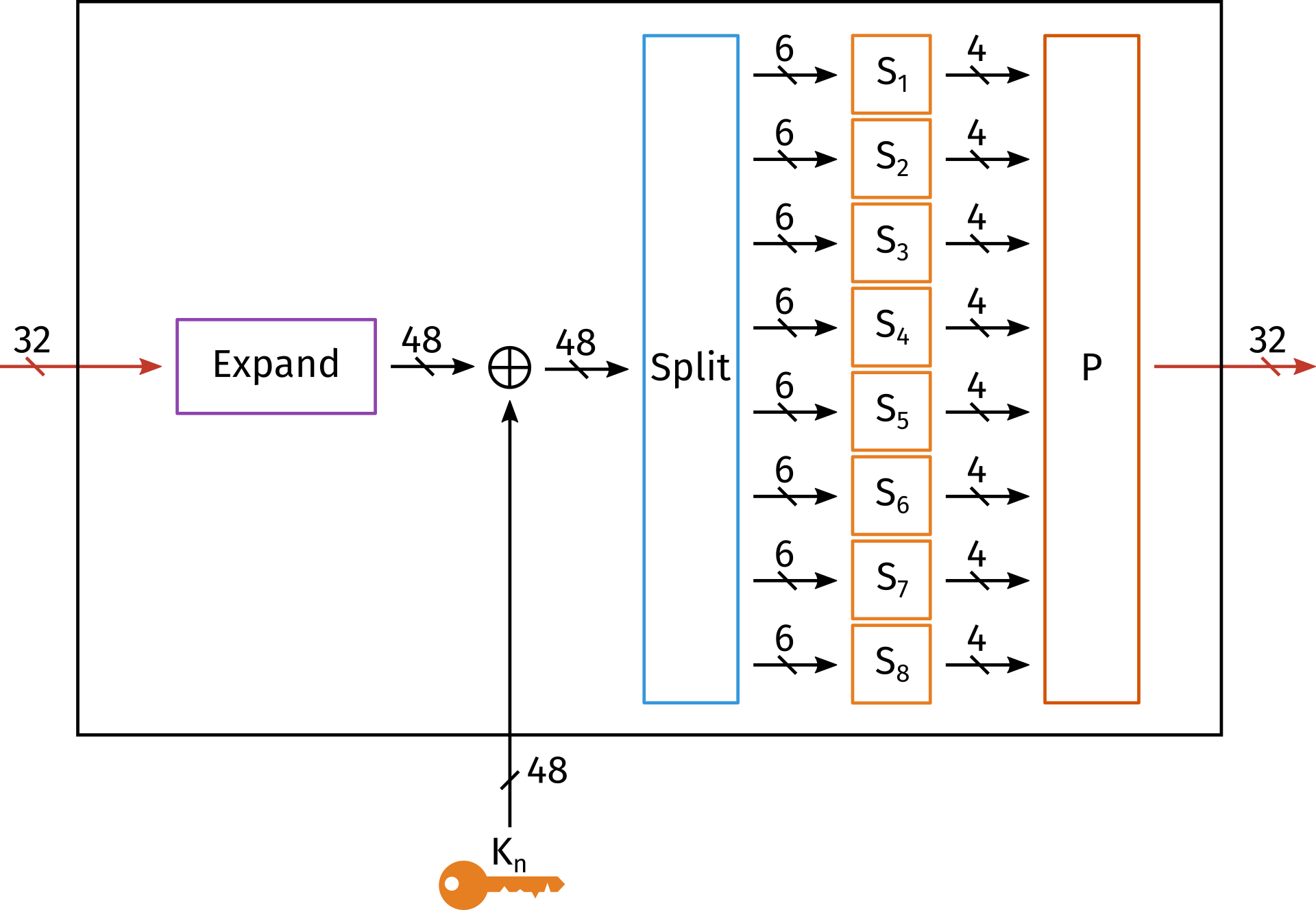
- Examples: RC4 S-box has Q4mta4Ck5NLHn = m = 8Zf1qH71g5gJY (i.e., each byte is replaced by a different byte), DESData Encryption Standard S-boxes have Q4mta4Ck5NLHn = 6, m = 4Zf1qH71g5gJY
Introduction
S-box and P-box
15 / 52
S-box
- Typically, but not necessarily, S-boxes need to be invertible
- They are designed to be highly (ideally perfectly) nonlinear
- Linearity can be quantified by using the Hadamard transform (also known as the Walsh transform), a generalization of the Fourier transform
Introduction
S-box and P-box
16 / 52
S-box
- Perfectly nonlinear boolean functions are also known as maximally nonlinear functions or bent functions
- If any linear combination of bits of S-box output vectors also constitutes a bent function, the S-box is called a perfect S-box
- Design of a good S-box is exceptionally complex topic and a research area of itself
Introduction
S-box and P-box
17 / 52
S-box
- I.e., the goal of a good S-box is not only to have a deterministic way of swapping values
- It also should promote the avalanche property (i.e., roughly half the output bits flip, statistically)
- Introduces nonlinearity in the transformation of input to output
Introduction
S-box and P-box
18 / 52
S-box
- An S-box is represented in code typically as a lookup table (array)
- The display is typically given in tabular form, where the input value is the XOR of the heading column and row and the output is the cell inside
Introduction
S-box and P-box
19 / 52
S-box example
| 00 | 01 | 02 | Q4mta4Ck5NLH\cdotsZf1qH71g5gJY | 0e | 0f | |
| 00 | 63 | 7c | 77 | Q4mta4Ck5NLH\cdotsZf1qH71g5gJY | ab | 76 |
| 10 | ca | 82 | c9 | Q4mta4Ck5NLH\cdotsZf1qH71g5gJY | 72 | c0 |
| 20 | b7 | fd | 93 | Q4mta4Ck5NLH\cdotsZf1qH71g5gJY | 31 | 15 |
Q4mta4Ck5NLH\vdotsZf1qH71g5gJY | Q4mta4Ck5NLH\ddotsZf1qH71g5gJY | |||||
| e0 | e1 | f8 | 98 | Q4mta4Ck5NLH\cdotsZf1qH71g5gJY | 28 | df |
| f0 | 8c | a1 | 89 | Q4mta4Ck5NLH\cdotsZf1qH71g5gJY | bb | 16 |
Introduction
S-box and P-box
20 / 52
P-box
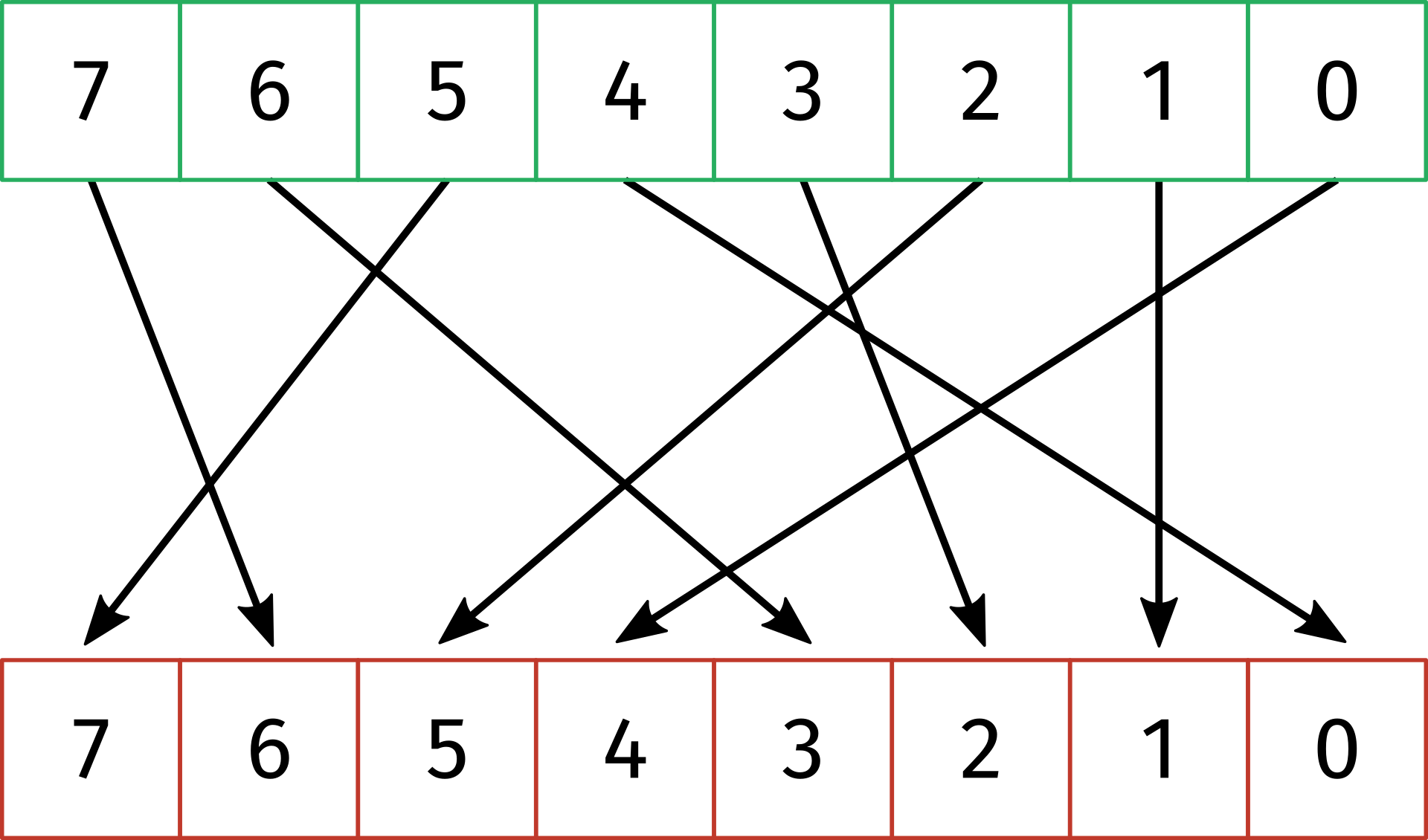
- A P-box (permutation box) is simpler and is the main instrument to achieve diffusion
- Generally, it simply maps input bits to output bits in a 1:1 fashion; it is a permutation of the input bits
- Any P-box can be shown as an S-box, but not the other way around (the S-box is the more general construction)
Introduction
S-box and P-box
21 / 52
P-box example
Introduction
S-box and P-box
22 / 52
Design goals
- A product cipher can have any arbitrary structure as long as the whole construction remains invertible
- This means, however, that during the design of the round function, invertibility has to be kept in mind
- Idea of a Feistel Network is to design a framework that does not need this property, i.e., the Feistel structure ensures invertibility by itself
Feistel Networks
23 / 52
Idea
- The Feistel network is a product cipher which has a specific structure
- It is most popular for its use in DESData Encryption Standard, but it is also used in GOST 28147-89, Camellia, CAST or TEATiny Encryption Algorithm
- The round function relies on an internal function Q4mta4Ck5NLHFZf1qH71g5gJY – this is the one which needs not to be invertible
- Versatility: for instance, hash functions can be turned into ciphers using a Feistel network
Feistel Networks
24 / 52
Advantages
- Another advantage is that encryption and decryption are exceptionally similar → hardware implementations only require one instance
- Key characteristic: blocks are cut into two halves Q4mta4Ck5NLHLZf1qH71g5gJY and Q4mta4Ck5NLHRZf1qH71g5gJY (not necessarily of the same size)
- Identical size halves: balanced Feistel network; non-identical: unbalanced Feistel network
Feistel Networks
25 / 52
Feistel network round application
Feistel Networks
Structure
26 / 52
Structure
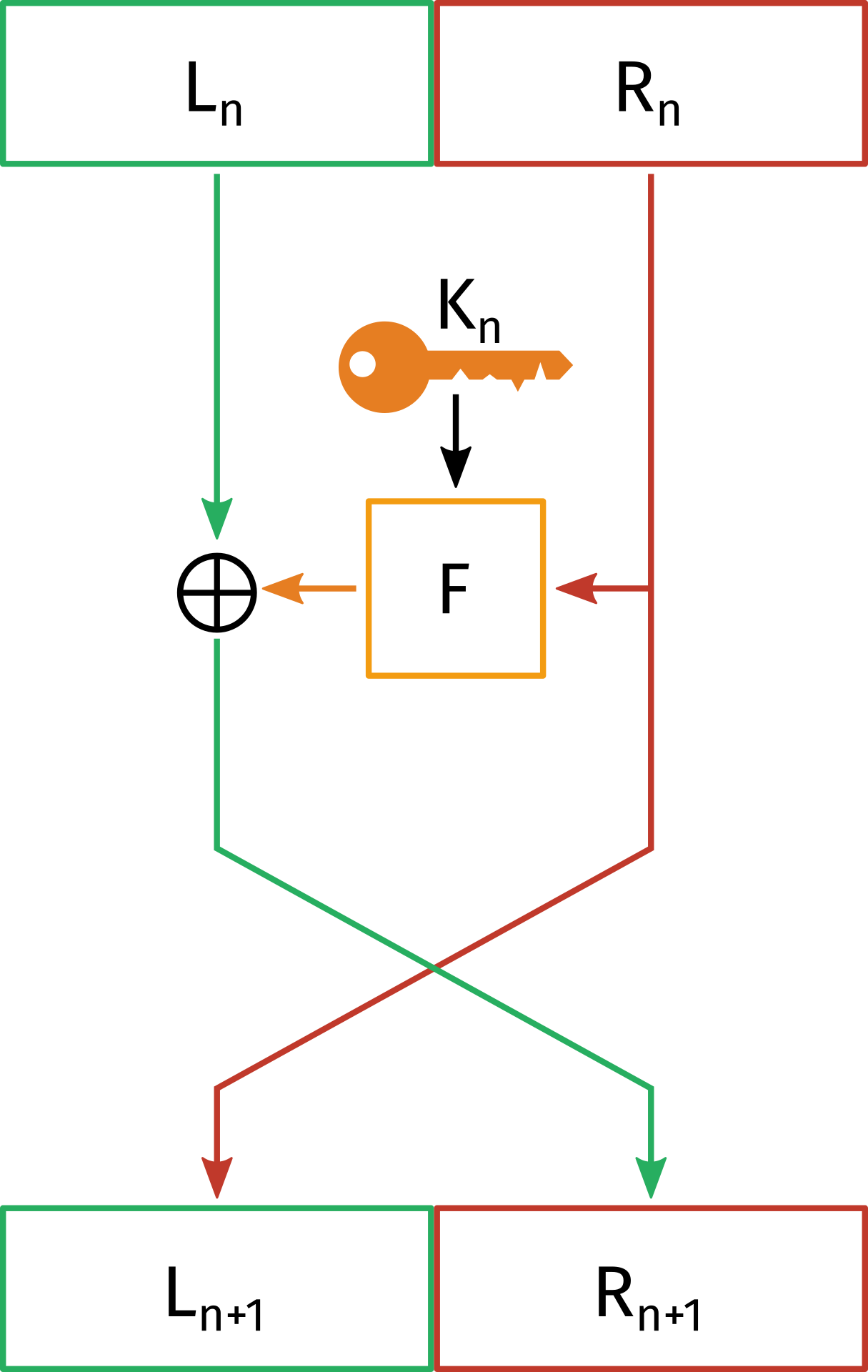
- In each round, the right half becomes the left half of the next round
- It is also used as input to Q4mta4Ck5NLHFZf1qH71g5gJY parameterized by Q4mta4Ck5NLHK_nZf1qH71g5gJY, which influences the left half (which becomes the right half next round)
QBEntEozXWioL_{n+1} = R_nkIt7msRdzcHK
QBEntEozXWioR_{n+1} = L_n \oplus F(R_n, K_n)kIt7msRdzcHK
Feistel Networks
Structure
27 / 52
Invertibility
- Because the half Q4mta4Ck5NLHR_nZf1qH71g5gJY which is used as input to Q4mta4Ck5NLHFZf1qH71g5gJY makes it to the next round unmodified, this guarantees invertibility
- Key schedule ensures all Q4mta4Ck5NLHK_nZf1qH71g5gJY are present
- The operation can then simply be performed bottom-up, decrypting a ciphertext to a plaintext
Feistel Networks
Structure
28 / 52
Security
- US cryptographers Luby and Rackoff have extensively analyzed the structure of Feistel Networks (1988: “How to construct pseudorandom permutations from pseudorandom functions”)
- Feistel networks are, because of this, sometimes also referred to as Luby-Rackoff ciphers
- Their results have been refined in further work extensively through peer reviewed papers
Feistel Networks
Security
29 / 52
Security models
- Increasingly strong adversary models:
- Known-Plaintext Attack: Adversary knows plaintext-ciphertext pairs but cannot influence
- Chosen-Plaintext Attack: Adversary can supply a plaintext and is given the corresponding ciphertext
- Chosen-Plaintext-Ciphertext Attack: Adversary can supply either plaintext or ciphertext and is given the corresponding ciphertext/plaintext
Feistel Networks
Security
30 / 52
Security
- Patarin 2003: Luby-Rackoff: 7 Rounds are Enough for Q4mta4Ck5NLH2^{n(1 - \epsilon)}Zf1qH71g5gJY Security
- Given the underlying function Q4mta4Ck5NLHFZf1qH71g5gJY is sufficiently pseudo-random, they find:
- 4 rounds make the Feistel network secure against KPAKnown-plaintext attack
- 7 rounds make it secure against all adaptive CPAChosen-plaintext attack
- 10 rounds make it security against all adaptive CPCAChosen-plaintext-ciphertext attack
Feistel Networks
Security
31 / 52
DES

32
Introduction
- DESData Encryption Standard was developed in the 1970s by IBM and is one of the most prominent examples of a Feistel cipher
- The NBS asked for encryption algorithm candidates and IBM submitted their algorithm as a DESData Encryption Standard candidate
- After consultation with the NSANational Security Agency, the algorithm was “tweaked”
DES
33 / 52
Introduction
- The changes made by the NSANational Security Agency achieved two goals:
- Strengthened the algorithm against differential cryptanalysis
- Weakened the algorithm against brute-force attacks (128 bit → 56 bit)
- It was officially published in 1977 as FIPSFederal Information Processing Standard 46-3
DES
34 / 52
Key schedule
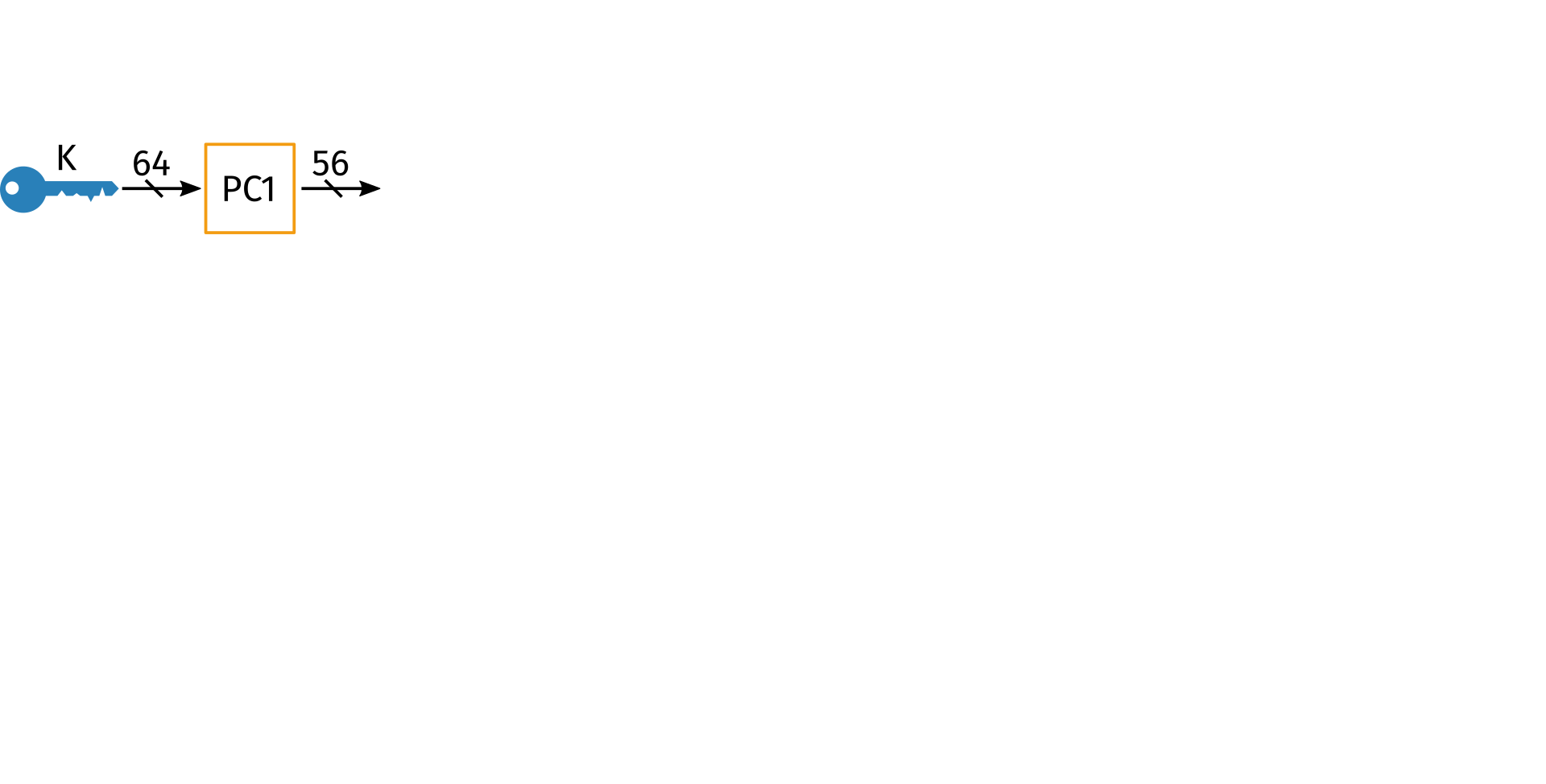
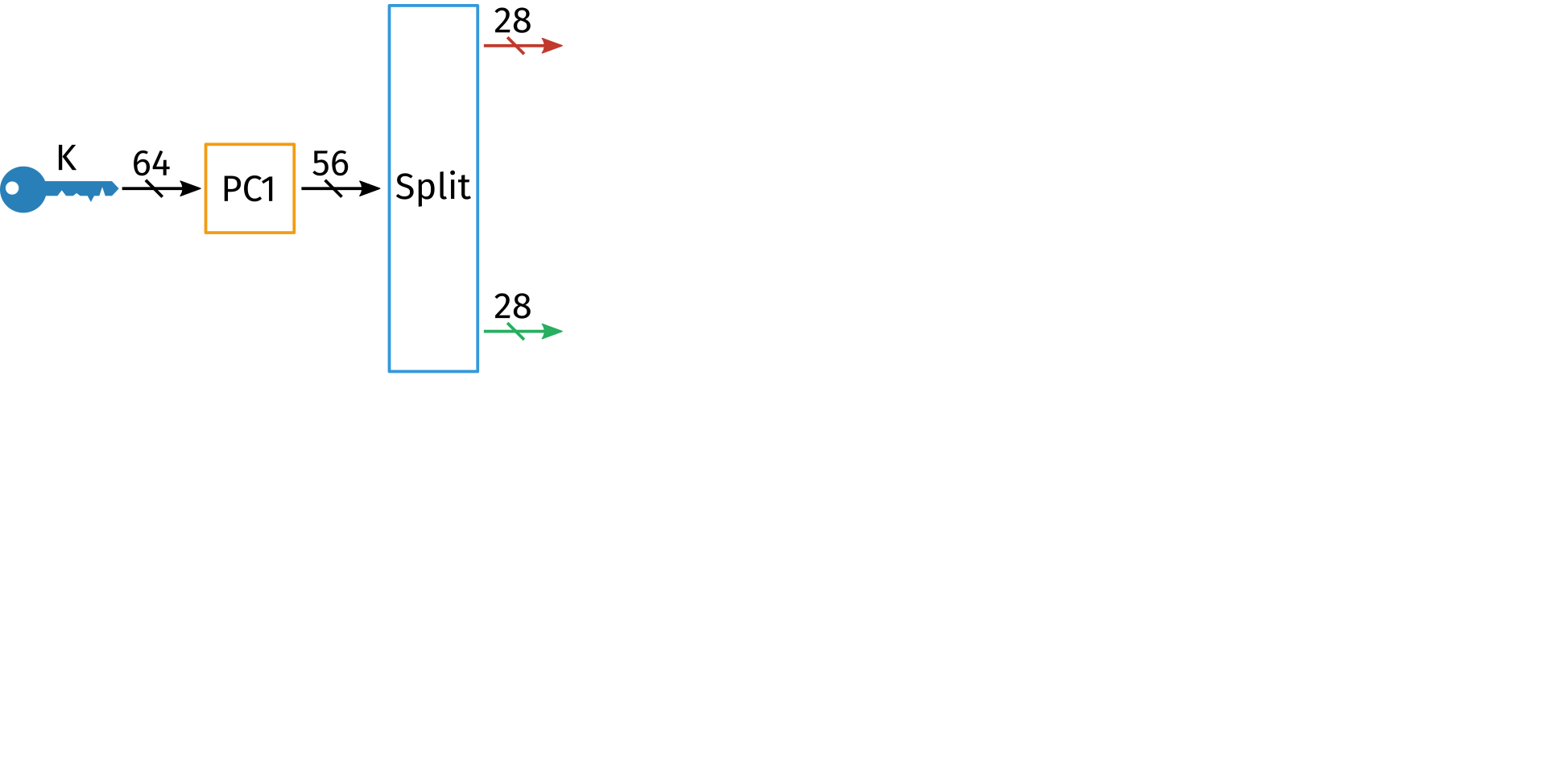
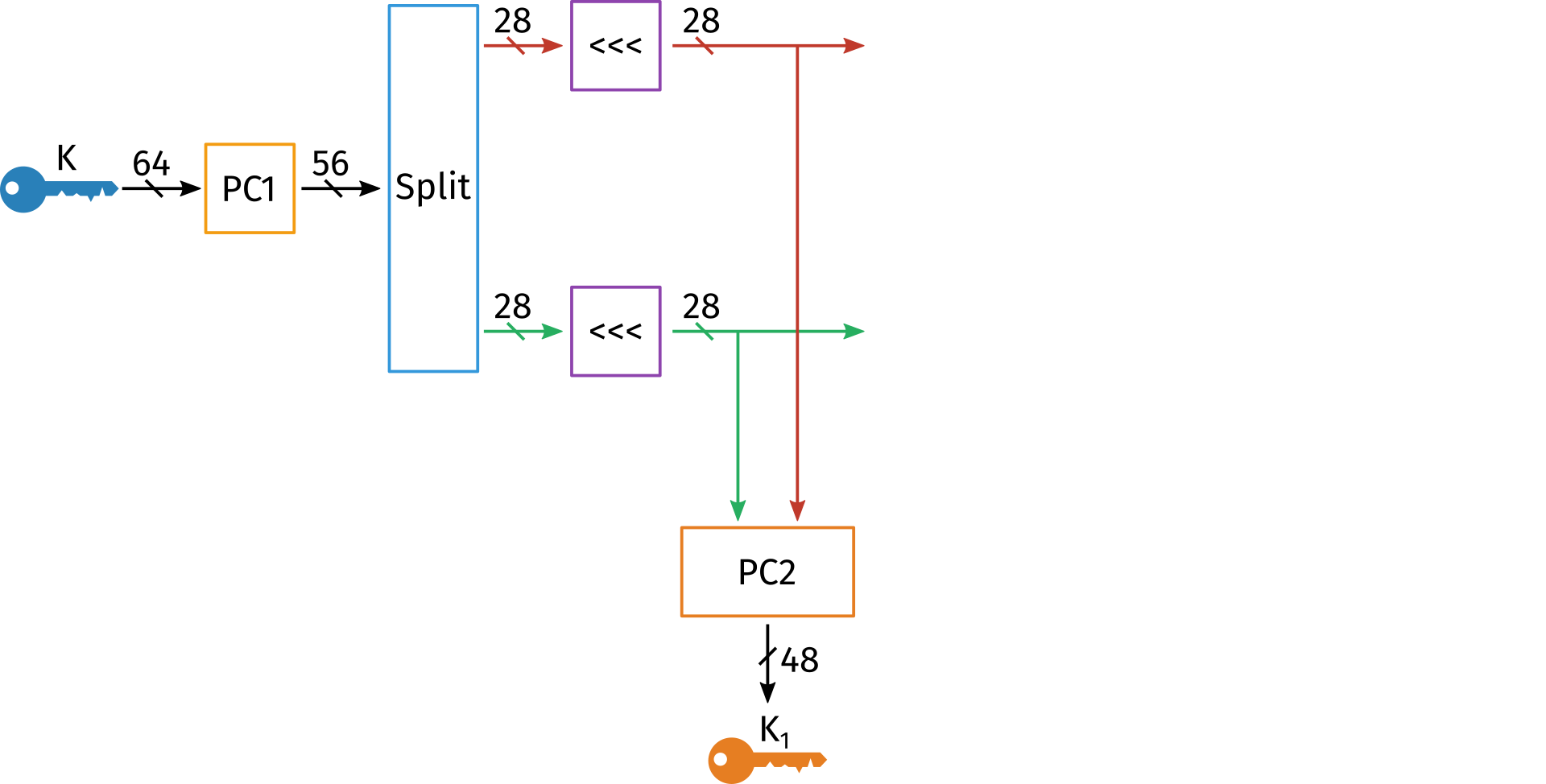
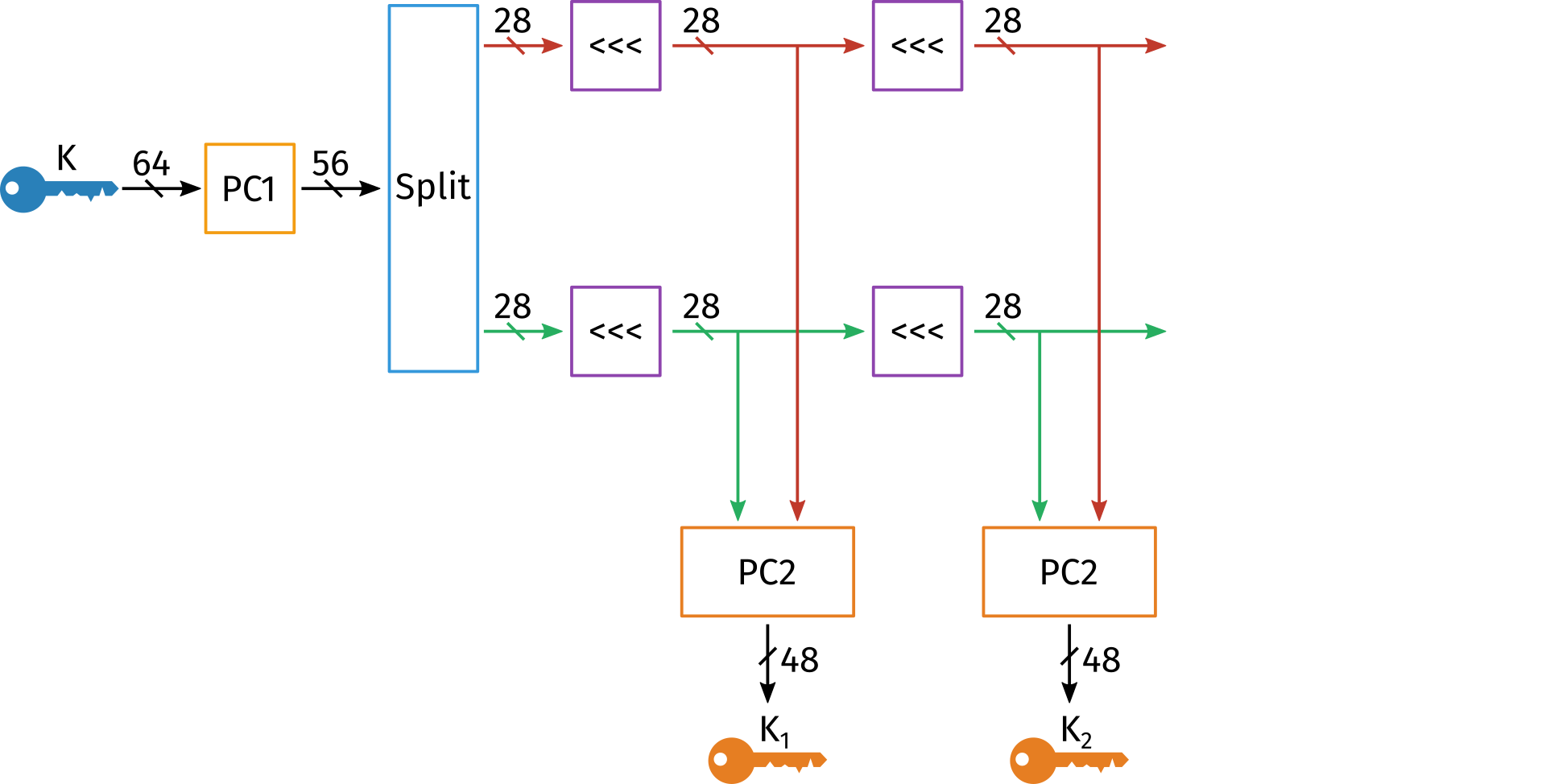
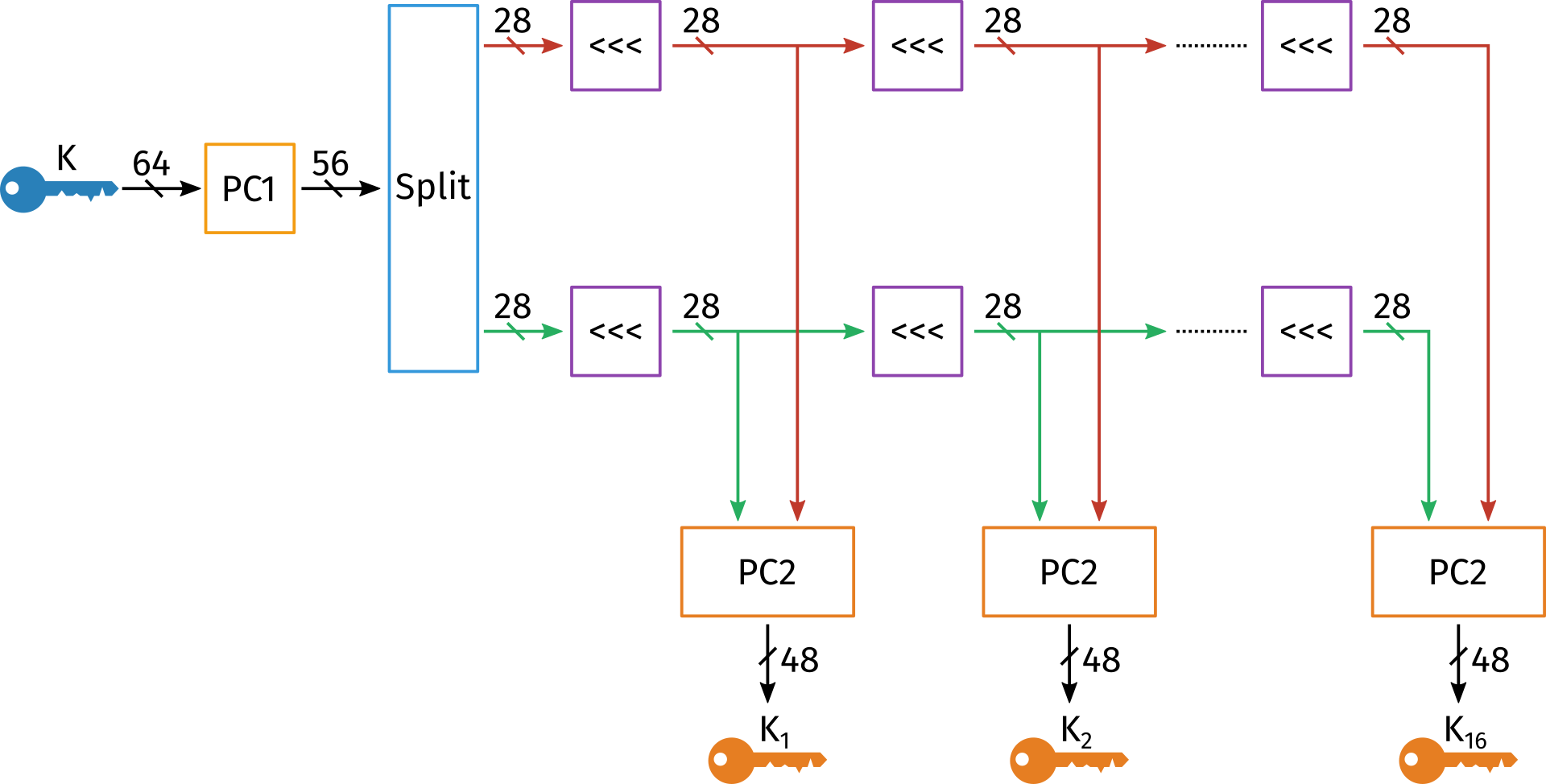
- The main operations of the DESData Encryption Standard KSAKey Scheduling Algorithm are the “permuted choices” (PCs) and bitwise rotation
- Rotation length depends on the round
- PC1 simply discards 8 of the 64 bits (sometimes used for parity reasons, but simply the NSANational Security Agency figleaf to justify a shorter key)
- PC2 then selects 48 of 56 bits for the round keys
- 16 of these round keys are generated
DES
35 / 52
Key schedule
DES
36 / 52
Key schedule
DES
36 / 52
Key schedule
DES
36 / 52
Key schedule
DES
36 / 52
Key schedule
DES
36 / 52
Key schedule
- After the key schedule, 16 subkeys of 48 bits each have been generated
- These are used as input for the Feistel network in the respective rounds
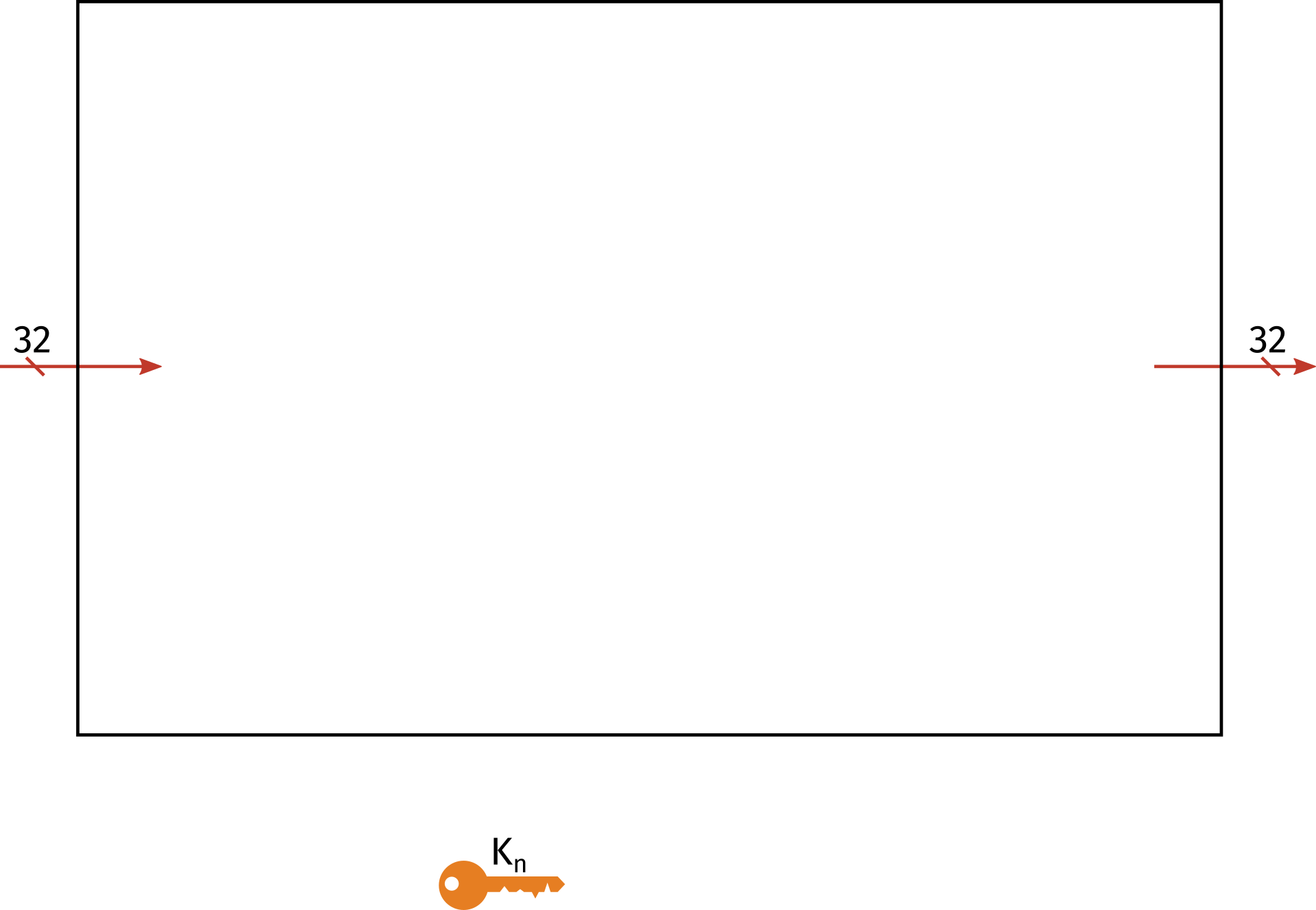
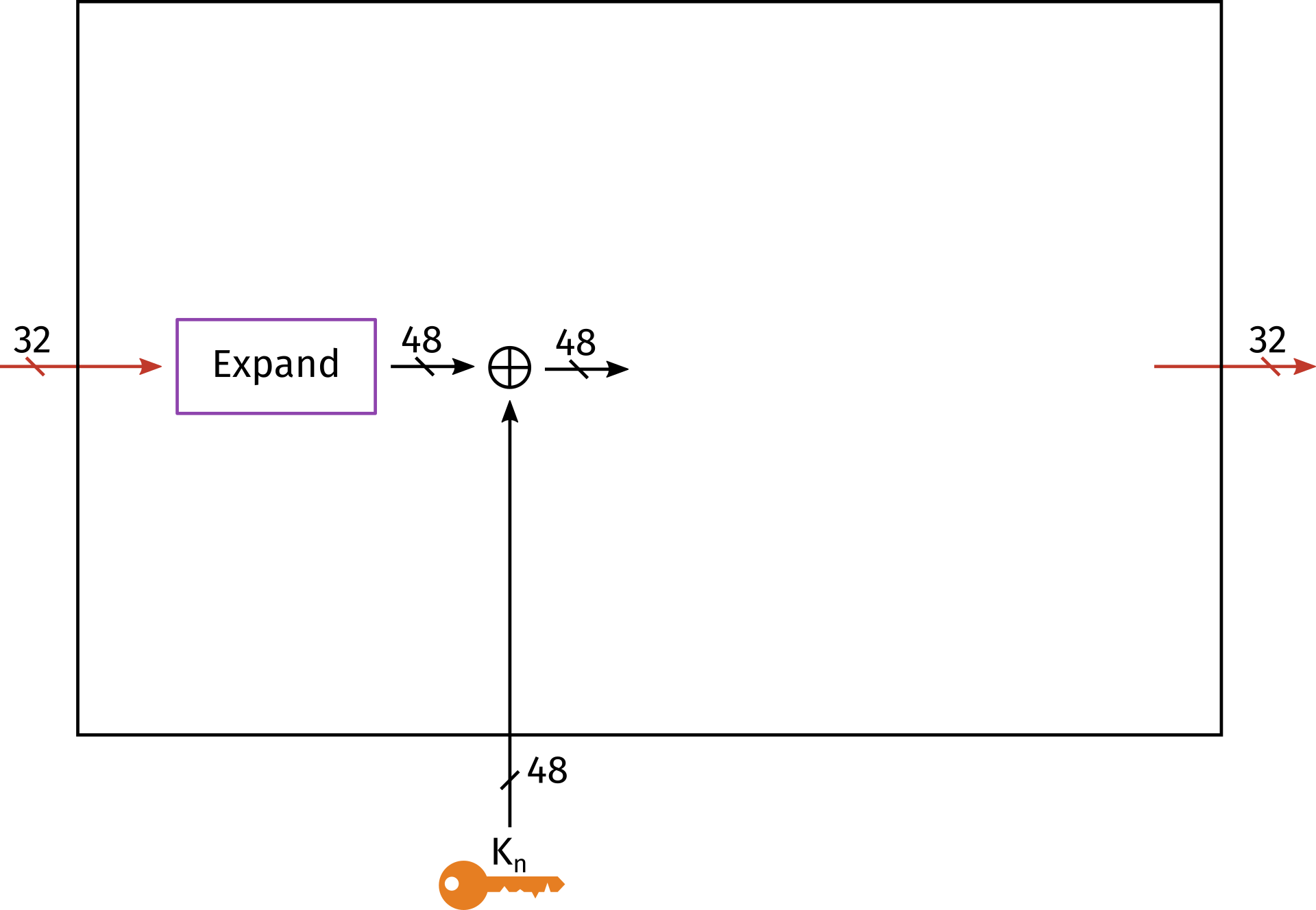
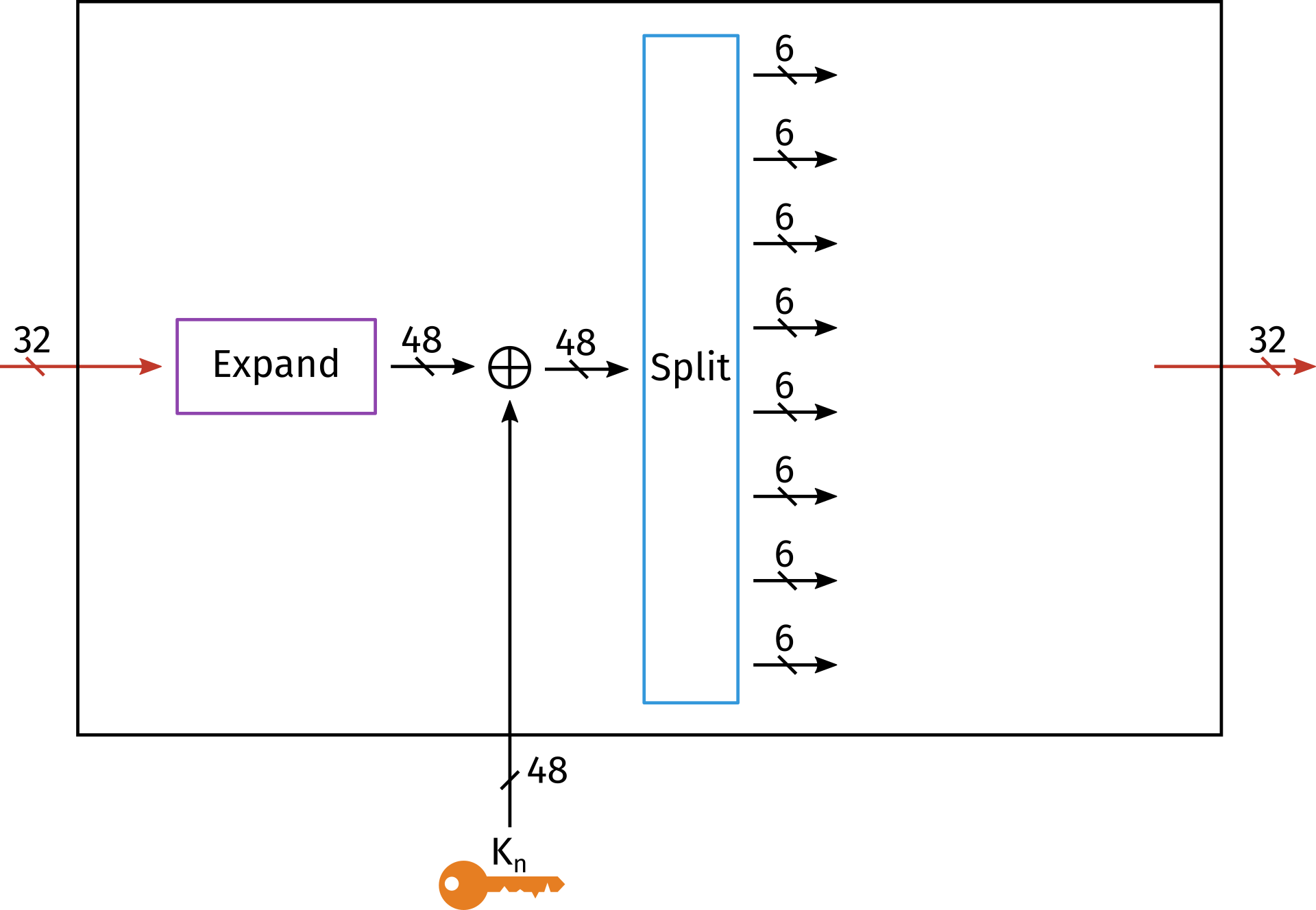
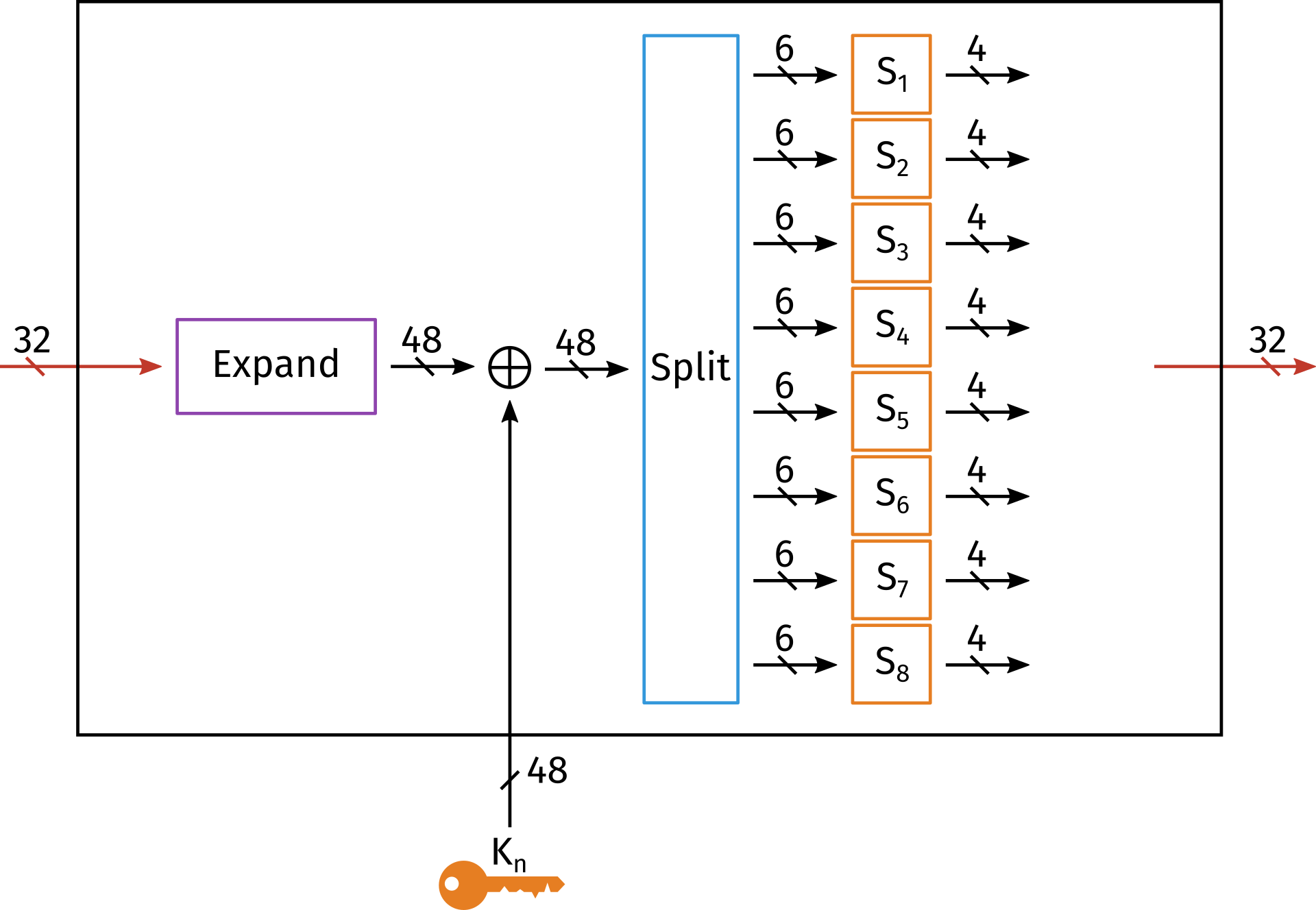
- Note that the DES function Q4mta4Ck5NLHFZf1qH71g5gJY takes a half block as input (32 bits), but the subkey is 48 bit long
DES
37 / 52
DES Feistel function
DES
38 / 52
DES Feistel function
DES
38 / 52
DES Feistel function
DES
38 / 52
DES Feistel function
DES
38 / 52
DES Feistel function
DES
38 / 52
Feistel round application
- This function is applied 16 times in a Feistel construction
- The output is then a 64-bit block (64 bit input, 64 bit output)
- This is the most basic variant of DES, the “single” DESData Encryption Standard
- 56 bits of security is not a lot
DES
39 / 52
DES constructions
- There are three constructions that are common when using DESData Encryption Standard:
- Single DES, used as is: 56 bit key
- Two-key DES: 112 bit key in two chunks Q4mta4Ck5NLHK_1, K_2Zf1qH71g5gJY:
Q4mta4Ck5NLHC = E_{K_1}(D_{K_2}(E_{K_1}(P)))Zf1qH71g5gJY - Triple DES (3DES, TDESTriple DES, DES-EDE): 168 bit key in three chunks Q4mta4Ck5NLHK_1, K_2, K_3Zf1qH71g5gJY:
Q4mta4Ck5NLHC = E_{K_3}(D_{K_2}(E_{K_1}(P)))Zf1qH71g5gJY
DES
Security
40 / 52
Security
- The security of macroscopic constructions is not straightforward to analyze
- While the simple variant for a key length of 56 bits provides (ideally) 56 bits of security, the composed variants do not provide 112/168 bits of security
- The exact reasons are beyond the scope of this lecture and are widely described in literature
DES
Security
41 / 52
2KTDES
- The security of two-key triple DES is difficult to estimate
- Good paper of Mitchell, 2016: On the Security of 2-Key Triple DES
- 112 bit key, but roughly 80 bits of security
DES
Security
42 / 52
3KTDES
- The security of triple DESData Encryption Standard is bound by the meet-in-the-middle attack
- The principle behind this attack is that the attacker can attack different parts of the composed function separately
- Recall that in TDESTriple DES Q4mta4Ck5NLHC = E_{K_3}(D_{K_2}(E_{K_1}(P)))Zf1qH71g5gJY
DES
Security
43 / 52
Meet-in-the-middle attack
- An attacker who has a pair Q4mta4Ck5NLHP, CZf1qH71g5gJY can now perform Q4mta4Ck5NLH2^{56}Zf1qH71g5gJY evaluations with candidates for Q4mta4Ck5NLHK_3Zf1qH71g5gJY, evaluating Q4mta4Ck5NLHD_{K_3}(C)Zf1qH71g5gJY
- This creates a table with Q4mta4Ck5NLH2^{56}Zf1qH71g5gJY entries, a map between Q4mta4Ck5NLHK_3Zf1qH71g5gJY candidates and decrypted ciphertexts
- I.e., this is from the “outside” to the “inside” (first step of TDESTriple DES decryption)
DES
Security
44 / 52
Meet-in-the-middle attack
- Then, the attacker performs Q4mta4Ck5NLH2^{112}Zf1qH71g5gJY evaluations with candidates for Q4mta4Ck5NLHK_1, K_2Zf1qH71g5gJY, performing Q4mta4Ck5NLHD_{K_2}(E_{K_1}(P))Zf1qH71g5gJY
- This is from the “inside” to the “outside” (first two steps of TDESTriple DES encryption)
- For each value, the attacker compares with the table from step 1. If a match is found, the attack can try if Q4mta4Ck5NLHK_1, K_2, K_3Zf1qH71g5gJY fit
DES
Security
45 / 52
Meet-in-the-middle attack
- Since the asymptotic complexity of Q4mta4Ck5NLH2^{56}Zf1qH71g5gJY is negligible compared to the Q4mta4Ck5NLH2^{112}Zf1qH71g5gJY operations, this means the latter dominates the total complexity
- The security of TDESTriple DES is therefore always at most 112 bits
- In practice, it is worse because there are algorithmic attacks on DESData Encryption Standard
DES
Security
46 / 52
Conclusion
47
Takeaway
- Basic building blocks: S-boxes, P-boxes
- Key scheduling algorithms, generation of round keys/subkeys
- Different attacker models (KPAKnown-plaintext attack, CPAChosen-plaintext attack, CPCAChosen-plaintext-ciphertext attack)
Conclusion
48 / 52
Takeaway
- Feistel networks are an elegant cryptographic construction with many advantages
- They have fallen out of favor recently; cannot compete performance-wise at same security level
- Compound cryptographic constructions are difficult to estimate accurately without knowledge of the underlying attacks
- You should be able to explain the impact of a possible meet-in-the-middle attack
Conclusion
49 / 52
Thank you!
Any questions?
Acronyms
- CPA: Chosen-plaintext attack
- CPCA: Chosen-plaintext-ciphertext attack
- DES: Data Encryption Standard
- FIPS: Federal Information Processing Standard
- KPA: Known-plaintext attack
- KSA: Key Scheduling Algorithm
- NSA: National Security Agency
- TDES: Triple DES
Acronyms
51 / 52