Main presentation file:
×

T4INF1202: Kryptologie
Part 6: AES and Cipher Implementation
2026-05-05
Table of Contents
2 / 69
Recap
- Last week, we talked about Feistel networks as a generalized way to construct invertible ciphers
- The advantage was that the Feistel function need not be invertible
- Today, we will cover AESAdvanced Encryption Standard, a substitution-permutation based cipher
- We will also talk a bit about implementation in a programming language
Introduction
3 / 69
Basic operations
- Recall that in a Feistel network, the general construction was given, but the function Q4mta4Ck5NLHFZf1qH71g5gJY was opaque
- There are various different types of Feistel networks, we've looked at Classical Feistel; others are e.g., Alternating, Numeric, Type-1, Type-2, Type-3 Feistel
- Hoang and Rogaway 2010: On Generalized Feistel Networks
Introduction
4 / 69
Basic operations
- Inside the Feistel function Q4mta4Ck5NLHFZf1qH71g5gJY, we've seen:
- Substitutions (e.g., S-boxes)
- Permutations (e.g., bit shifts and rotations)
- A cipher that only uses substitutions/permutations without the Feistel structure is called an SP-network (substitution-permutation)
- Needs to ensure invertibility on its own
Introduction
5 / 69
Standardization
- After it was clear that DESData Encryption Standard is not secure enough anymore, NISTNational Institute of Standards and Technology held a cipher competition in 1997
- The formal requirements for the algorithm were:
- Block ciphers with 128 bit block size and 128, 192 and 256 bit keys (uncommon at the time)
- Non patent-encumbered, royalty free
- Good performance in software and hardware (size and speed)
- Secure against all known attacks (e.g., differential cryptanalysis)
AES
6 / 69
AES Candidates
- There were 15 submissions in total
- In three conferences, all ciphers were publicly evaluated and improved by their authors from the feedback they got
- Some ciphers were withdrawn altogether (e.g., MAGENTAMultifunctional Algorithm for General-purpose Encryption and Network Telecommunication Applications)
- In the end, a vote was cast to determine the winner of the five finalists
AES
7 / 69
AES Candidates
- Rijndael, named after their authors (Rijmen and Daemen) won the competition
- It showed the best security-performance relationship
- Rijndael is therefore now also known as AESAdvanced Encryption Standard
- It uses 10, 12 or 14 rounds, depending on the key length (AES-128, AES-192, AES-256)
AES
9 / 69
Algorithmic steps
- AESAdvanced Encryption Standard has four internal primitive functions that are applied:
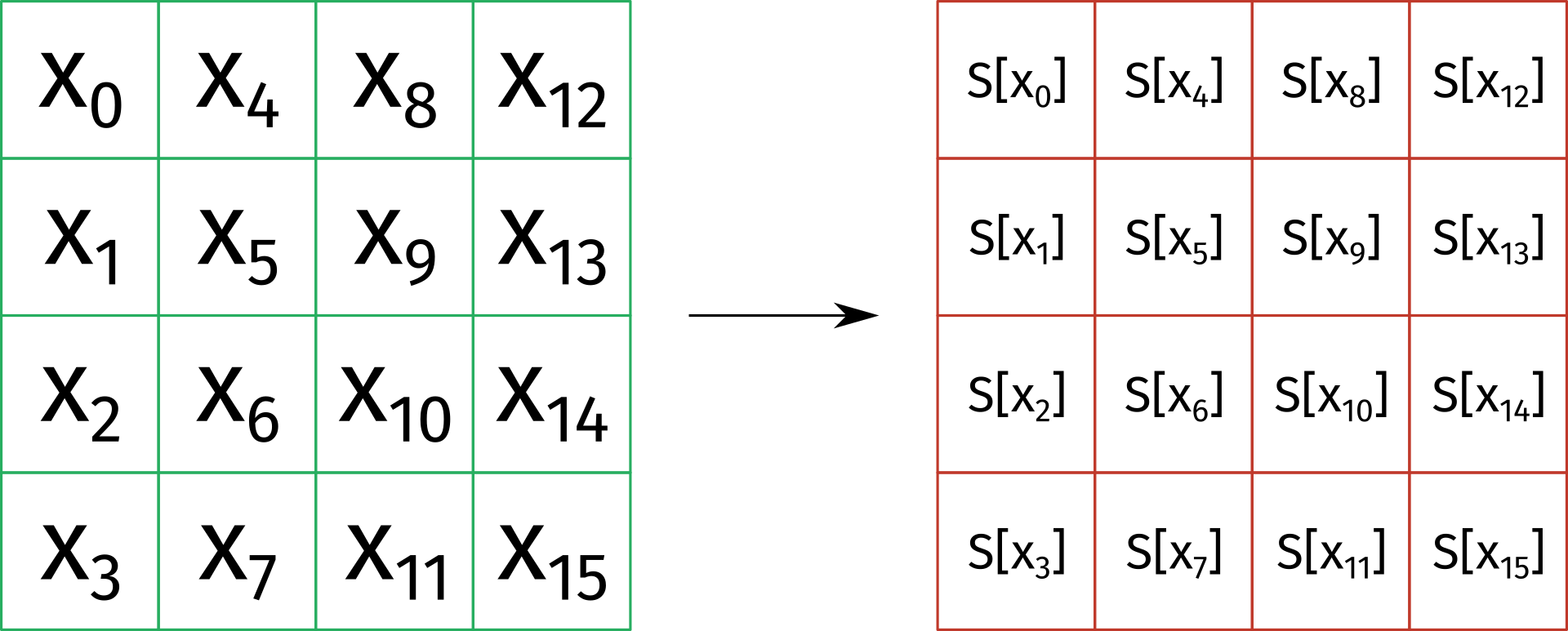
- SubBytes: Substitution on byte basis
- ShiftRows: Permutation on byte basis
- MixColumns: Permutation on bit basis
- AddRoundKey: XOR of bytes with the round-specific subkey
- Application on an interative per-round basis
AES
Anatomy
10 / 69
AES S-box construction
- AESAdvanced Encryption Standard uses an Q4mta4Ck5NLH8 \times 8Zf1qH71g5gJY S-box (i.e., an uint8_t[256])
- Arithmetic operations in Q4mta4Ck5NLH\mathbb{F}_{2^8}Zf1qH71g5gJY using the division polynomial Q4mta4Ck5NLHx^8 + x^4 + x^3 + x + 1Zf1qH71g5gJY (sometimes also called the field of AESAdvanced Encryption Standard)
- Minimal irreducible polynomial (monic, least amount of terms, coefficients mainly in low exponents)
AES
Anatomy
11 / 69
AES S-box construction
- In this field, every element (but zero) has an inverse element
- For AESAdvanced Encryption Standard, the input is first inverted and then an (invertible) affine transformation is applied
- Essentially, this is a field inversion followed by a matrix multiplication
- Both can be collapsed into a lookup table
AES
Anatomy
12 / 69
AES S-box example
- Q4mta4Ck5NLHq = \texttt{\{ab\}} = x^7 + x^5 + x^3 + x + 1Zf1qH71g5gJY
- Q4mta4Ck5NLHq^{-1} = x^6 + x^3 + x = \texttt{\{4a\}}Zf1qH71g5gJY
- Q4mta4Ck5NLHq \cdot q^{-1} = \texttt{\{ab\}} \cdot \texttt{\{4a\}} = 1 = \texttt{\{01\}}Zf1qH71g5gJY
AES
Anatomy
13 / 69
QBEntEozXWio
s(q) = \begin{pmatrix}
1 & 0 & 0 & 0 & 1 & 1 & 1 & 1\\
1 & 1 & 0 & 0 & 0 & 1 & 1 & 1\\
1 & 1 & 1 & 0 & 0 & 0 & 1 & 1\\
1 & 1 & 1 & 1 & 0 & 0 & 0 & 1\\
1 & 1 & 1 & 1 & 1 & 0 & 0 & 0\\
0 & 1 & 1 & 1 & 1 & 1 & 0 & 0\\
0 & 0 & 1 & 1 & 1 & 1 & 1 & 0\\
0 & 0 & 0 & 1 & 1 & 1 & 1 & 1\\
\end{pmatrix} \cdot q^{-1}
+ \begin{pmatrix}
1\\
1\\
0\\
0\\
0\\
1\\
1\\
0\\
\end{pmatrix}
kIt7msRdzcHK
AES
Anatomy
14 / 69
AES S-box example
- Input and output bytes are read as column vectors
- Least significant bit is at the top
- Inversion and affine transformation are typically combined in one step (already precomputed in the S-box)
- For decryption, an inverted S-box is necessary that performs the steps in the reversed order (invert the affine transformation and invert the substitution)
AES
Anatomy
15 / 69
AES round functions
- When applying the individual steps, the 16-byte blocks are typically read as a Q4mta4Ck5NLH4 \times 4Zf1qH71g5gJY array of one byte each
- Only useful for visualisation, in memory blocks are simple arrays (uint8_t[16])
AES
Anatomy
16 / 69
AES round functions

AES
Anatomy
17 / 69
SubBytes
AES
Anatomy
18 / 69
ShiftRows
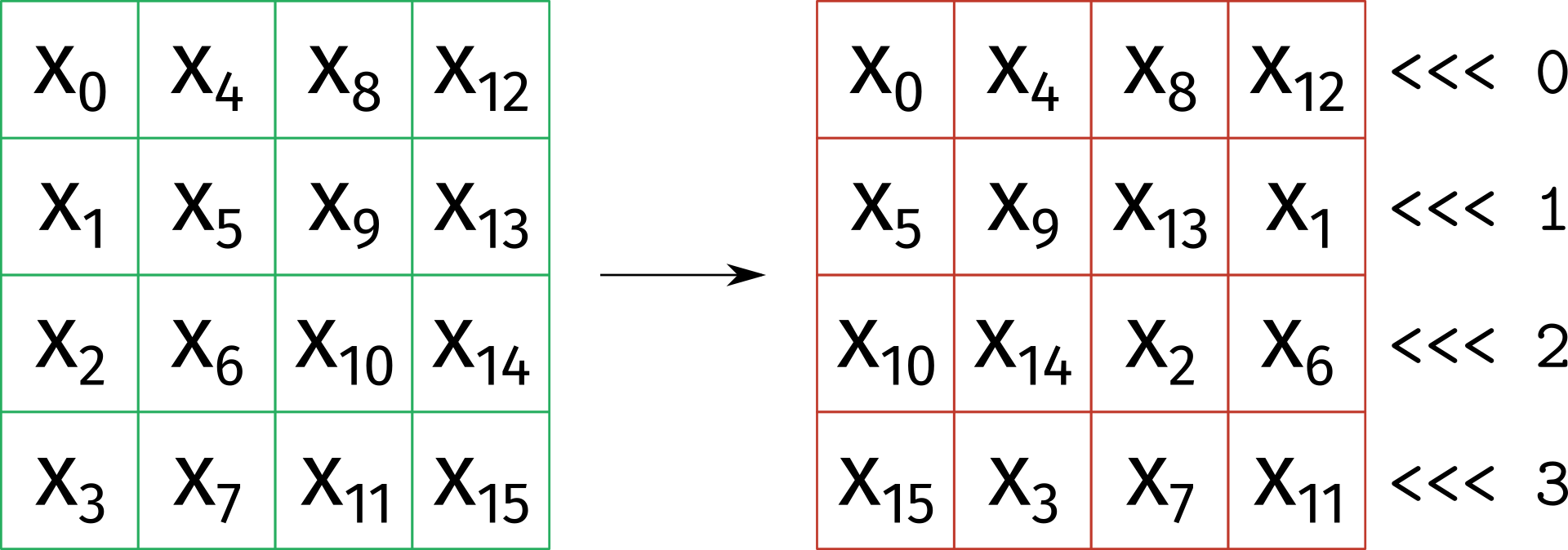
- The ShiftRows operation is a simple permutation on a byte basis
- Then, each row is rotated for a specific amount:
- first row is not rotated
- second row is rotated 1 byte to the left
- third row is rotated 2 bytes to the left
- fourth row is rotated 3 bytes to the left
AES
Anatomy
19 / 69
ShiftRows
- Terminology may be a bit confusing: shifting usually discards everything that is shifted out of the register
- This does not happen here; firstly because we do not shift bits, but bytes
- Rotation is shifting but instead of discarding the bits, they are fed back into the other side of the register
- Sometimes, it is more precisely synonymously referred to as a circular shift
AES
Anatomy
20 / 69
ShiftRows
AES
Anatomy
21 / 69
Shifting vs. rotation
- Bit shifts are also frequently used in cryptography
- Generally, shifting cannot be inverted because information may be lost (shifted out the register)
- Some tricks need to be used (such as those used by Feistel networks)
- Rotation can always be inverted (rotation to the other direction by the same amount of bits)
AES
Anatomy
22 / 69
MixColumns
- MixColumns is a bit more complicated; each column is interpreted as four polynomials in Q4mta4Ck5NLH\mathbb{F}_{2^8}Zf1qH71g5gJY
- Then, a polynomial multiplication is performed: Q4mta4Ck5NLHb_3 X^3 + b_2 X^2 + b_1 X + b_0Zf1qH71g5gJY
- The result is then reduced modulo Q4mta4Ck5NLHX^4 + 1Zf1qH71g5gJY
AES
Anatomy
23 / 69
MixColumns
- Polynomials with which the values are multiplied are part of an MDSMaximum distance separable matrix
- This ensures good mixing properties: confusion and diffusion; avalanche property
- There are other MDSMaximum distance separable matrices, but this one is, for the aforementioned reason, particularly efficient
AES
Anatomy
24 / 69
MixColumns
QBEntEozXWio
M = \begin{pmatrix}
x & x+1 & 1 & 1\\
1 & x & x+1 & 1\\
1 & 1 & x & x+1\\
x+1 & 1 & 1 & x\\
\end{pmatrix}
=
kIt7msRdzcHK
QBEntEozXWio
= \begin{pmatrix}
\texttt{\{02\}} & \texttt{\{03\}} & \texttt{\{01\}} & \texttt{\{01\}}\\
\texttt{\{01\}} & \texttt{\{02\}} & \texttt{\{03\}} & \texttt{\{01\}}\\
\texttt{\{01\}} & \texttt{\{01\}} & \texttt{\{02\}} & \texttt{\{03\}}\\
\texttt{\{03\}} & \texttt{\{01\}} & \texttt{\{01\}} & \texttt{\{02\}}\\
\end{pmatrix}
kIt7msRdzcHK
AES
Anatomy
25 / 69
MixColumns
- Note that literature sometimes switches back and forth between different conventions for representing these polynomials
- Sometimes, the integer representation is used for convenience purposes (more on that later)
- Can be a bit confusing, we will use mainly polynomial notation here
AES
Anatomy
26 / 69
MixColumns
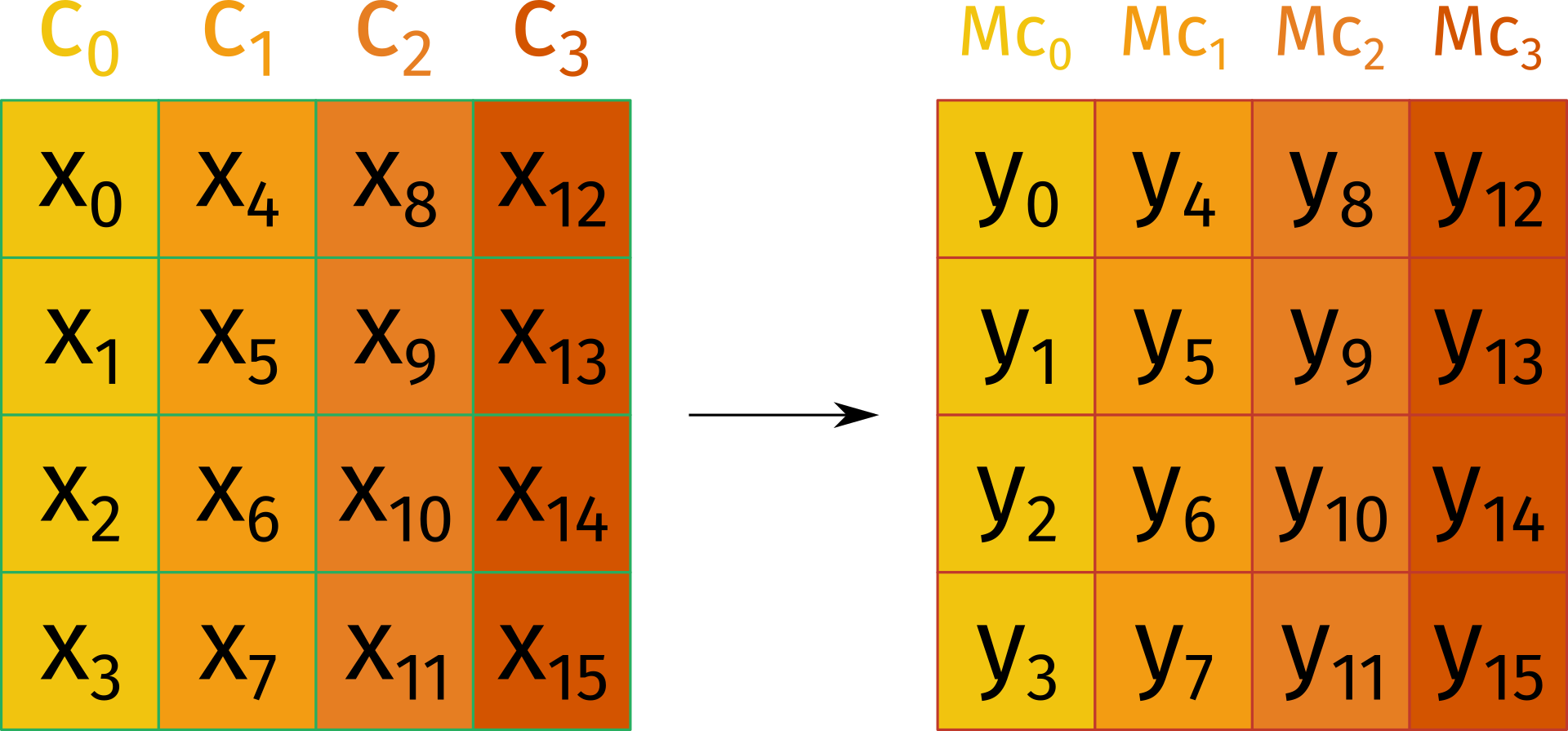
- Each column vector Q4mta4Ck5NLH\vec{c}Zf1qH71g5gJY is multiplied with Q4mta4Ck5NLHMZf1qH71g5gJY individually and returns a new column vector Q4mta4Ck5NLH\vec{y}Zf1qH71g5gJY
- QBEntEozXWio \vec{c}_i = \begin{pmatrix} x_{4i}\\ x_{4i+1}\\ x_{4i+2}\\ x_{4i+3}\\ \end{pmatrix},\ \ i = [0 \ldots 3] kIt7msRdzcHK
- Q4mta4Ck5NLHM\vec{c} = \vec{y}Zf1qH71g5gJY
AES
Anatomy
27 / 69
MixColumns
- This gives a resulting polynomial with only four coefficients
- They can be easily combined using XOR operations by using a small precomputation (terms are only Q4mta4Ck5NLH0, 1, x, x+1Zf1qH71g5gJY)
- Multiplication with 0 and 1 are trivial; with Q4mta4Ck5NLHxZf1qH71g5gJY is a shift operation followed by modular reduction. Q4mta4Ck5NLHx+1Zf1qH71g5gJY is the XOR of Q4mta4Ck5NLHxZf1qH71g5gJY and Q4mta4Ck5NLH1Zf1qH71g5gJY
- Effectively, this mixes bytes and bits within the columns of the block
AES
Anatomy
28 / 69
MixColumns
AES
Anatomy
29 / 69
MixColumns example
QBEntEozXWio
B = \begin{pmatrix}
\texttt{\{12\}} & \texttt{\{34\}} & \texttt{\{56\}} & \texttt{\{78\}}\\
\texttt{\{c0\}} & \texttt{\{ff\}} & \texttt{\{ee\}} & \texttt{\{11\}}\\
\texttt{\{de\}} & \texttt{\{ad\}} & \texttt{\{be\}} & \texttt{\{ef\}}\\
\texttt{\{ba\}} & \texttt{\{ad\}} & \texttt{\{c0\}} & \texttt{\{de\}}\\
\end{pmatrix}
kIt7msRdzcHK
QBEntEozXWio
\vec{c}_0 = \begin{pmatrix}
\texttt{\{12\}}\\
\texttt{\{c0\}}\\
\texttt{\{de\}}\\
\texttt{\{ba\}}\\
\end{pmatrix}
kIt7msRdzcHK
AES
Anatomy
30 / 69
MixColumns example
QBEntEozXWio
M\vec{c}_0 = \begin{pmatrix}
\texttt{\{02\}} & \texttt{\{03\}} & \texttt{\{01\}} & \texttt{\{01\}}\\
\texttt{\{01\}} & \texttt{\{02\}} & \texttt{\{03\}} & \texttt{\{01\}}\\
\texttt{\{01\}} & \texttt{\{01\}} & \texttt{\{02\}} & \texttt{\{03\}}\\
\texttt{\{03\}} & \texttt{\{01\}} & \texttt{\{01\}} & \texttt{\{02\}}\\
\end{pmatrix} \cdot \begin{pmatrix}
\texttt{\{12\}}\\
\texttt{\{c0\}}\\
\texttt{\{de\}}\\
\texttt{\{ba\}}\\
\end{pmatrix}
kIt7msRdzcHK
QBEntEozXWio
\vec{y}_{0,0} = \texttt{\{02\}} \cdot \texttt{\{12\}} + \texttt{\{03\}} \cdot \texttt{\{c0\}}\ +
kIt7msRdzcHK
QBEntEozXWio
+ \texttt{\{01\}} \cdot \texttt{\{de\}} + \texttt{\{01\}} \cdot \texttt{\{ba\}}
kIt7msRdzcHK
AES
Anatomy
31 / 69
MixColumns example
QBEntEozXWio
\vec{y}_{0,0} = \texttt{\{02\}} \cdot \texttt{\{12\}} + \texttt{\{03\}} \cdot \texttt{\{c0\}}\ +
kIt7msRdzcHK
QBEntEozXWio
+ \texttt{\{01\}} \cdot \texttt{\{de\}} + \texttt{\{01\}} \cdot \texttt{\{ba\}}
kIt7msRdzcHK
AES
Anatomy
32 / 69
MixColumns example
QBEntEozXWio
\vec{y}_{0,0} = \texttt{\{02\}} \cdot \texttt{\{12\}} + \texttt{\{03\}} \cdot \texttt{\{c0\}}\ +
kIt7msRdzcHK
QBEntEozXWio
+ \texttt{\{01\}} \cdot \texttt{\{de\}} + \texttt{\{01\}} \cdot \texttt{\{ba\}}
kIt7msRdzcHK
QBEntEozXWio
\vec{y}_{0,0} = \texttt{\{02\}} \cdot \texttt{\{12\}} + \texttt{\{03\}} \cdot \texttt{\{c0\}} + \texttt{\{de\}} + \texttt{\{ba\}}
kIt7msRdzcHK
QBEntEozXWio
\vec{y}_{0,0} = \texttt{\{02\}} \cdot \texttt{\{12\}} + \texttt{\{03\}} \cdot \texttt{\{c0\}} + \texttt{\{64\}}
kIt7msRdzcHK
QBEntEozXWio
\vec{y}_{0,0} = x \cdot \texttt{\{12\}} + \texttt{\{03\}} \cdot \texttt{\{c0\}} + \texttt{\{64\}}
kIt7msRdzcHK
AES
Anatomy
32 / 69
MixColumns example
QBEntEozXWio
\vec{y}_{0,0} = x \cdot \texttt{\{12\}} + \texttt{\{03\}} \cdot \texttt{\{c0\}} + \texttt{\{64\}}
kIt7msRdzcHK
AES
Anatomy
33 / 69
MixColumns example
QBEntEozXWio
\vec{y}_{0,0} = x \cdot \texttt{\{12\}} + \texttt{\{03\}} \cdot \texttt{\{c0\}} + \texttt{\{64\}}
kIt7msRdzcHK
QBEntEozXWio
\vec{y}_{0,0} = \texttt{\{24\}} + \texttt{\{03\}} \cdot \texttt{\{c0\}} + \texttt{\{64\}}
kIt7msRdzcHK
AES
Anatomy
33 / 69
MixColumns example
QBEntEozXWio
\vec{y}_{0,0} = x \cdot \texttt{\{12\}} + \texttt{\{03\}} \cdot \texttt{\{c0\}} + \texttt{\{64\}}
kIt7msRdzcHK
QBEntEozXWio
\vec{y}_{0,0} = \texttt{\{24\}} + \texttt{\{03\}} \cdot \texttt{\{c0\}} + \texttt{\{64\}}
kIt7msRdzcHK
QBEntEozXWio
\vec{y}_{0,0} = \texttt{\{03\}} \cdot \texttt{\{c0\}} + \texttt{\{40\}}
kIt7msRdzcHK
QBEntEozXWio
\vec{y}_{0,0} = (\texttt{\{01\}} \cdot \texttt{\{c0\}} + \texttt{\{02\}} \cdot \texttt{\{c0\}}) + \texttt{\{40\}}
kIt7msRdzcHK
QBEntEozXWio
\vec{y}_{0,0} = \texttt{\{02\}} \cdot \texttt{\{c0\}} + \texttt{\{c0\}} + \texttt{\{40\}}
kIt7msRdzcHK
QBEntEozXWio
\vec{y}_{0,0} = \texttt{\{02\}} \cdot \texttt{\{c0\}} + \texttt{\{80\}}
kIt7msRdzcHK
AES
Anatomy
33 / 69
MixColumns example
QBEntEozXWio
\vec{y}_{0,0} = \texttt{\{02\}} \cdot \texttt{\{c0\}} + \texttt{\{80\}}
kIt7msRdzcHK
AES
Anatomy
34 / 69
MixColumns example
QBEntEozXWio
\vec{y}_{0,0} = \texttt{\{02\}} \cdot \texttt{\{c0\}} + \texttt{\{80\}}
kIt7msRdzcHK
QBEntEozXWio
\vec{y}_{0,0} = \texttt{\{180\}} + \texttt{\{80\}}
kIt7msRdzcHK
AES
Anatomy
34 / 69
MixColumns example
QBEntEozXWio
\vec{y}_{0,0} = \texttt{\{02\}} \cdot \texttt{\{c0\}} + \texttt{\{80\}}
kIt7msRdzcHK
QBEntEozXWio
\vec{y}_{0,0} = \texttt{\{180\}} + \texttt{\{80\}}
kIt7msRdzcHK
QBEntEozXWio
\vec{y}_{0,0} = \texttt{\{180\}} + \texttt{\{11b\}} + \texttt{\{80\}} = \texttt{\{1b\}}
kIt7msRdzcHK
AES
Anatomy
34 / 69
MixColumns example
uint8_t B[16] = {
    0x12, 0xc0, 0xde, 0xba,
    0x34, 0xff, 0xad, 0xad,
    0x56, 0xee, 0xbe, 0xc0,
    0x78, 0x11, 0xef, 0xde
};
aes_mix_columns(B);
for (int i = 0; i < 16; i++) {
    printf("%02x ", B[i]);
}
printf("\n");
// result: 1b 4a a0 47 72 90 66 4f fb 88 84 31 f2 ae d5 d1
AES
Anatomy
35 / 69
AddRoundKey
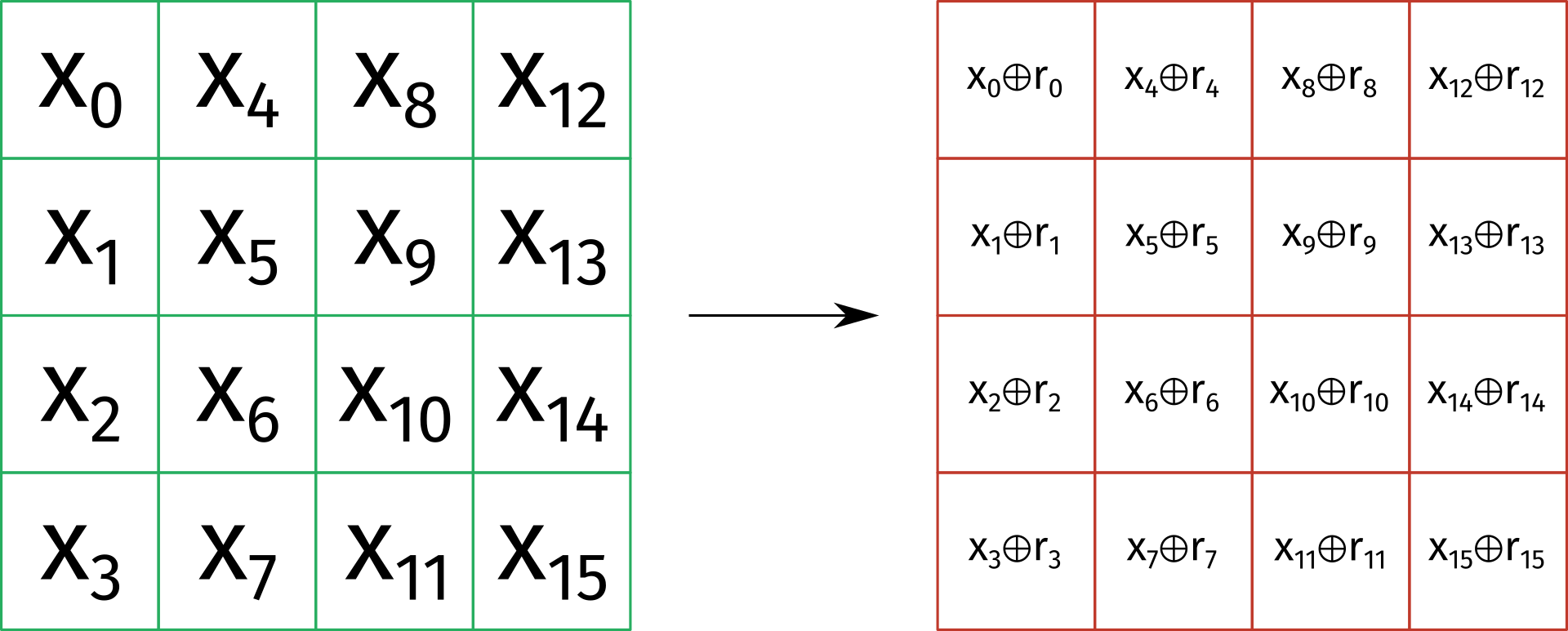
- AddRoundKey is probably the easiest operation of them all
- Each round key is added on the block (each round key has also 128 bits) – the respective round key is added in Q4mta4Ck5NLH\mathbb{F}_{2^8}Zf1qH71g5gJY
- Simple bytewise/blockwise XOR operation
AES
Anatomy
36 / 69
AddRoundKey
AES
Anatomy
37 / 69
Key schedule
- The key schedule uses all these operations as well, which is why we cover it last
- Additionally, it uses a fairly trivial RotWord operation which rotates words in the input block (similar to ShiftRows)
- It uses the AESAdvanced Encryption Standard S-box and adds a predefined round constant at each round (different for each round)
- In AESAdvanced Encryption Standard, Q4mta4Ck5NLHK_1 = KZf1qH71g5gJY
AES
Anatomy
38 / 69
Representation of polynomials
- As we have seen, bytes of blocks are regularly interpreted as polynomials in the AESAdvanced Encryption Standard field
- Those have up to eight coefficients which are all in Q4mta4Ck5NLH\mathbb{F}_2Zf1qH71g5gJY
- How would you efficiently implement this? What is the most compact representation?
AES
Implementation
39 / 69
Representation of polynomials
- Since every coefficient is one bit, we need 8 bits for every polynomial in Q4mta4Ck5NLH\mathbb{F}_{2^8}Zf1qH71g5gJY
- This means every polynomial is exactly one byte, and it's the preferred way of storing polynomials – also for other fields like the Q4mta4Ck5NLH\mathbb{F}_{2^{128}}Zf1qH71g5gJY used in AESAdvanced Encryption Standard-GCMGalois/Counter Mode
- What notation maps bits to coefficients? In other words, does the value Q4mta4Ck5NLH\texttt{\{04\}}Zf1qH71g5gJY mean the polynomial Q4mta4Ck5NLHx^2Zf1qH71g5gJY or Q4mta4Ck5NLHx^5Zf1qH71g5gJY?
AES
Implementation
40 / 69
Representation of polynomials
- This actually is a trick question.
- It can be represented either way (or any other way as long as it's consistent) and is just a matter of representation
- For AESAdvanced Encryption Standard, the LSBLeast significant bit corresponds to the lowest exponent of the polynomial. I.e., bit 0 is the coefficient of Q4mta4Ck5NLH1Zf1qH71g5gJY, while bit 1 is the coefficient of Q4mta4Ck5NLHxZf1qH71g5gJY
- However, other standard do this differently (notably AESAdvanced Encryption Standard-GCMGalois/Counter Mode): you need to check
AES
Implementation
41 / 69
Multiplication of polynomials
- For now, let's assume that we have a polynomial given in byte form the way that it is typically used.
- Let's say we want to multiply this polynomial by Q4mta4Ck5NLHxZf1qH71g5gJY – what is the operation we're doing on the byte?
AES
Implementation
42 / 69
Multiplication of polynomials
- Multiplication by Q4mta4Ck5NLHxZf1qH71g5gJY is simply a shift-left by one instruction, which makes it delightfully efficient on computers
- There is one caveat: What happens if we have a byte value (e.g., a uint8_t in C) of which the leftmost bit is 1 and we shift left by one?
- The bit is lost! Is this what we want?
AES
Implementation
43 / 69
Multiplication of polynomials
- Of course not! The proper way of doing this is to perform a modular reduction.
- For example, say we've just multiplied Q4mta4Ck5NLHx^7Zf1qH71g5gJY by Q4mta4Ck5NLHxZf1qH71g5gJY, this gives Q4mta4Ck5NLHx^8Zf1qH71g5gJY
- We need to do a modular reduction and, in this case, can simply subtract the field polynomial
- Luckily, subtraction is addition is XOR – again, delightfully efficient
AES
Implementation
44 / 69
Multiplication of polynomials
- Some cases require modular reduction, others don't.
- In particular, for multiplying with Q4mta4Ck5NLHxZf1qH71g5gJY, modular reduction is only necessary if Q4mta4Ck5NLHx^7Zf1qH71g5gJY was present in the polynomial
- How do we check this in a byte representation?
AES
Implementation
45 / 69
Multiplication of polynomials
- Check if MSBMost significant bit is set (then we need to post-perform a modular reduction) – only needed if the shift would lose the MSBMost significant bit
- Shift left by one
- If the MSBMost significant bit was set before, XOR the field polynomial
AES
Implementation
46 / 69
Multiplication of polynomials
def mul_x(poly):
    poly <<= 1
    if poly & 0x100:
        poly ^= 0x11b
AES
Implementation
47 / 69
Bit operations

48
General bit operations
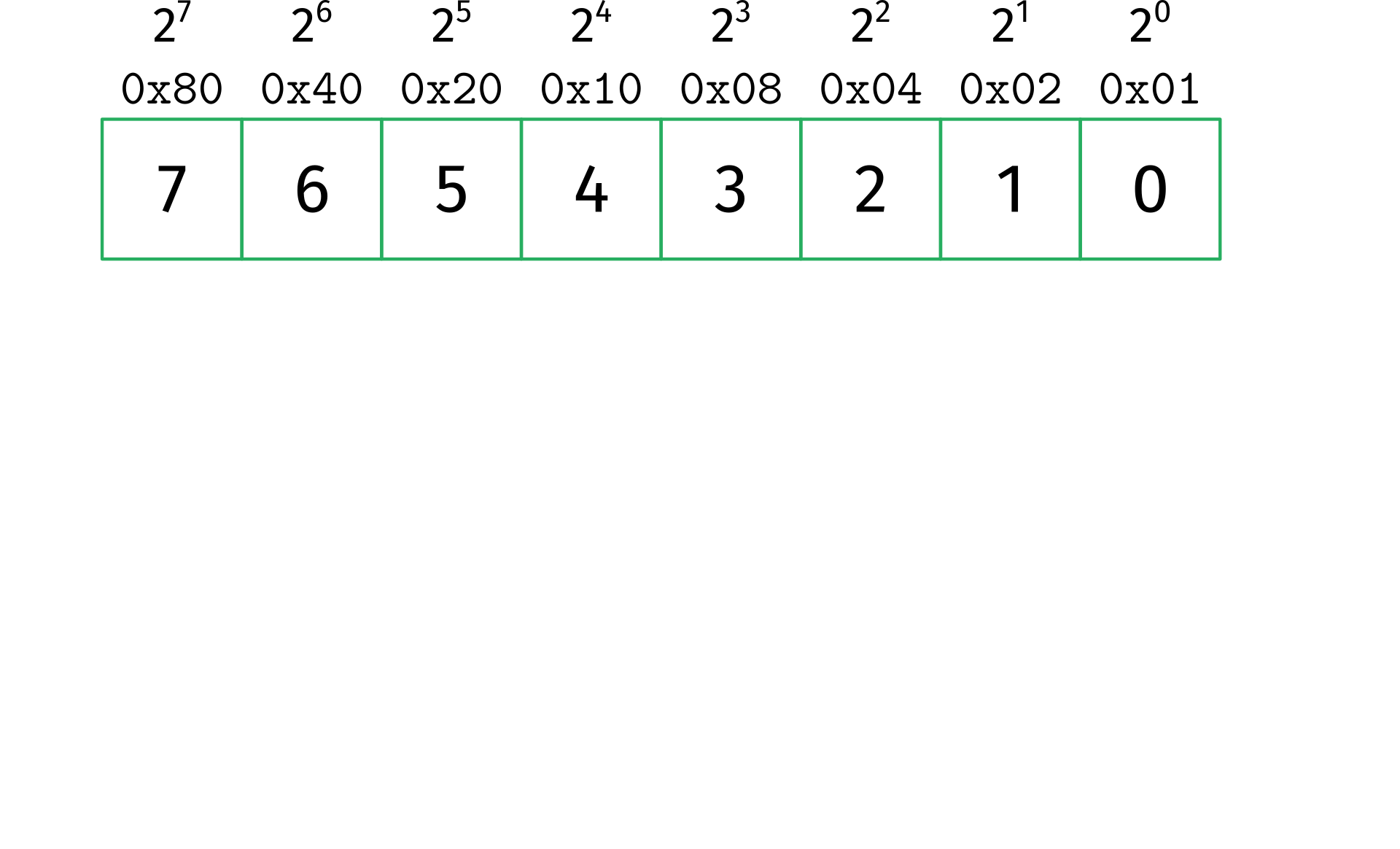
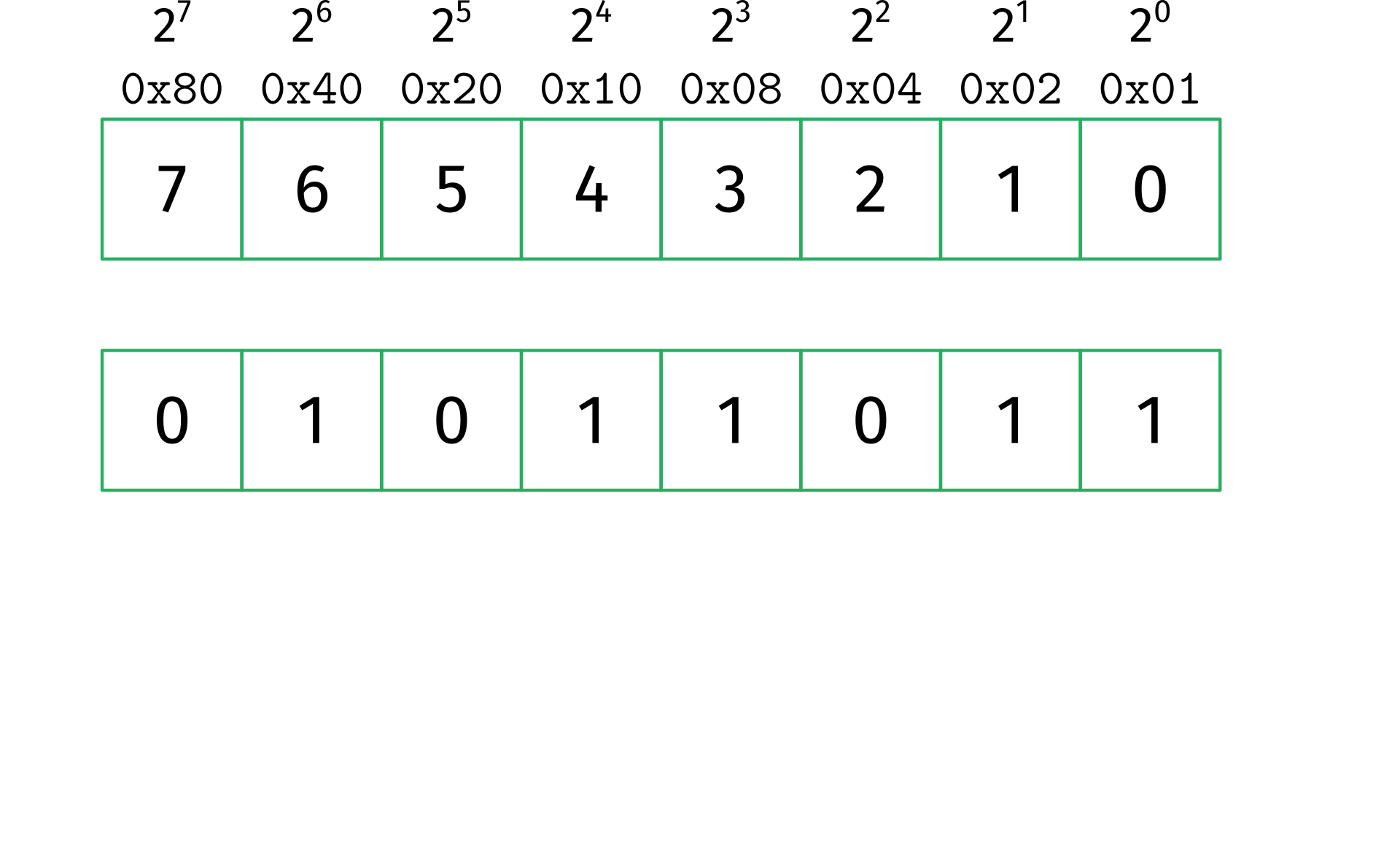
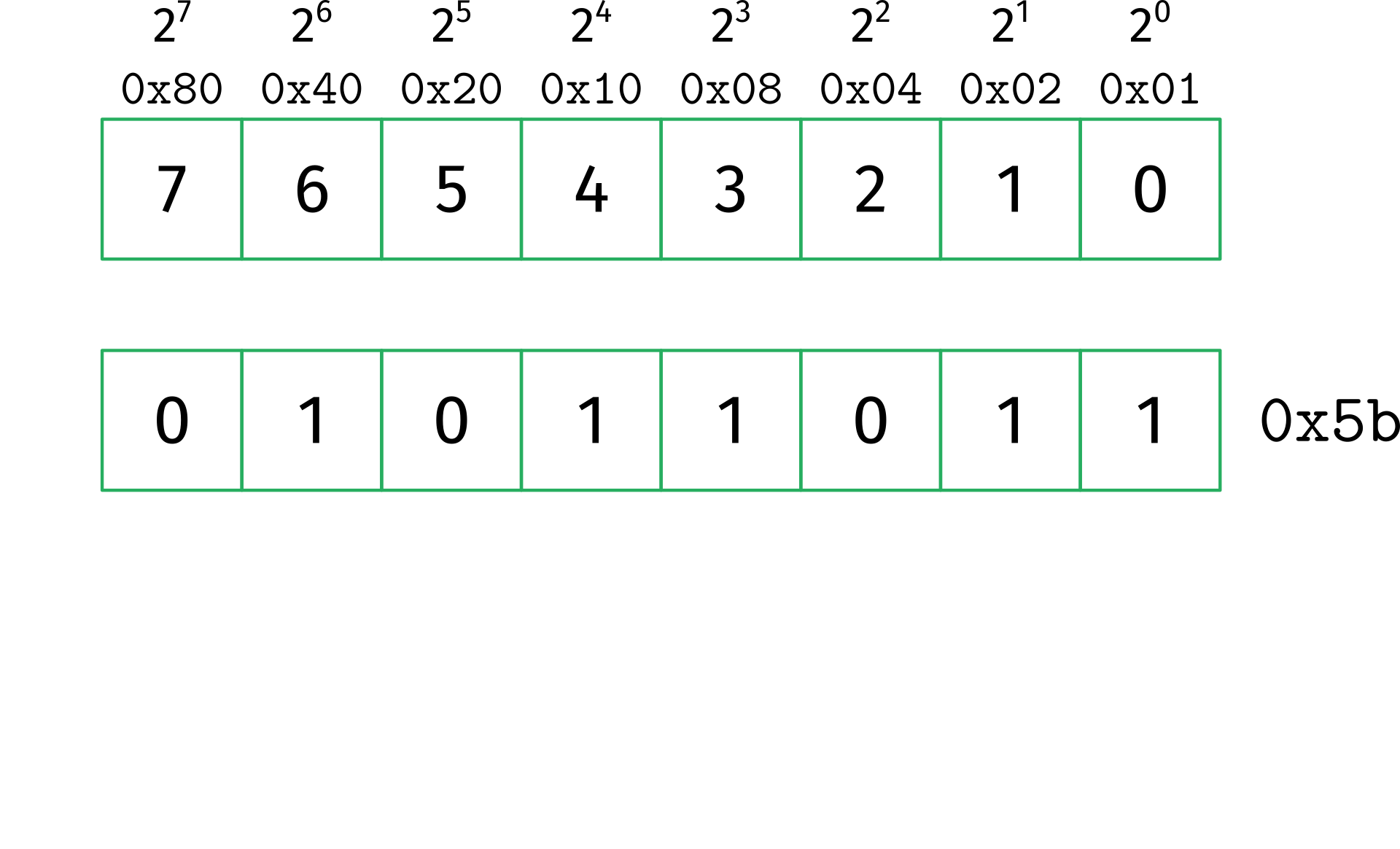
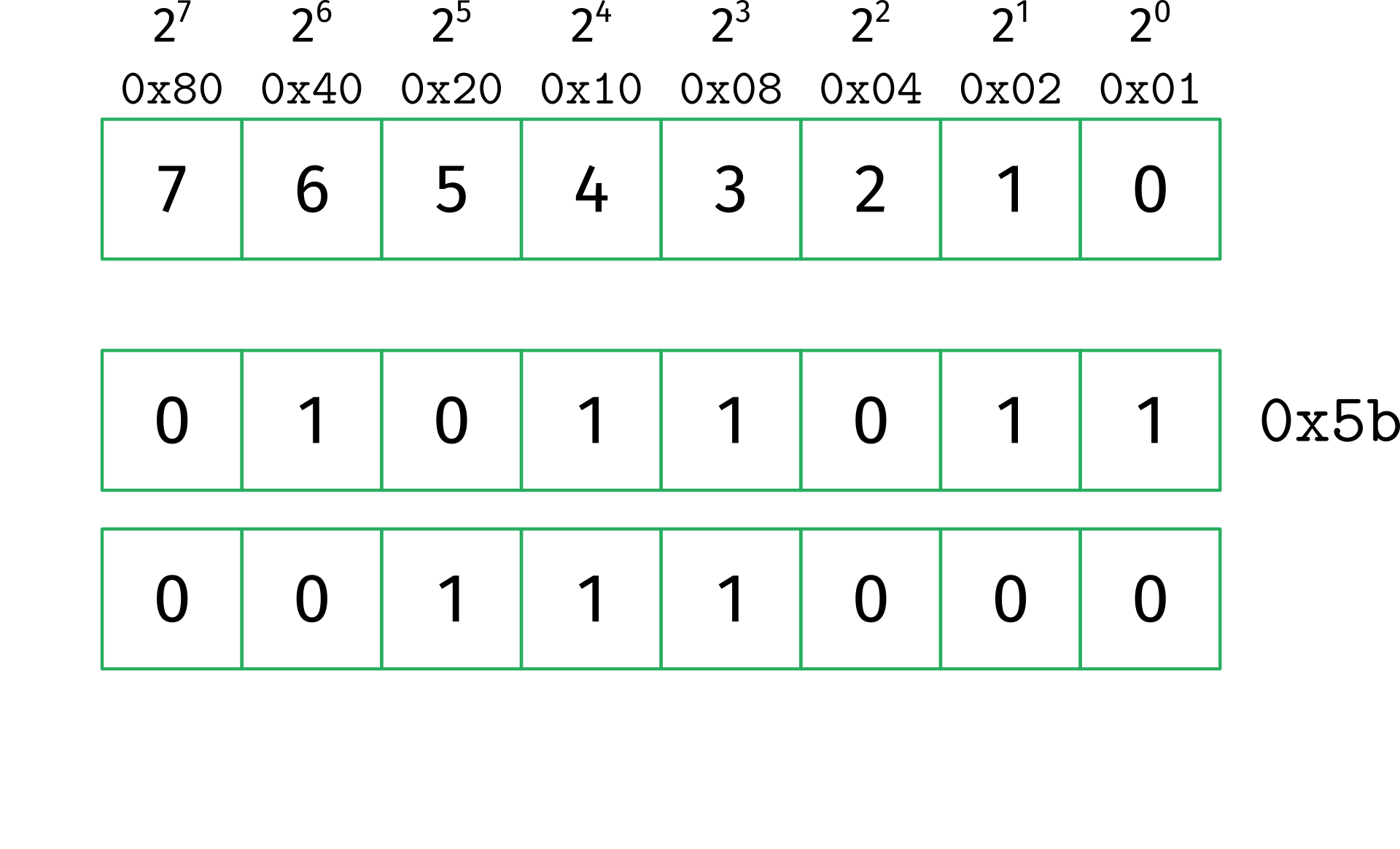
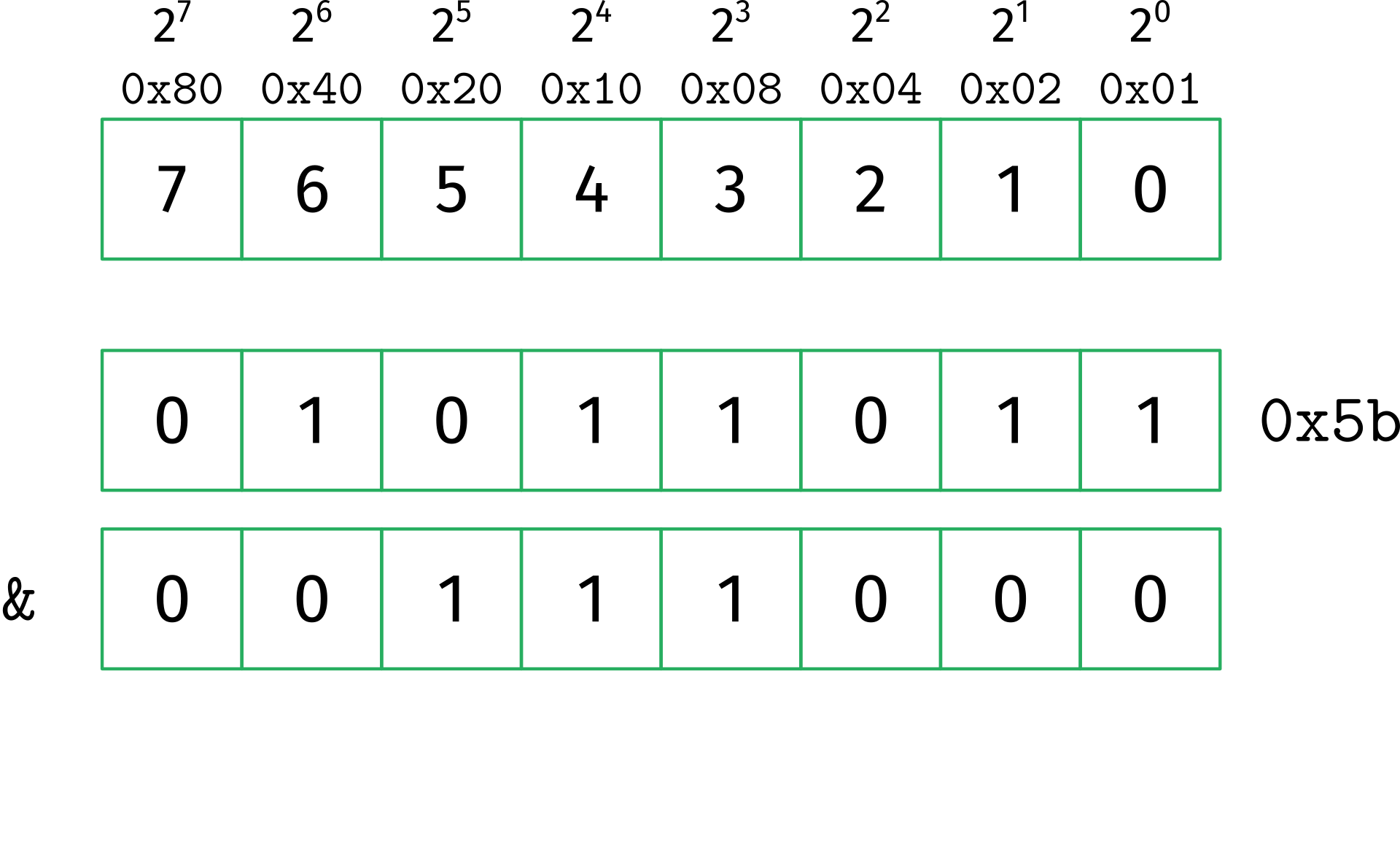
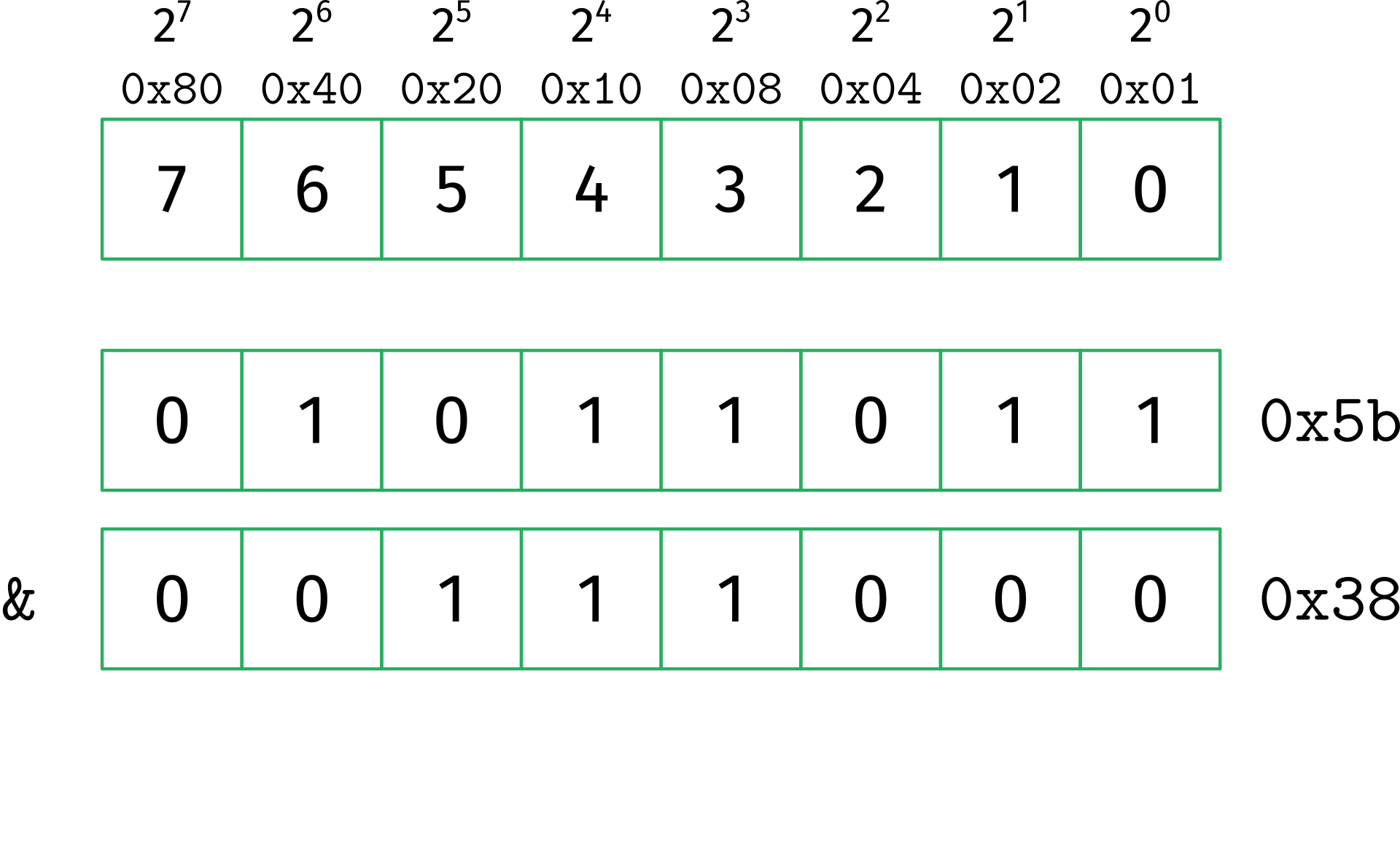
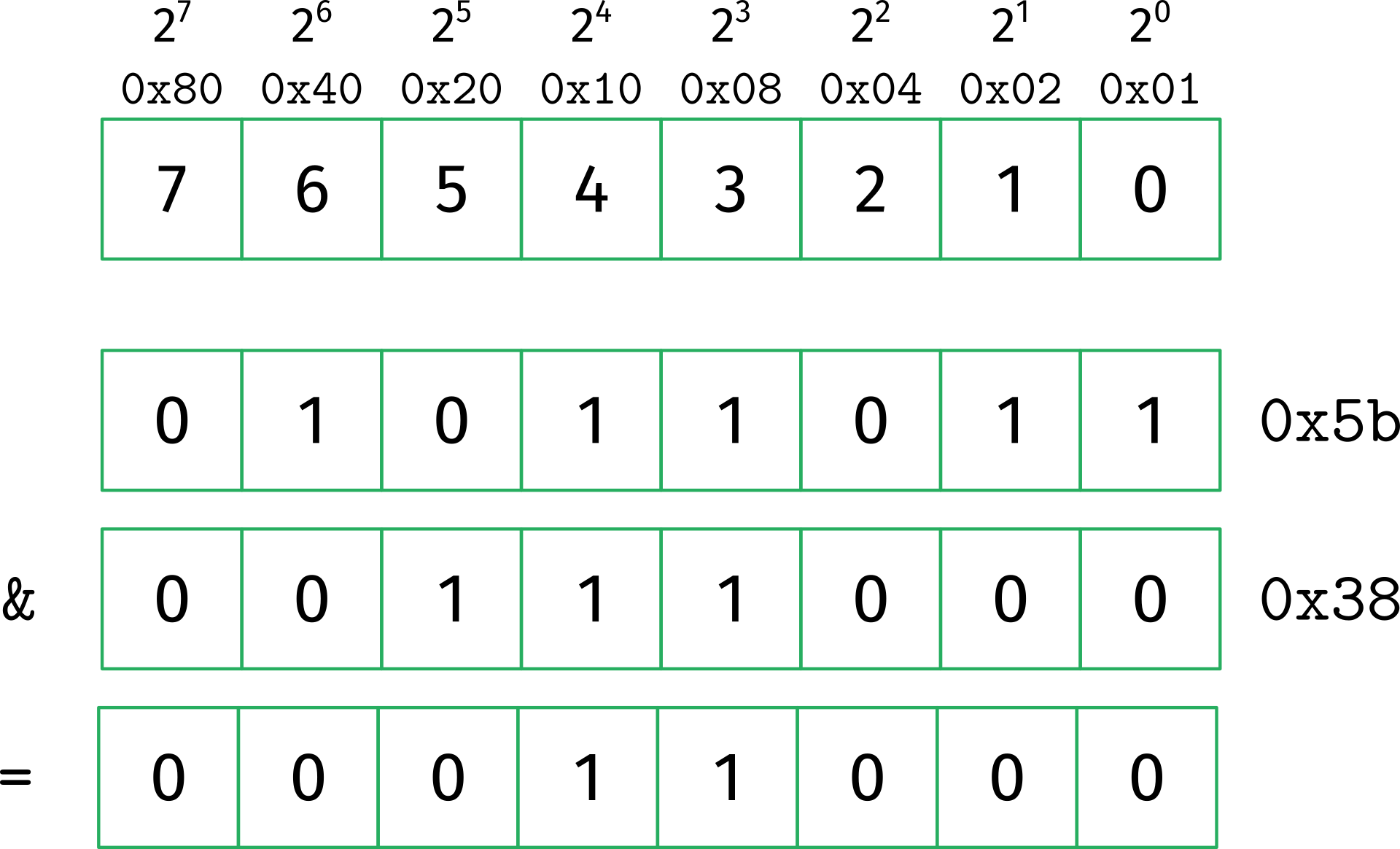
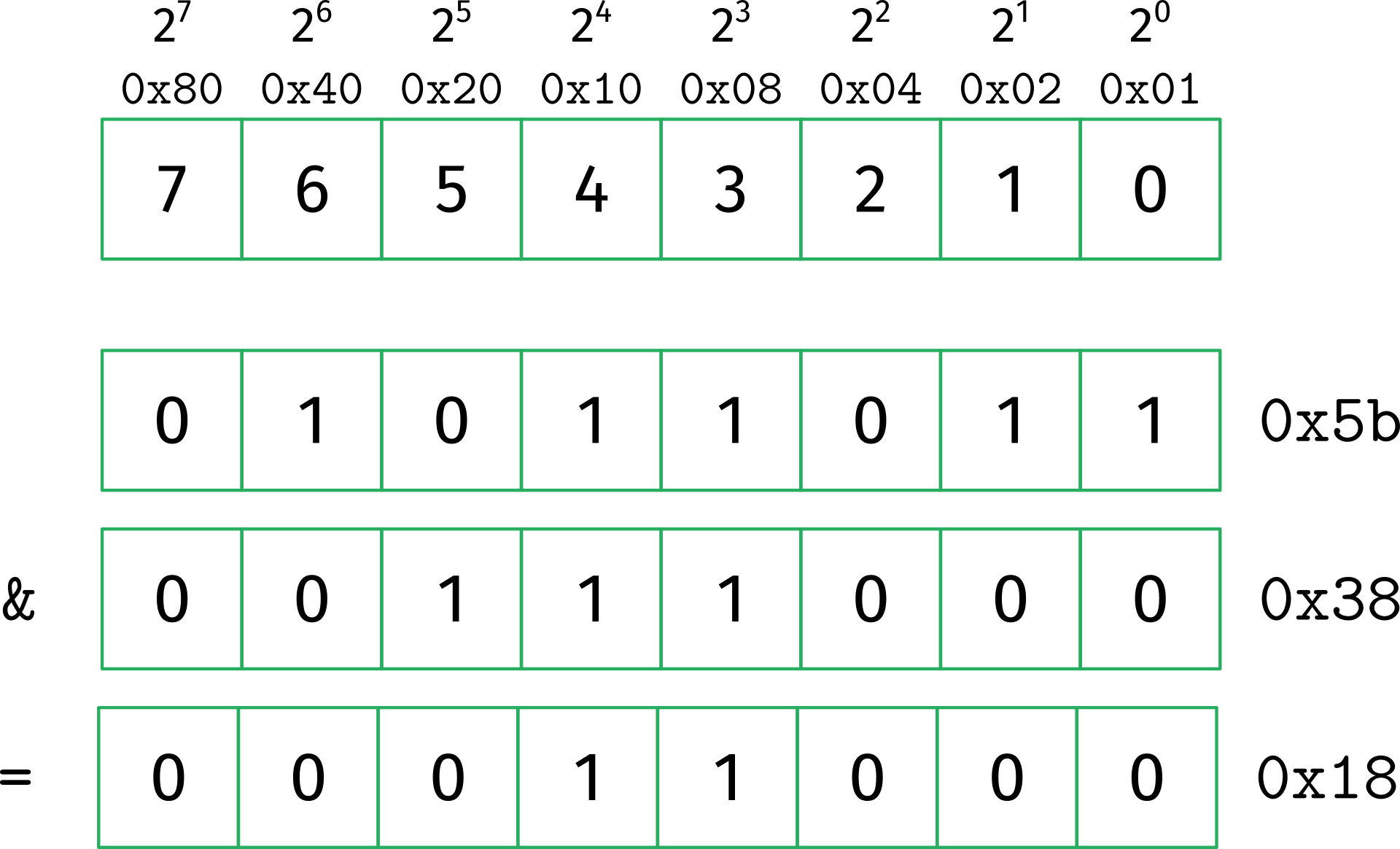
- Bitwise AND (&): Mask bits. Everything gets set to zero but the mask.
- Bitwise OR (|): Merge bits. The result has bits set where any of the operands had bits set.
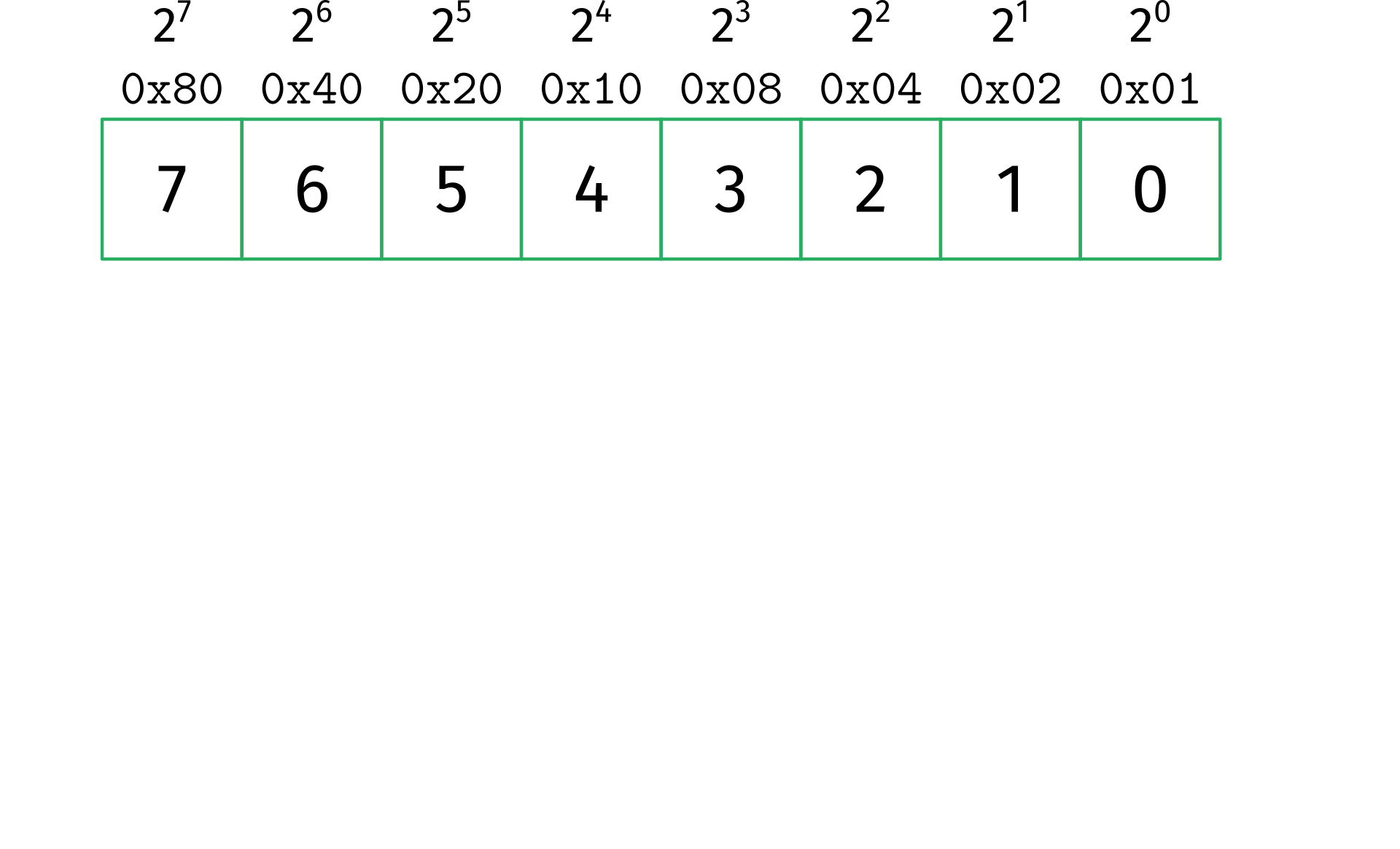
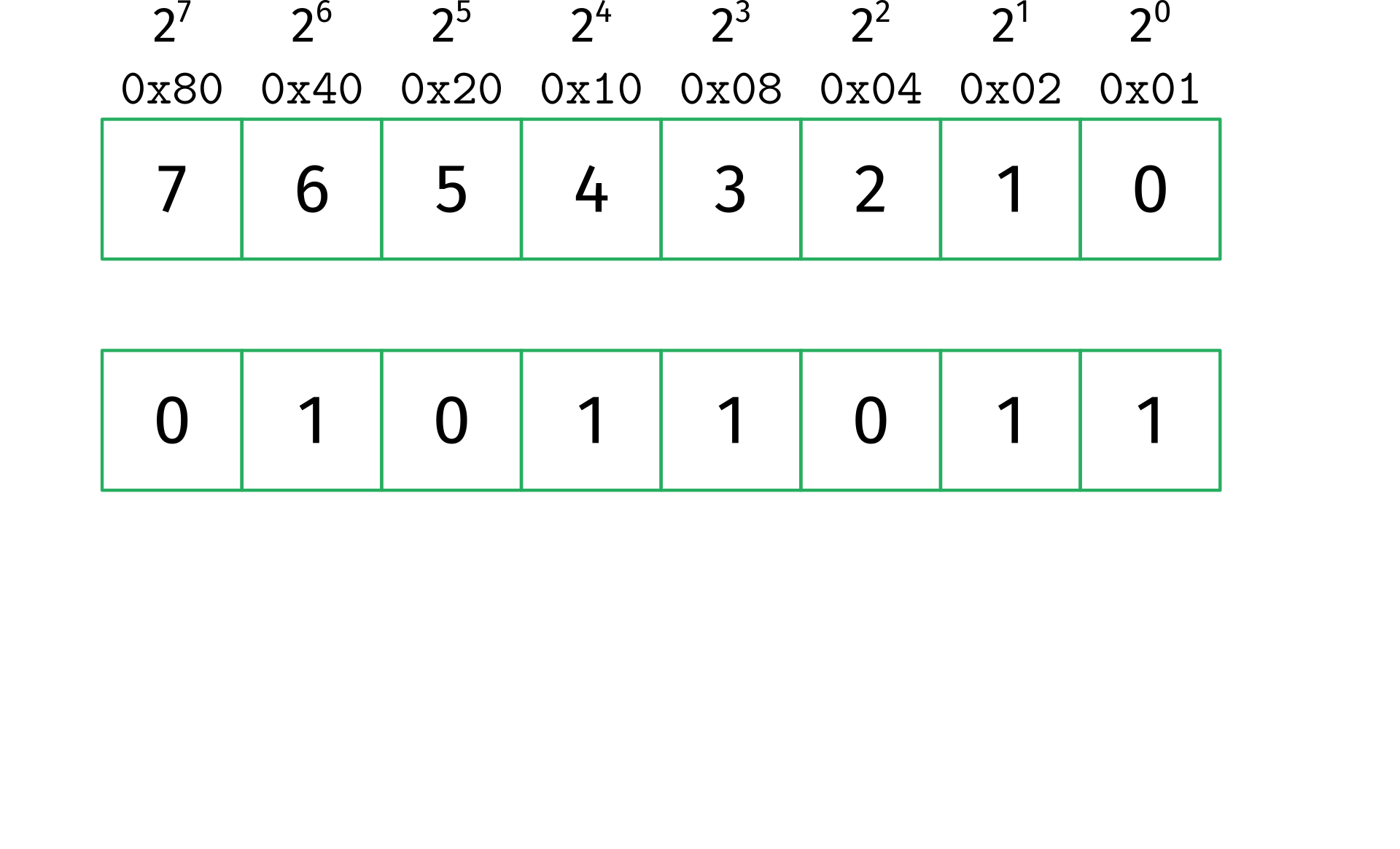
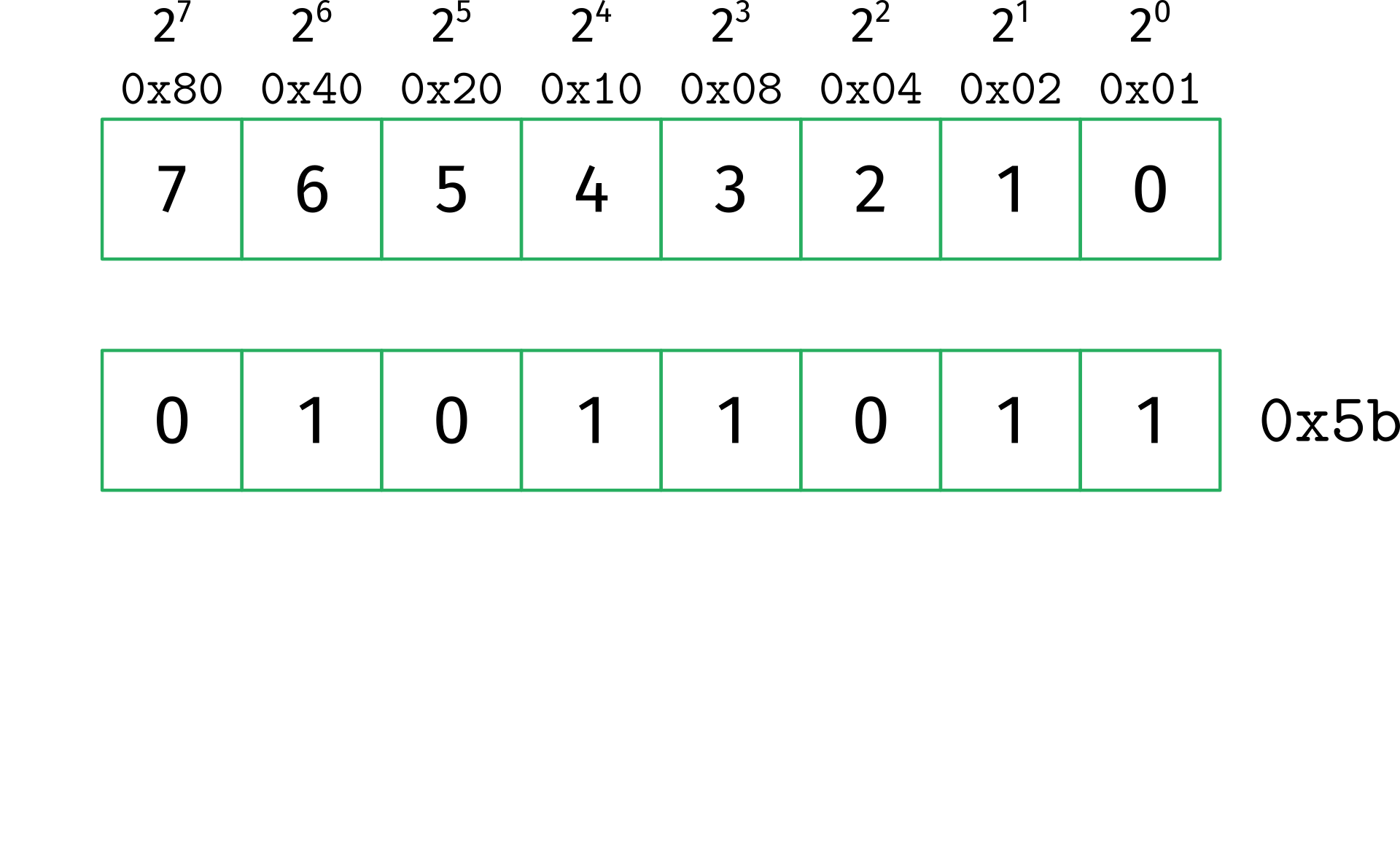
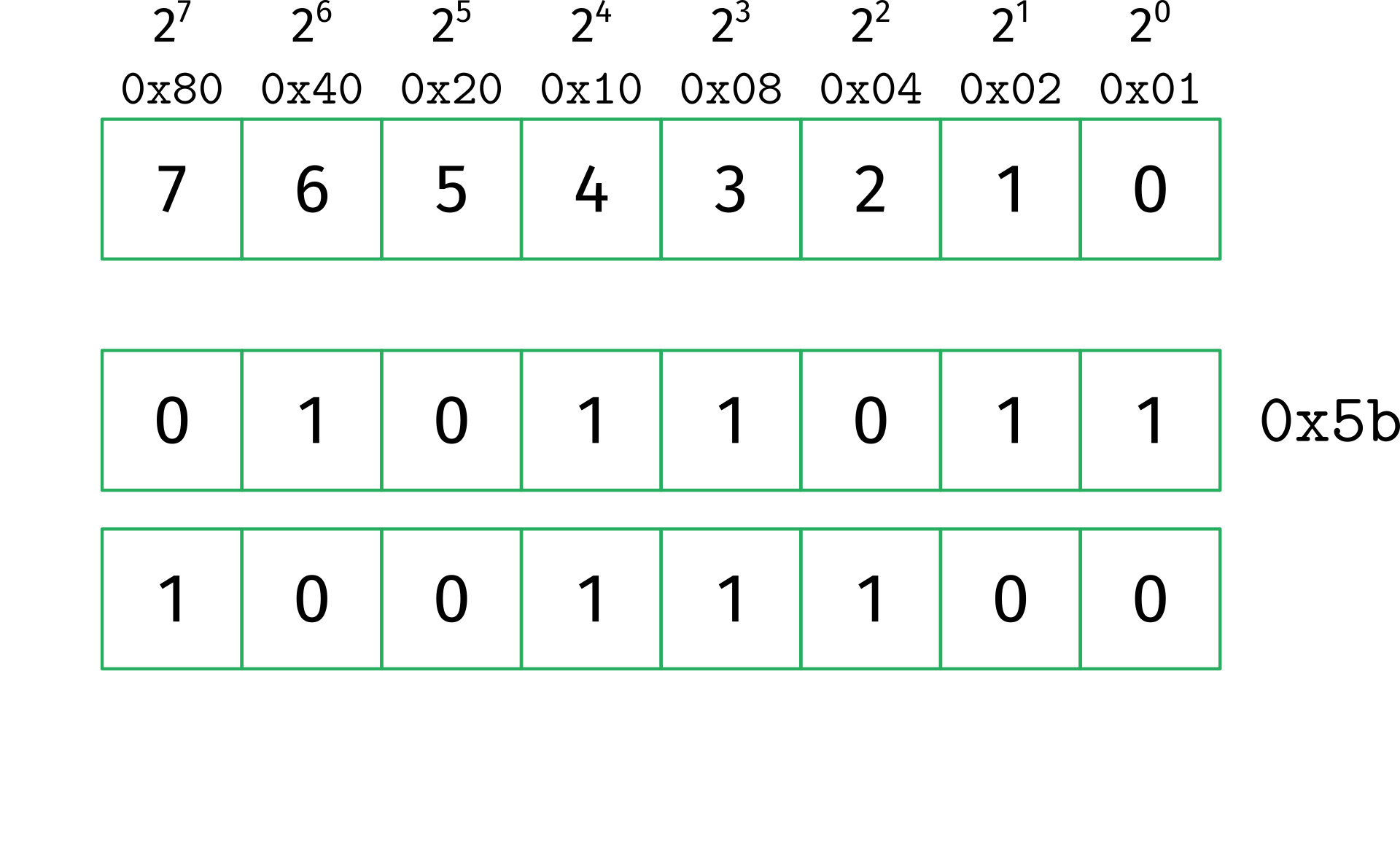
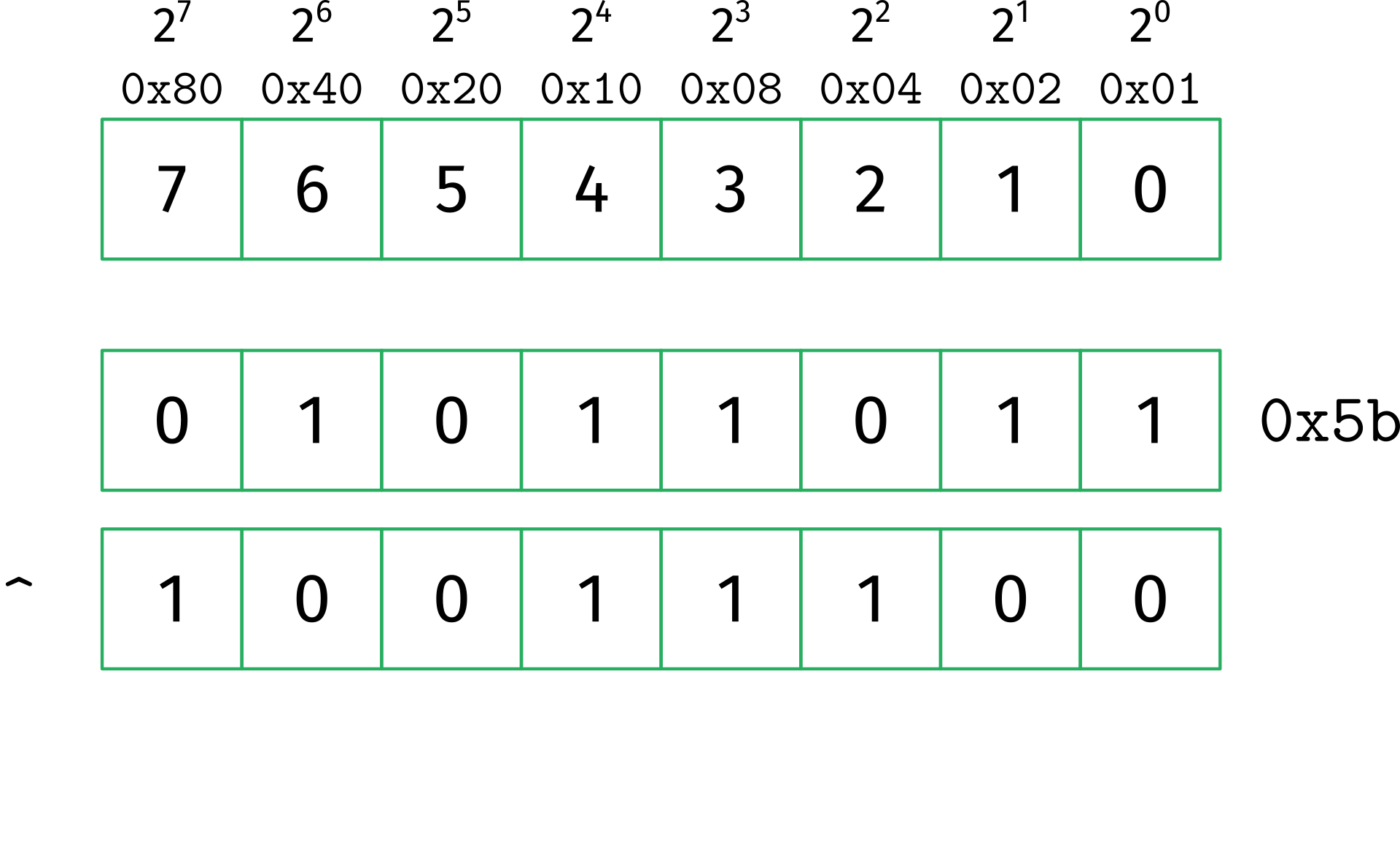
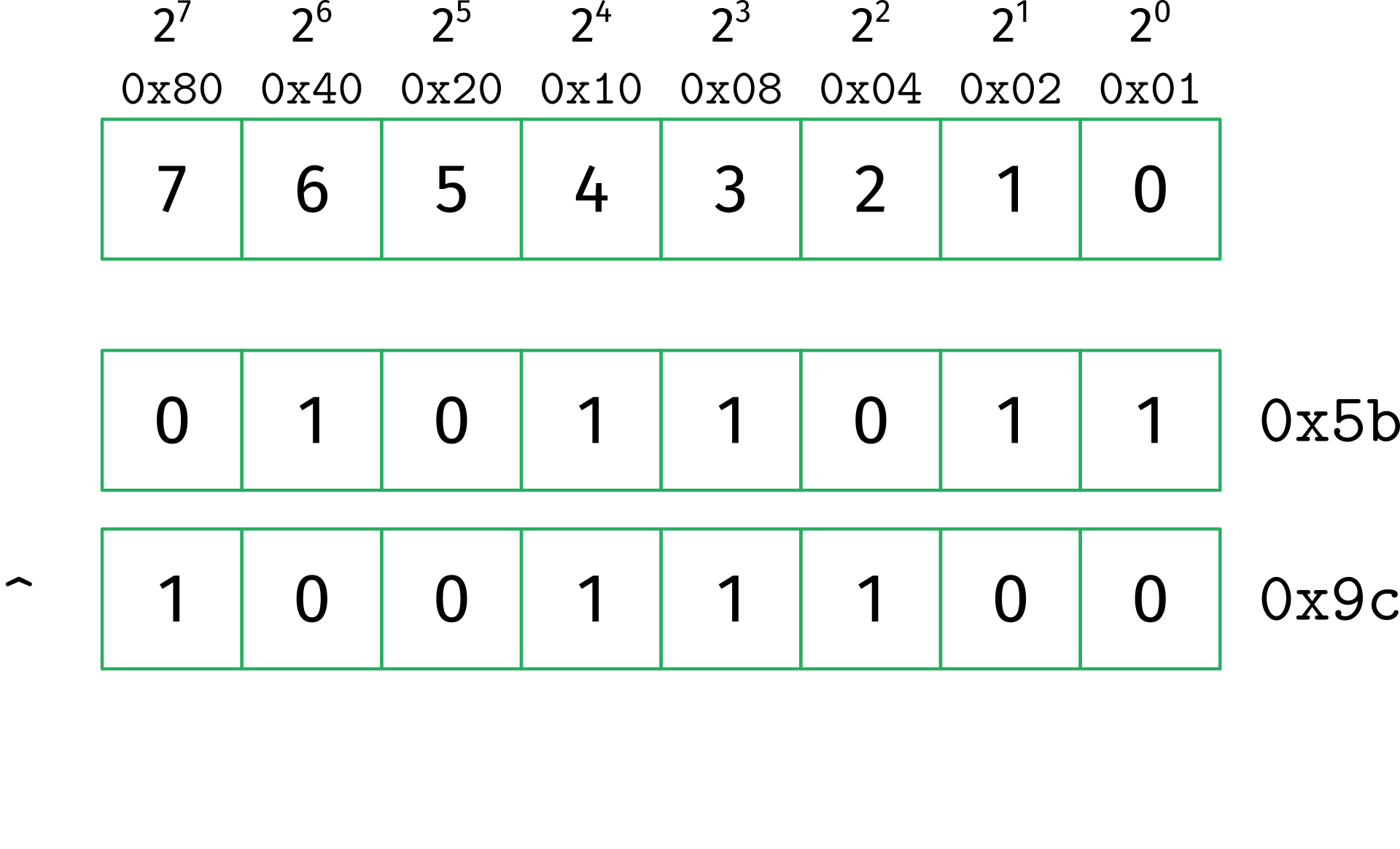
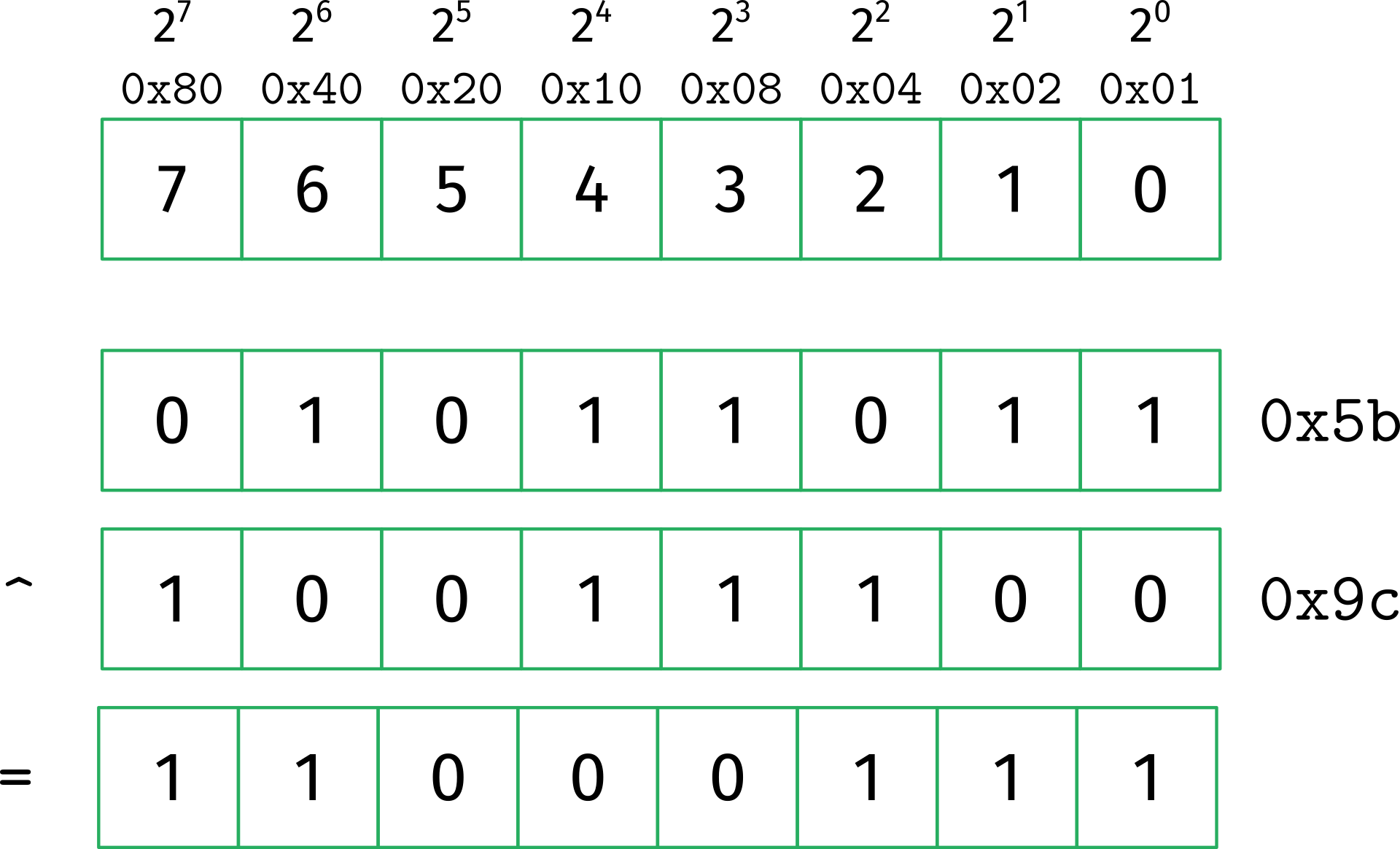
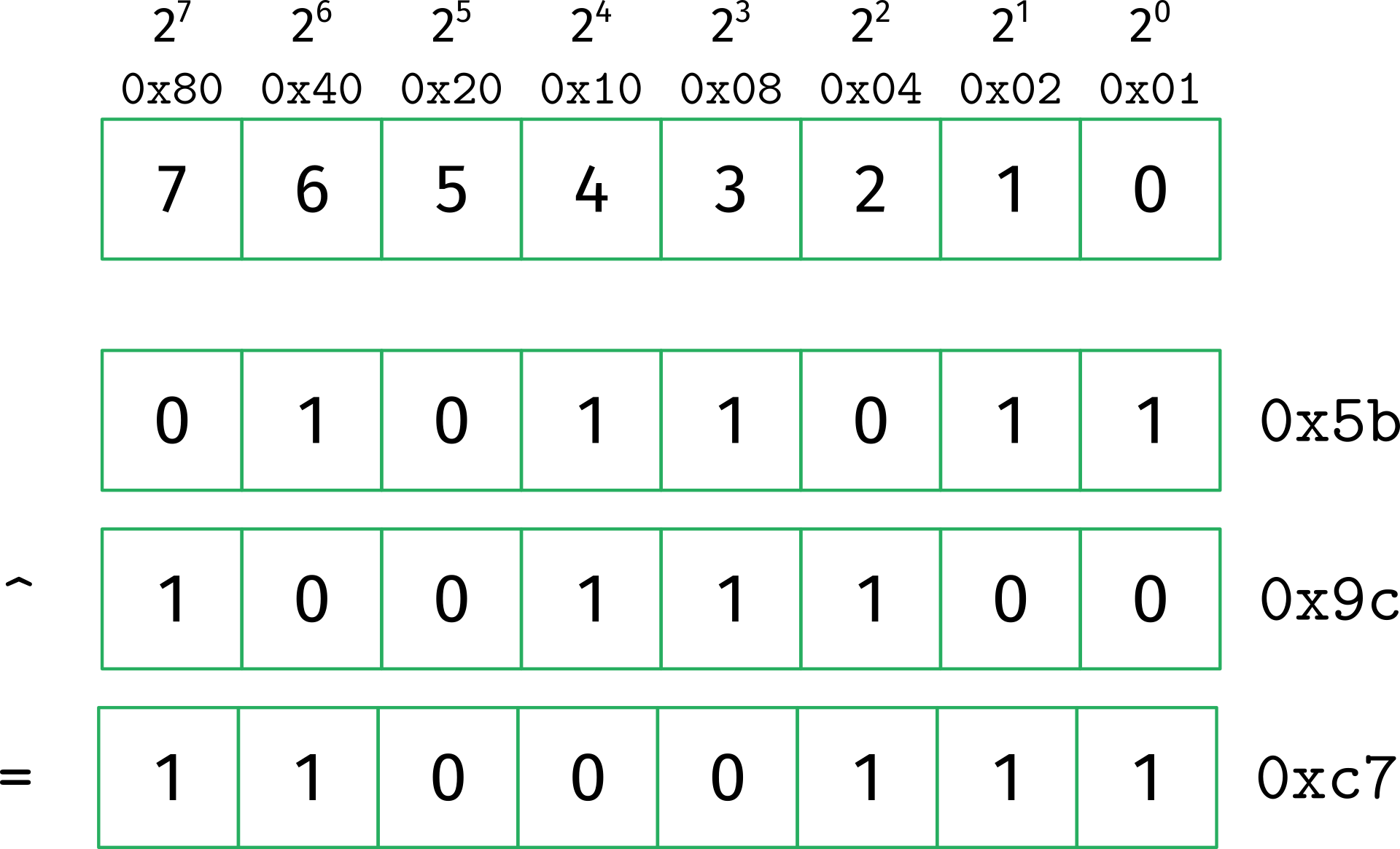
- Bitwise XOR (^): Toggle bits. The result flips bits exactly where the mask was set.
- Bitwise shift (<< and >>): Shift bits in their position left or right.
Bit operations
49 / 69
Bit masking
Bit operations
50 / 69
Bit masking
Bit operations
50 / 69
Bit masking
Bit operations
50 / 69
Bit masking
Bit operations
50 / 69
Bit masking
Bit operations
50 / 69
Bit masking
Bit operations
50 / 69
Bit masking
Bit operations
50 / 69
Bit masking
Bit operations
50 / 69
Bit toggling
Bit operations
51 / 69
Bit toggling
Bit operations
51 / 69
Bit toggling
Bit operations
51 / 69
Bit toggling
Bit operations
51 / 69
Bit toggling
Bit operations
51 / 69
Bit toggling
Bit operations
51 / 69
Bit toggling
Bit operations
51 / 69
Bit toggling
Bit operations
51 / 69
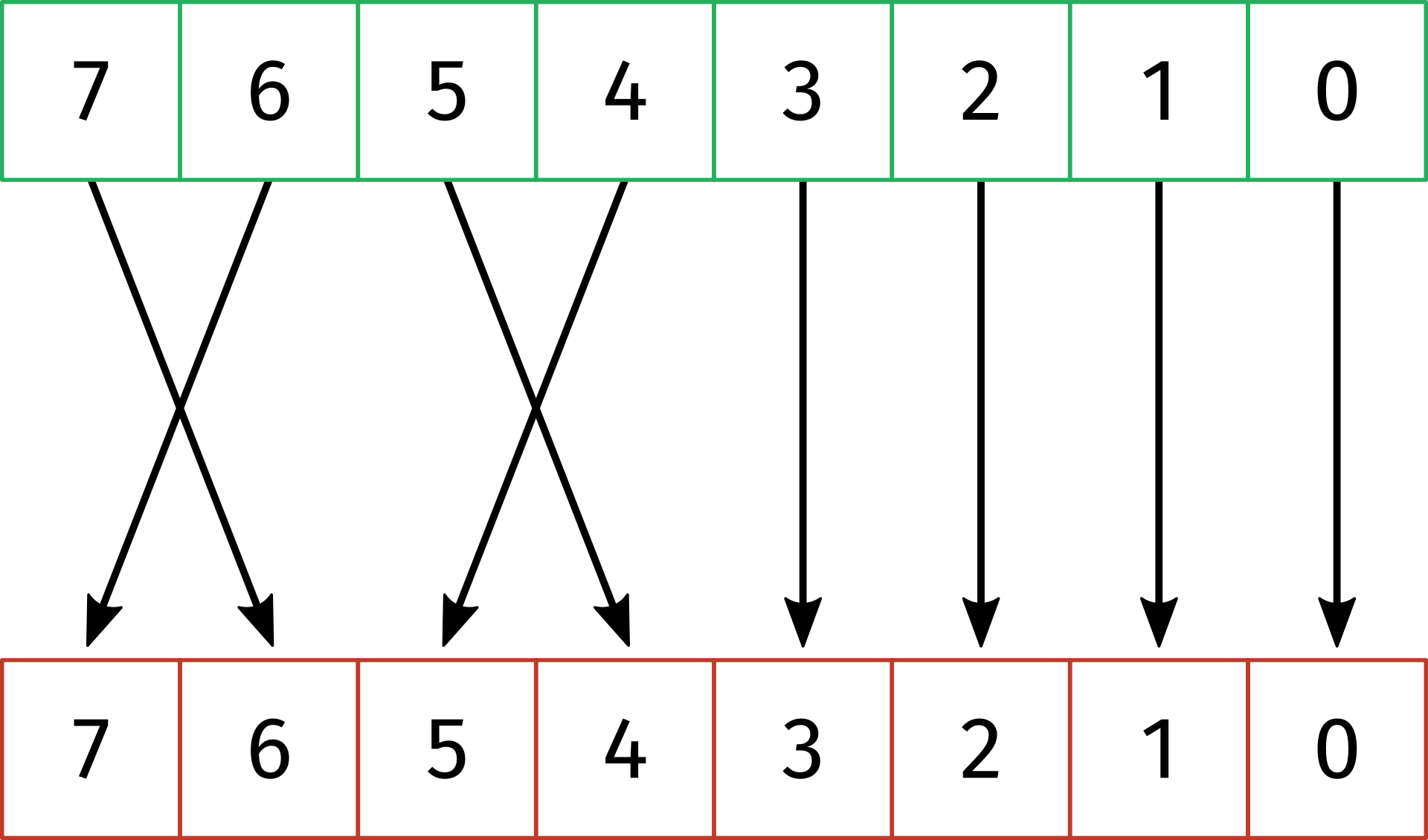
From P-box to code
- Let's say we have a given permutation that you should put into code
- You can always find the canonical form by doing one bit at a time, but this is extremely inefficient (not just for the computer, but for you)
- The trick is to combine all shifting operations that are identical and mask only once
Bit operations
52 / 69
From P-box to code
Bit operations
53 / 69
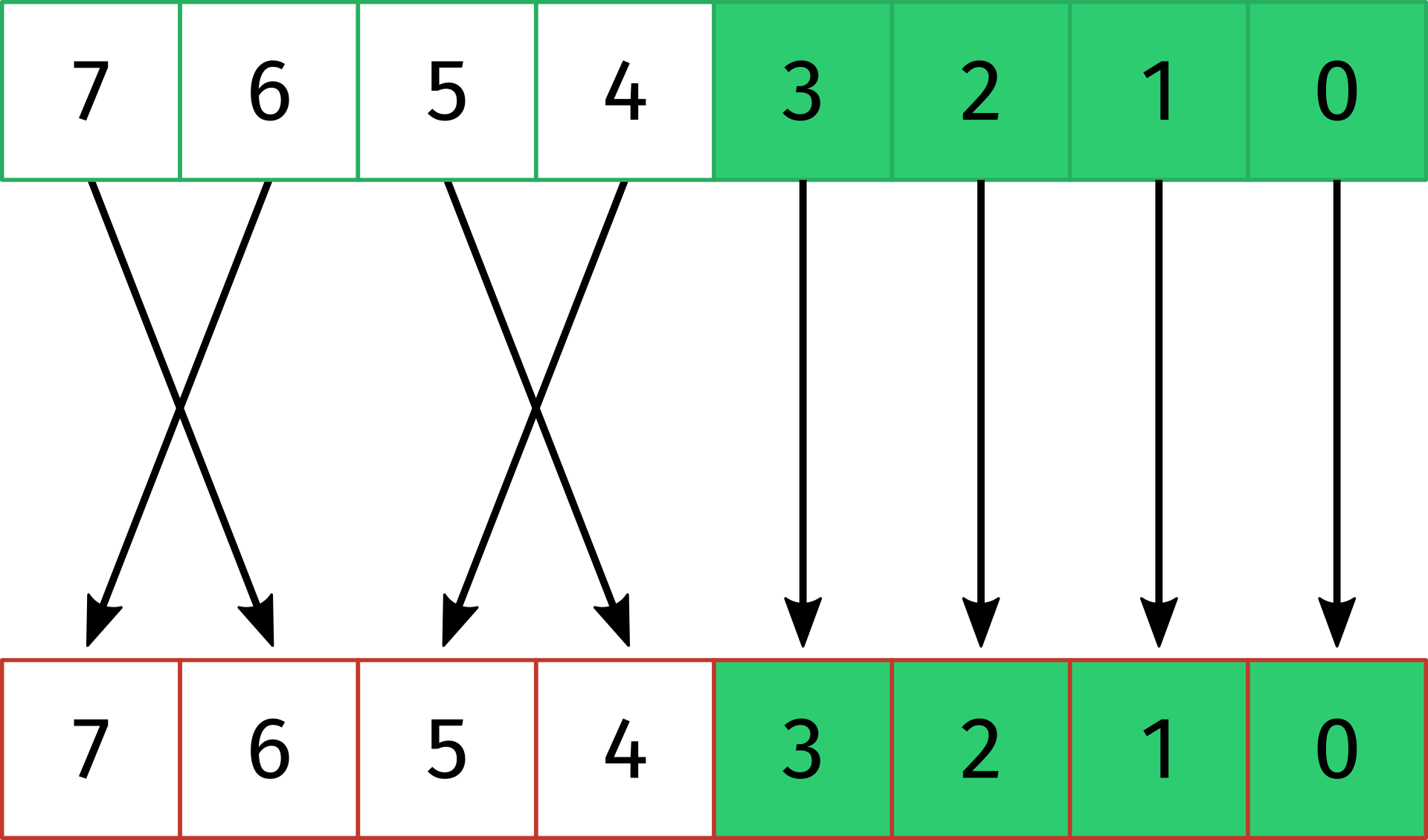
From P-box to code
- First, take a look at all the bits that are not shifted at all
- Those we only need to mask, and we're done!
Bit operations
54 / 69
From P-box to code
Bit operations
55 / 69
From P-box to code
outval = (inval & 0x0f)
Bit operations
56 / 69
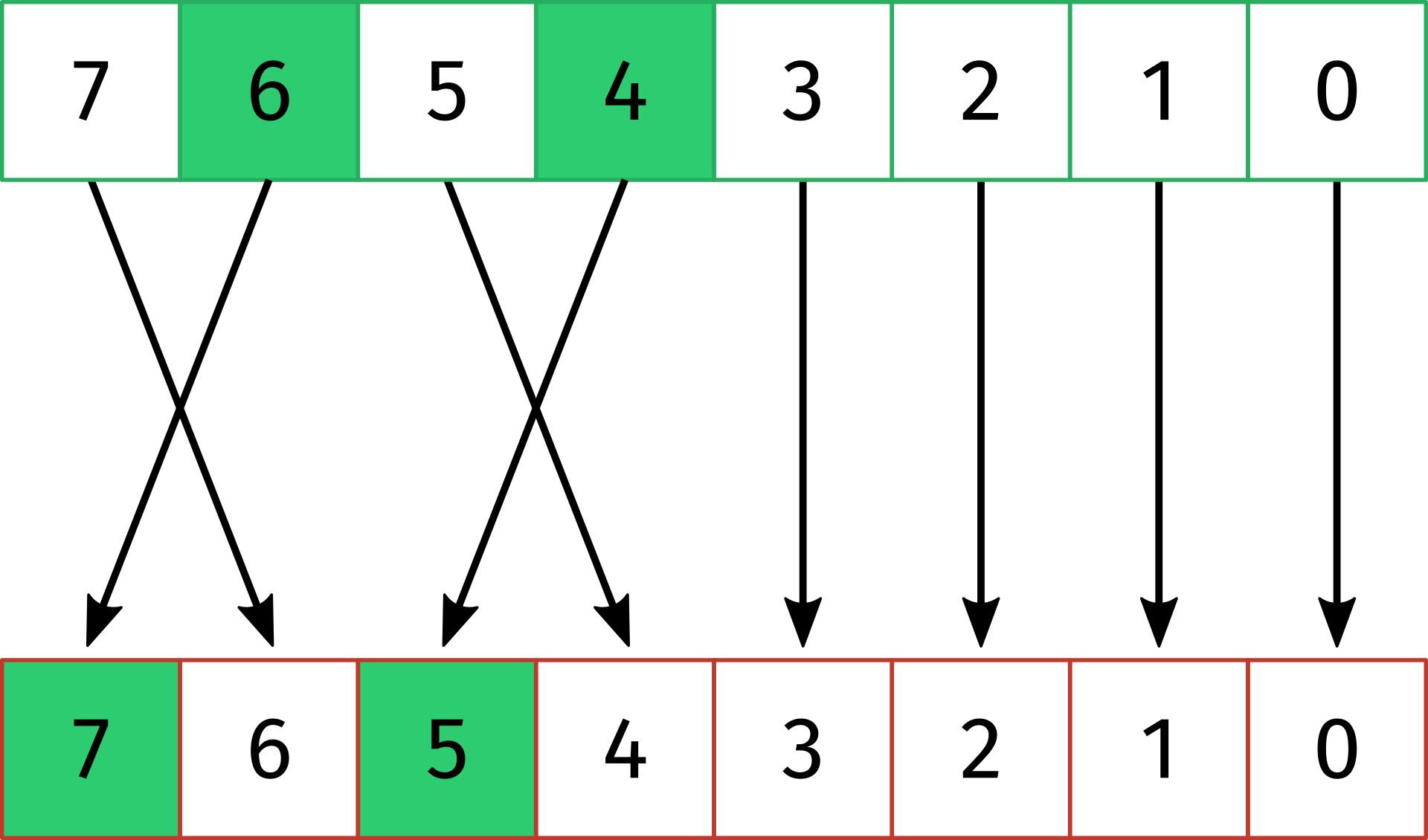
From P-box to code
- Then, look at all those bits that are shifted left by one bit
- We need to first mask those together, then shift them.
- Then we do a bitwise OR with the result of the previous exercise
Bit operations
57 / 69
From P-box to code
Bit operations
58 / 69
From P-box to code
outval = (inval & 0x0f)
         | ((inval & 0x50) << 1)
Bit operations
59 / 69
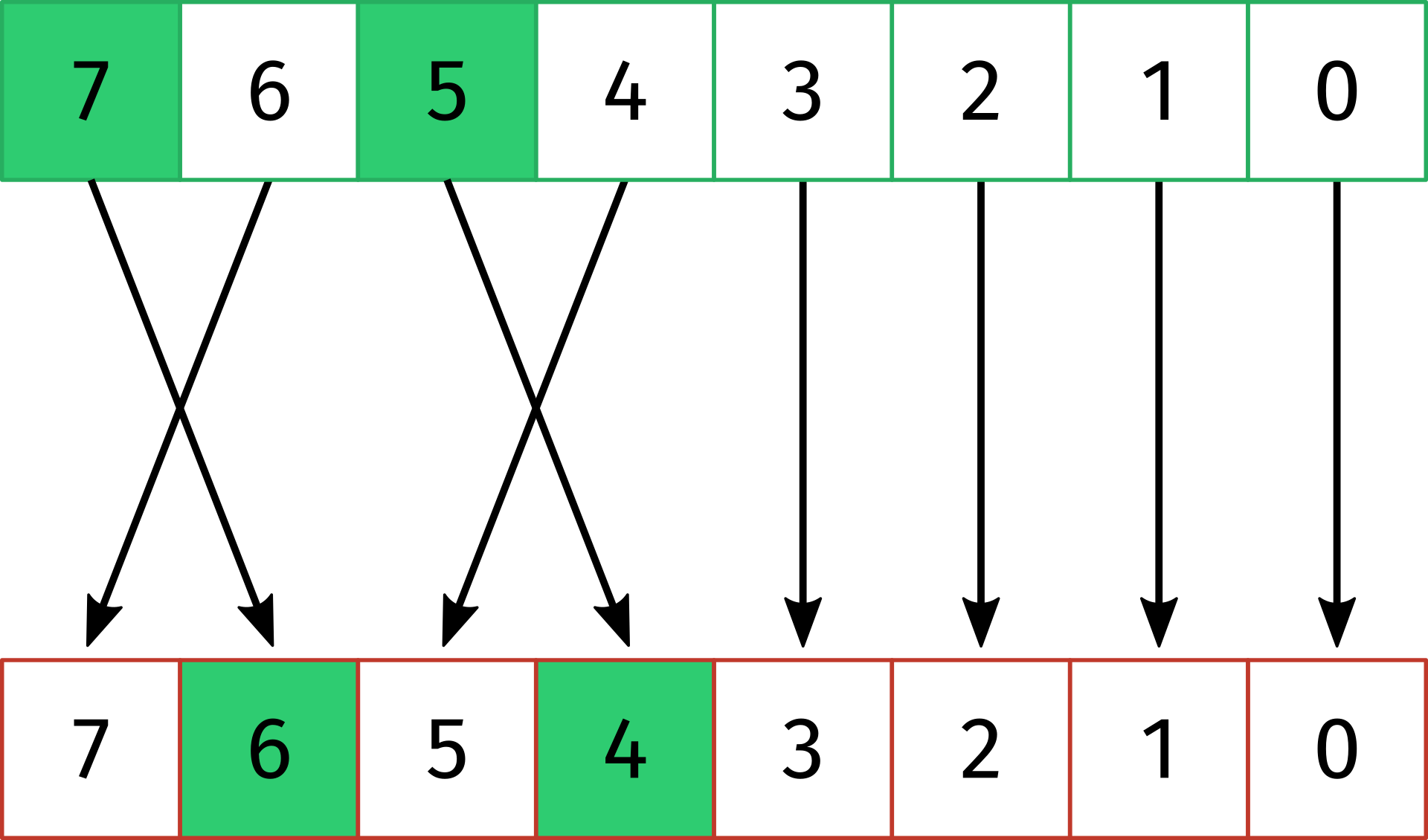
From P-box to code
- Finally, there are two bits which need to be shifted right by one bit.
- Again we need to mask those bits, then shift them right.
- And again we do a bitwise OR with the result of the previous exercise
Bit operations
60 / 69
From P-box to code
Bit operations
61 / 69
From P-box to code
outval = (inval & 0x0f)
         | ((inval & 0x50) << 1)
         | ((inval & 0xa0) >> 1)
Bit operations
62 / 69
Trick: Set a particular bit
- How do you set a bit at bitoffset 18 programmatically?
- I.e., you can obviously write the constant 262144 or 0x40000 but it becomes difficult to read.
- Is there a better way?
Bit operations
63 / 69
Trick: Set a particular bit
- How do you set a bit at bitoffset 18 programmatically?
- I.e., you can obviously write the constant 262144 or 0x40000 but it becomes difficult to read.
- Is there a better way?
- There is:
1 << 18
Bit operations
63 / 69
Trick: Set a whole mask
- What if you want to create a bitmask that is exactly 18 bits wide? I.e., all lower 18 bits should be set, all others not.
Bit operations
64 / 69
Trick: Set a whole mask
- What if you want to create a bitmask that is exactly 18 bits wide? I.e., all lower 18 bits should be set, all others not.
- Very similar to the previous trick:
(1 << 18) - 1
Bit operations
64 / 69
Conclusion
65
Takeaway
- You should understand and be comfortable with efficient implementation of field arithmetic in the AESAdvanced Encryption Standard field
- Bit masking, combining and toggling operations should be known to you, and you should be able to put code into graph and vice versa
Conclusion
66 / 69
Thank you!
Any questions?
Acronyms
Acronyms
68 / 69
Acronyms
Acronyms
68 / 69