Main presentation file:
×

T4INF1202: Kryptologie
Part 7: LFSR stream ciphers and their cryptanalysis
2026-05-13
Table of Contents
2 / 48
Table of Contents
2 / 48
Recap
- In the last lecture, we talked about AESAdvanced Encryption Standard and implementation of block cipher primitives
- This week we switch back to stream ciphers, with the focus on LFSRLinear-feedback shift register-based algorithms
- We are going to look at security implementation of this class of ciphers
Introduction
3 / 48
Basic security assurance
- As we've discussed numerous times, the two critical pillars ciphers rely on are confusion and diffusion
- One implication of having good diffusion is a resulting avalanche property of the cipher
- Essentially, the output looks like random data, regardless of the input – it is indistinguishable from random
Introduction
4 / 48
Security compromise
- Security is always a compromise between performance and assurance
- Good slow ciphers are easy. Bad fast ciphers are easy. Good fast ciphers are difficult.
- Coming from the performance side of things, it is understandable that implementations that are particularly efficient in hardware end up being used for cryptographic purposes.
Introduction
5 / 48
Galois fields and polynomials
- Think about the implementation we have developed last week which does polynomial reduction after multiplication with Q4mta4Ck5NLHxZf1qH71g5gJY
- This was a particularly efficient algorithm, since it depended only on a shift and (possibly) one XOR operation
- Exceptionally cheap in hardware, single-cycle operation
Introduction
6 / 48
Galois fields and polynomials
- If the division polynomial is irreducible, we are guaranteed to get maximum periodicity when repeatedly applying this operation
- In other words, we are walking through all field elements in a deterministic fashion
- True for any initialization state that is different from zero
LFSRs
7 / 48
Hardware implementation
- So how would an implementation look in hardware?
- In other words, what are the macroblocks and/or gates required to implement this?
- Recall that we need storage of Q4mta4Ck5NLHmZf1qH71g5gJY bits and conditional XOR
LFSRs
8 / 48
Hardware implementation
- A shift register is a string of D-flipflops, each capable of storing one bit (SRAMStatic RAM)
- They are cascaded in a way that the output of one is the input of the next
- All clocks are connected in parallel
LFSRs
9 / 48
LFSRs in hardware
- An LFSRLinear-feedback shift register has a feedback loop: the start and end of the shift register are connected
- This feedback bit (also known as output bit) is a linear combination of the inputs
- Linear combination is the XOR operation and, therefore, cheap in hardware
LFSRs
10 / 48
LFSRs in hardware
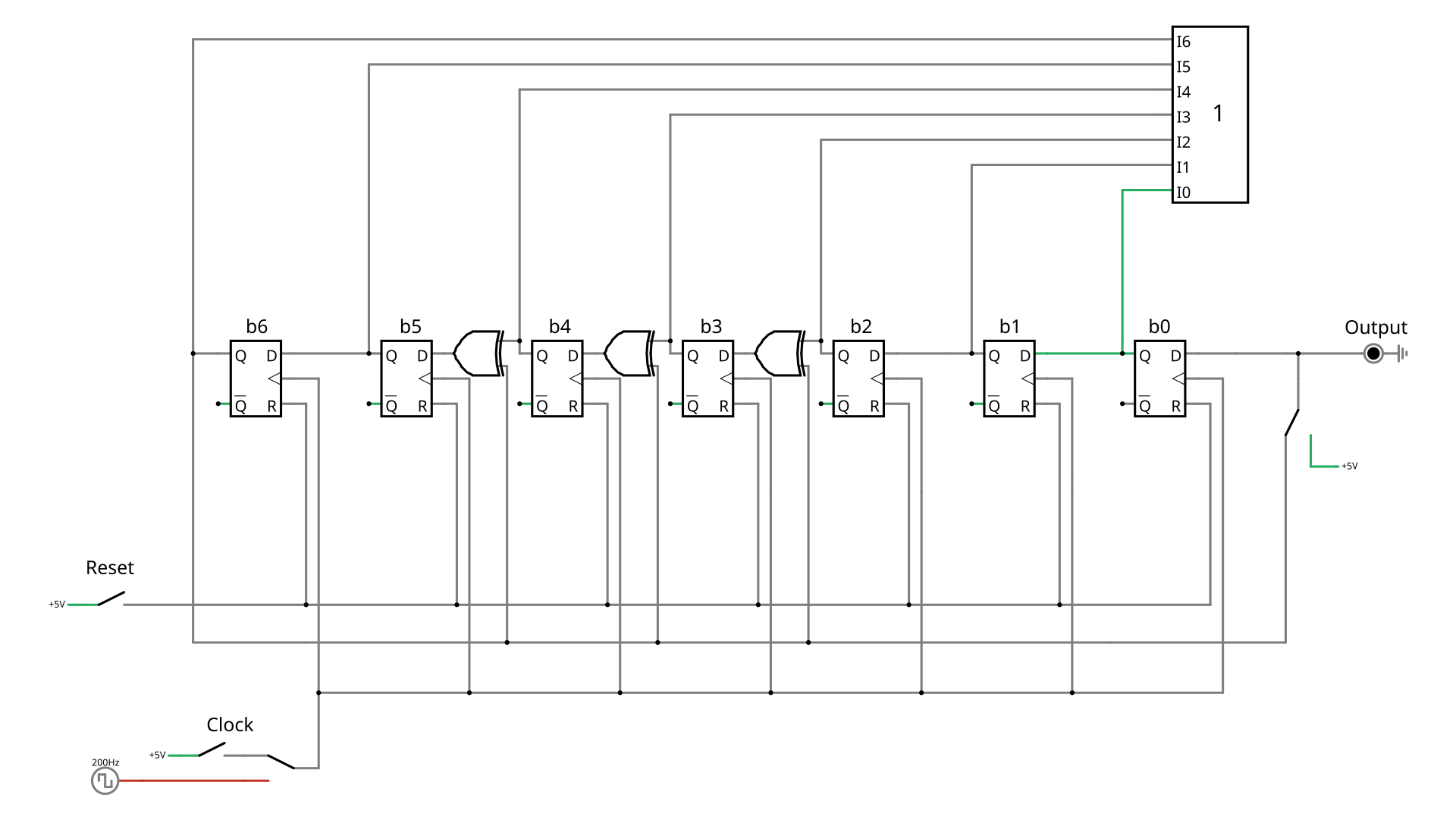
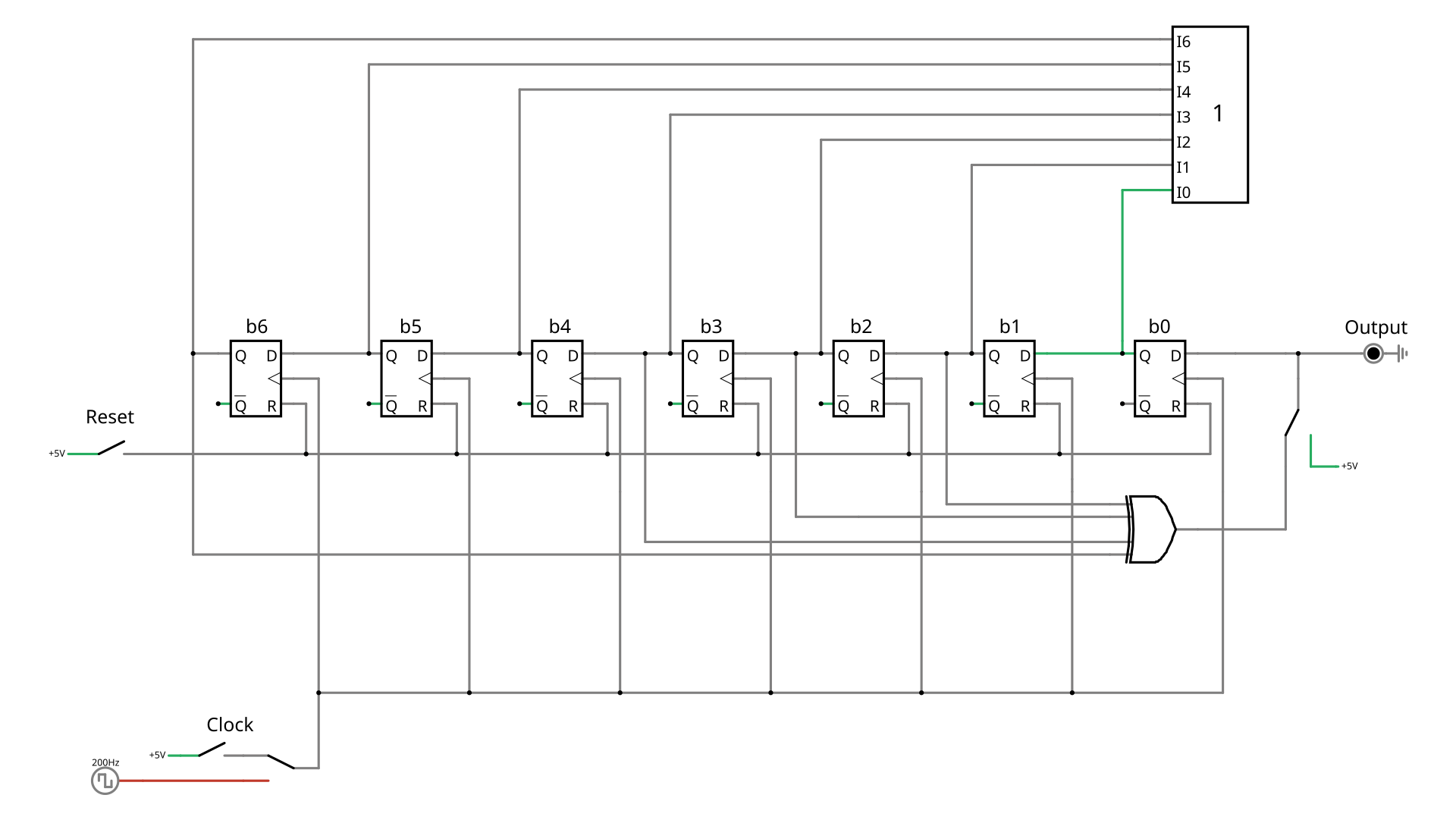
- Using a simulator you can easily visualize what is happening in hardware
- You can also write some Python code to do the same thing in software
- In my example, both generate the continued multiplication with Q4mta4Ck5NLHxZf1qH71g5gJY and residual after division by Q4mta4Ck5NLHx^7 + x^5 + x^4 + x^3 + 1Zf1qH71g5gJY
LFSRs
11 / 48
LFSR in software
# x^7 + x^5 + x^4 + x^3 + 1
exponents = [ 7, 5, 4, 3, 0 ]
poly = sum(2 ** exponent for exponent in exponents)
highbit = max(exponents) - 1

state = 1
for i in range(2 ** (highbit + 1)):
    feedback_bit = (state >> highbit) & 1
    print(f"{state:4d} {state:4x} -> feedback {feedback_bit}")
    state <<= 1
    if feedback_bit:
        state ^= poly
LFSRs
12 / 48
LFSR in hardware (Galois)
LFSRs
13 / 48
LFSRs in hardware
- An LFSRLinear-feedback shift register in this topology is called a Galois representation; its internal state corresponds exactly to the Galois field arithmetic
- Another way of expressing the same LFSRLinear-feedback shift register is called the Fibonacci representation, and it is more prevalent in hardware
- The advantage of a Fibonacci LFSRLinear-feedback shift register is that there is only one feedback/output bit which is a linear combination of the state – no XOR gates between the D-flipflops are needed
LFSRs
14 / 48
LFSR in hardware (Fibonacci)
LFSRs
15 / 48
LFSR in software (Fibonacci)
# x^7 + x^5 + x^4 + x^3 + 1
degree = 7
taps = [ degree - 1 - 5, degree - 1 - 4, degree - 1 - 3, degree - 1 ]
mask = (1 << degree) - 1

state = 0x79
for i in range(2 ** degree):
    nextbit = 0
    for tap in taps:
        nextbit ^= (state >> tap) & 1
    print(f"{state:4d} {state:4x} -> feedback {nextbit}")
    state = ((state << 1) & mask) | nextbit
LFSRs
16 / 48
Differences
- Note that the output sequence of every Galois LFSRLinear-feedback shift register can be expressed as a Fibonacci LFSRLinear-feedback shift register and vice versa
- The internal state, however, differs – only the output sequence is identical
- Also note that the taps are inverted in Fibonacci, while in Galois representation they correspond directly to the exponents
LFSRs
17 / 48
Differences
- In the example above, the sequence produced by the Fibonacci generator with state 0x79 is the same as that of the Galois generator at state 0x01
LFSRs
18 / 48
LFSRs in hardware
- This sort of pseudo-random sequence generator is cheap in hardware – energy-efficient and little silicon area
- It matters in embedded implementations where energy is scare such as passive NFCNear-field communication, this matters greatly
- Less energy means full operation with worse coupling, which equals greater reading distance
LFSRs
19 / 48
State recovery
- What this means is that for a sufficiently long internal state and unknown polynomial and internal state, the output seems fairly random
- However, note that the output bit of such a generator always is a linear function of the state bits of the previous clock cycle
- This becomes especially clear when the LFSRLinear-feedback shift register is arranged in Fibonacci representation
LFSRs
Recovery
20 / 48
State recovery
- In turn, what this means is that from the keystream output of a LFSRLinear-feedback shift register-based DRBGDeterministic Random Bit Generator the feedback polynomial can be computed using linear algebra
- In particular, for an Q4mta4Ck5NLHmZf1qH71g5gJY-bit LFSRLinear-feedback shift register you need only Q4mta4Ck5NLH2mZf1qH71g5gJY bits of keystream
- You then can take Q4mta4Ck5NLHmZf1qH71g5gJY bit of the stream as equation coefficients and the next bit is the output
LFSRs
Recovery
21 / 48
State recovery
- For example, let's say for a 6-bit LFSRLinear-feedback shift register there is a bit sequence output which is Q4mta4Ck5NLH(1, 0, 0, 0, 0, 1, 1)Zf1qH71g5gJY
- The keystream is extracted at Q4mta4Ck5NLHb_0Zf1qH71g5gJY
- What this means is the first six bits of the keystream can be interpreted as state bits; the last bit is the linear combination (next bit to become Q4mta4Ck5NLHb_0Zf1qH71g5gJY)
LFSRs
Recovery
22 / 48
State recovery
QBEntEozXWiob_x \in \mathbb{F}_2kIt7msRdzcHK
QBEntEozXWio1 b_0 + 0 b_1 + 0 b_2 + 0 b_3 + 0 b_4 + 1 b_5 = 1kIt7msRdzcHK
LFSRs
Recovery
23 / 48
State recovery
- We can simply process an ongoing keystream this way, always taking Q4mta4Ck5NLHn+1Zf1qH71g5gJY consecutive bits for a Q4mta4Ck5NLHnZf1qH71g5gJY-bit LFSRLinear-feedback shift register
- At Q4mta4Ck5NLH2nZf1qH71g5gJY bits we can form Q4mta4Ck5NLHnZf1qH71g5gJY equations
- Those can then be simply solved, revealing the taps of the LFSRLinear-feedback shift register
LFSRs
Recovery
24 / 48
State recovery
QBEntEozXWioS = (1, 0, 0, 0, 0, 1, 1, 0, 0, 0, 1, 0)kIt7msRdzcHK
Q4mta4Ck5NLH1 b_0 + 0 b_1 + 0 b_2 + 0 b_3 + 0 b_4 + 1 b_5 = 1Zf1qH71g5gJY
Q4mta4Ck5NLH0 b_0 + 0 b_1 + 0 b_2 + 0 b_3 + 1 b_4 + 1 b_5 = 0Zf1qH71g5gJY
Q4mta4Ck5NLH0 b_0 + 0 b_1 + 0 b_2 + 1 b_3 + 1 b_4 + 0 b_5 = 0Zf1qH71g5gJY
Q4mta4Ck5NLH0 b_0 + 0 b_1 + 1 b_2 + 1 b_3 + 0 b_4 + 0 b_5 = 0Zf1qH71g5gJY
Q4mta4Ck5NLH0 b_0 + 1 b_1 + 1 b_2 + 0 b_3 + 0 b_4 + 0 b_5 = 1Zf1qH71g5gJY
Q4mta4Ck5NLH1 b_0 + 1 b_1 + 0 b_2 + 0 b_3 + 0 b_4 + 1 b_5 = 0Zf1qH71g5gJY
LFSRs
Recovery
25 / 48
State recovery
QBEntEozXWioAx = bkIt7msRdzcHK
QBEntEozXWio\begin{pmatrix}
1 & 0 & 0 & 0 & 0 & 1\\
0 & 0 & 0 & 0 & 1 & 1\\
0 & 0 & 0 & 1 & 1 & 0\\
0 & 0 & 1 & 1 & 0 & 0\\
0 & 1 & 1 & 0 & 0 & 0\\
1 & 1 & 0 & 0 & 0 & 1\\
\end{pmatrix}x =
\begin{pmatrix}
1\\
0\\
0\\
0\\
1\\
0\\
\end{pmatrix}kIt7msRdzcHK
LFSRs
Recovery
26 / 48
State recovery
QBEntEozXWioAx = bkIt7msRdzcHK
QBEntEozXWiox =
\begin{pmatrix}
b_0\\
b_1\\
b_2\\
b_3\\
b_4\\
b_5\\
\end{pmatrix} =
\begin{pmatrix}
1\\
1\\
0\\
0\\
0\\
0\\
\end{pmatrix} \rightarrow x^6 + x + 1kIt7msRdzcHK
LFSRs
Recovery
27 / 48
Polynomial recovery
- Even if we do not know the bit width of a polynomial, we can use an algorithm like Berlekamp-Massey
- It will synthesize the shortest LFSRLinear-feedback shift register that generates the given key stream, i.e., give us the polynomial directly
- Therefore, even if LFSRLinear-feedback shift register outputs look fairly random, they are not
LFSRs
Recovery
28 / 48
Improving LFSR-based stream ciphers
- The key point is that a single LFSRLinear-feedback shift register is, obviously, linear in its characteristic
- This makes cryptanalysis quite easy
- However, LFSR are extremely attractive for their simple implementation; ciphers like Bluetooth's E0 therefore use multiple LFSRLinear-feedback shift registers and produce a keystream by nonlinear combination of their outputs
LFSRs
Recovery
29 / 48
Mifare Classic

30
Kerckhoffs's Principle
- We've talked numerous times about Kerckhoffs's Principle
- Postulated by Auguste Kerckhoffs, 1835-1903, Dutch cryptographer
- “The system should not require secrecy except for the keys it uses”
Mifare Classic
Introduction
31 / 48
Kerckhoffs's Principle
- Reformulated by Claude Shannon as “Shannon's maxim”
- “one ought to design systems under the assumption that the enemy will immediately gain full familiarity with them”
- Algorithm public knowledge, keys secret
Mifare Classic
Introduction
32 / 48
Security by obscurity
- The opposite principle is called “security by obscurity” and often used by clueless people to justify the use of shoddy practices
- “Nobody will be able to find out how it works, therefore it is secure”
- Great fallacy in the world of cryptography. Don't fall for it.
Mifare Classic
Introduction
33 / 48
Security by obscurity
- Security by obscurity can make a system more difficult to reverse engineer, but its power is widely overestimated
- Computer game copy protection or app obfuscation are two examples of commonly applied security by obscurity mechanisms
- Can be annoying, but are also notoriously unreliable in protecting anything
Mifare Classic
Introduction
34 / 48
MIFARE Classic overview
- In 1994, Philips (now owned by NXP) created MIFARE (now known as MIFARE Classic), an 13.56 MHz RFIDRadio-Frequency Identification PICCProximity integrated circuit card
- It featured a proprietary algorithm used to keep transponder communication safe and authenticate legitimate chips
- Good reading range, fast, cheap, extremely popular
Mifare Classic
Early NFC
35 / 48
MIFARE Classic propagation
- In the next 10+ years, MIFARE classic pops up everywhere:
- Payment terminals for public transport (e.g., London Oyster Card)
- Hotel doors
- Cafeterias
- Roughly 200 million cards in circulation by then
Mifare Classic
Early NFC
36 / 48
MIFARE Classic propagation
- In his diploma thesis, Plötz opened up a MIFARE Classic transponder.
- Made pictures of the chip layers. Used image recognition to recover the netlist of the processor.
- Then reverse engineered the hardware and revealed the “secret” algorithm.
- Plötz/Nohl 24C3 2007: “Mifare: Little Security, Despite Obscurity”
Mifare Classic
Early NFC
37 / 48
MIFARE Classic propagation
- LFSRLinear-feedback shift register-based design with 48 bit key. Algorithm called “Crypto-1”
- When the algorithm is known, can easily be broken in seconds using the mathematical relationships between keystream bits
- Crypto community nickname for the algorithm: “Crapto-1”
Mifare Classic
Early NFC
38 / 48
MIFARE Classic propagation
- Internally, 48-bit LFSRLinear-feedback shift register followed by a 20-to-1 nonlinear function (S-box)
- 16-bit LFSRLinear-feedback shift register used as a PRNGPseudorandom Number Generator
- Short PRNGPseudorandom Number Generator period allowed predictable sequences after restart of reader and allowed inferring internals of the algorithm purely by inspecting the output
Mifare Classic
Early NFC
39 / 48
MIFARE Classic analysis
- Having such a short PRNGPseudorandom Number Generator state means that repeated collection of samples is feasible until a duplicate random number is issued by the PCDProximity Coupling Device side
- If many of those values are captured in which the PICCProximity integrated circuit card side communication differs only in one bit, you can directly learn the tap of an LFSRLinear-feedback shift register
Mifare Classic
Early NFC
40 / 48
MIFARE Classic legal battle
- NXP tried – unsuccessfully – to stop various security-related publications via lawsuit
- Dutch court denied injunction in 2008: “It should be considered that the publication of scientific studies carries a lot of weight in a democratic society, as does informing society about serious issues in the chip, because it allows for mitigating of the risks.”
- Streisand effect made it much worse for NXP
Mifare Classic
Aftermath
41 / 48
MIFARE Classic legal battle
- Numerous – partially or fully backwards-compatible – successors were implemented (e.g., MIFARE Plus)
- “Hardened” MIFARE Classic variant: MIFARE EV1
- New attacks developed continuously, creating better and more effective ways of breaking security; Meijer, Verdult 2015: “Ciphertext-only Cryptanalysis on Hardened Mifare Classic Cards”
Mifare Classic
Aftermath
42 / 48
MIFARE Classic improved attacks
- After the latest attacks, NXP conceded and now recommends migrating away from MIFARE Classic for security-relevant applications
- However, MIFARE Classic haunts us to this day and is likely not going away for an even longer time
- Knockoff transponders are incredibly cheap and installations (e.g., in hospitality business) are expensive to replace
Mifare Classic
Aftermath
43 / 48
Conclusion
44
Takeaway
- Creating good cryptographic algorithms is incredibly difficult
- What performs well in hardware does not necessarily make a good cipher
- Security by obscurity is the dumbest idea
- Be able to compute the internal polynomial from a keystream of an LFSRLinear-feedback shift register
Conclusion
45 / 48
Thank you!
Any questions?
Acronyms
Acronyms
47 / 48